Softude
Small language models are compact AI models that handle focused business tasks, such as classifying tickets, extracting document fields, or routing requests, at lower cost and latency than large language models. Enterprises use them for high-volume, well-defined work and keep larger models for complex reasoning, broad knowledge, and high-stakes judgment.
Key highlights
- SLMs suit repetitive, well-defined enterprise tasks such as classification, extraction, routing, and scoped chat.
- Qwen3.5, Gemma 4, Phi-4-mini, Ministral 3, SmolLM3, and Llama 3.2 are some of the most-used small language models.
- SLMs can run on private servers or devices, giving more control over sensitive data.
- Smaller models are not always cheaper.
What is a small language model (SLM)?
A small language model is an AI model that understands and generates text like a large language model (LLM), but with far fewer parameters, so it needs less memory and computing power. Most models considered SLMs today have up to roughly 15 billion parameters, though there is no official cutoff.
Parameter count is only a rough guide. What makes a model “small” in practice is where it can run and what it’s built to do. An SLM can typically run on a single GPU, a laptop, or even a phone, and it performs best on a narrow set of tasks rather than everything at once.
SLMs get their capabilities in a few common ways:
- Distillation: A small “student” model learns from the outputs of a larger “teacher” model.
- Curated training data: Training data is filtered more tightly, since a small model has less room for noise.
- Fine-tuning: The model is adapted to one company’s terminology, documents, or task.
- Quantization: The model’s weights are stored at lower precision, so it fits into less memory.
Because of their size, many SLMs can run in private cloud environments, on-premises servers, or on edge devices, giving organizations more choice over where their data is processed.
Why should enterprises use SLMs?

Enterprises can use small language models to lower inference costs for high-volume, focused tasks that require quick responses. SLMs also provide greater control over sensitive data and customization.
However, their value depends on choosing workloads where they can deliver the required level of accuracy and reliability. An SLM delivers value when it can perform a task accurately and reliably enough to meet the business requirement.
- Lower inference spend. Smaller models need less computing power for each request. For workloads that run thousands or millions of times a day, that difference adds up quickly. The real saving depends on usage volume, hosting, engineering, and maintenance, so the cost of SLM vs LLM should be compared per finished task.
- Faster responses for focused work. Less computation per request means lower latency, which matters for real-time classification, routing, and customer-facing tools where people are waiting for an answer.
- More deployment options. Because SLMs need less memory and computing power, they aren’t tied to a provider’s cloud. Most can run on a single GPU, so you can host them in your private cloud, on your own servers, or directly on devices such as laptops and factory equipment. That means a small language model can run on-premises, close to your data and even without an internet connection.
- More control over sensitive data. Running a model inside your own environment gives you more control over where data is processed and who can access it. An SLM doesn’t make a system secure or compliant by itself, though. Access controls, encryption, and monitoring are still required.
- Task-specific customization. Fine-tuning a small language model for one task is practical on modest hardware, which makes it easier to teach the model your terminology, document formats, and business rules. Whether to fine-tune or retrieve information at query time is a separate decision, explained in our comparison of RAG vs fine-tuning.
- A more efficient AI architecture. Many enterprises combine both model types. A small model handles routine volume, and a larger model takes the complex or unusual requests. This keeps expensive capacity for the work that truly needs it.
What are some examples of small language models?
Well-known examples of small language models include Alibaba’s Qwen3.5 small sizes, Google’s Gemma 4 E2B and E4B, Microsoft’s Phi-4-mini, Mistral’s Ministral 3, Hugging Face’s SmolLM3-3B, and Meta’s Llama 3.2 1B and 3B. Each one targets different hardware, languages, and tasks, so the right choice depends on the workload.
| Model | Developer | Sizes | Known for | Enterprise relevance |
| Qwen3 / Qwen3.5 (small sizes) | Alibaba | 0.8B to 9B | Multilingual text, long context, image input on newer sizes | Document processing and multilingual support at modest hardware cost |
| Gemma 4 E2B / E4B | ~2B and ~4B effective | Text, image and audio input on phones and laptops | On-device and offline apps, field tools | |
| Phi-4 / Phi-4-mini | Microsoft | 14B / 3.8B | Strong reasoning and math for their size | Structured analysis and internal assistants on limited hardware |
| Ministral 3 | Mistral AI | 3B, 8B, 14B | Text and image input, long context | Edge deployments that read documents or images |
| SmolLM3-3B | Hugging Face | 3B | Openly documented training data and code | Teams that want full transparency before fine-tuning |
| Llama 3.2 | Meta | 1B, 3B | Lightweight text models built for devices | Widely supported, lightweight on-device tasks |
Not every model in a family qualifies as small. Qwen and Llama, for example, also come in much larger sizes.
How Do Small Language Models (SLMs) Compare With Large Language Models (LLMs)?
The main difference between a Small Language Model (SLM) and a Large Language Model (LLM) is their size, computational requirements, and range of capabilities.
SLMs are designed to perform language tasks with fewer parameters and comparatively limited computing resources, while LLMs are built to handle a broader range of tasks, including complex reasoning, content generation, and diverse user instructions.
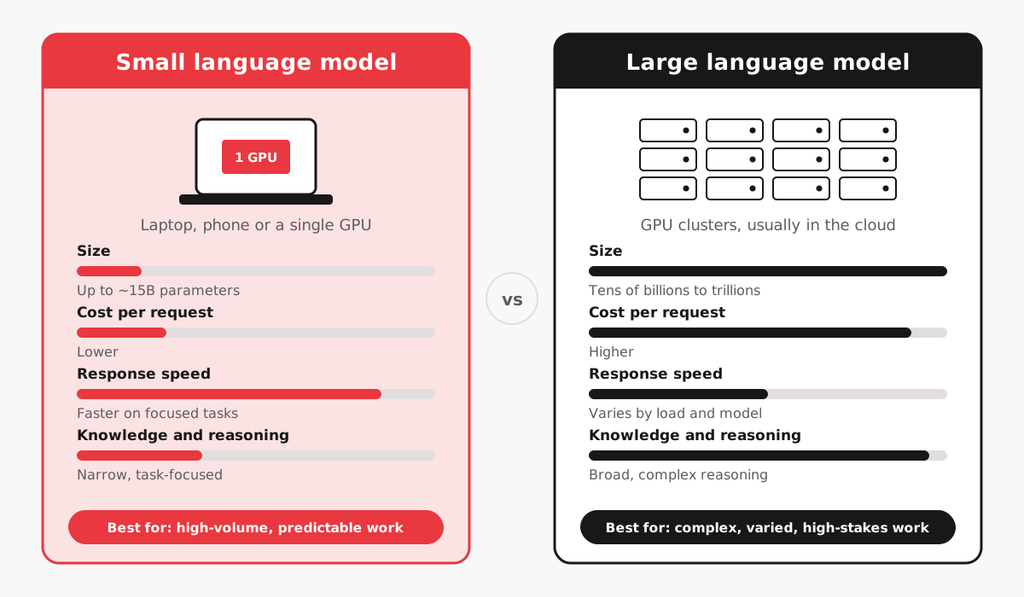
However, a smaller model is not necessarily a less capable version of a larger one. SLMs can perform competitively on specific, well-defined tasks, particularly when they are optimized or fine-tuned for a particular domain. LLMs generally offer greater versatility when applications require broad knowledge, complex reasoning, or varied interactions.
Here is how they compare across key technical and business parameters:
| Comparison parameter | Small Language Models (SLMs) | Large Language Models (LLMs) |
| Model size | Fewer parameters and smaller computational footprint | More parameters and generally greater computational requirements |
| Computing requirements | Can run on comparatively modest hardware, depending on model size and quantization | Often require more powerful GPUs and infrastructure, particularly for self-hosting |
| Inference cost | Potentially lower for suitable, high-volume workloads | Can involve higher inference expenditure, depending on model and usage |
| Response speed | Can deliver faster responses for focused tasks on suitable hardware | Performance varies with model size, infrastructure, and serving configuration |
| Reasoning capabilities | Effective for focused tasks but may struggle with complex, multi-step reasoning | Generally better suited to demanding reasoning and broader problem-solving |
| Customization | Can be fine-tuned or adapted for specific business tasks | Can also be customized, but may require more computational resources |
| Deployment flexibility | Suitable for cloud, private infrastructure, on-premises, and edge deployments, depending on hardware requirements | Available through cloud APIs and self-hosted deployments, with more demanding infrastructure requirements for larger models |
| Typical enterprise applications | Classification, information extraction, intent detection, routing, and focused conversational tasks | Complex analysis, advanced reasoning, content generation, and applications involving diverse instructions |
Can SLMs deliver better performance than LLMs with fewer resources?
Research suggests that they can, depending on the task. A 2026 study published in the International Joint Conference on Artificial Intelligence (IJCAI) evaluated 75 SLMs across five benchmarks and compared their performance and inference energy consumption with two large language models.
Qwen3-4B, a 4-billion-parameter SLM, achieved 93.2% accuracy. Mistral Large 3, a 675-billion-parameter LLM, achieved approximately two percentage points higher accuracy but consumed around 32 times more inference energy in the study’s experimental setup.
This demonstrates that a much larger model does not always deliver proportionally better results for a particular task. For enterprises handling focused workloads, an SLM may provide sufficient performance with substantially lower inference energy requirements.
However, model size alone does not determine efficiency. The same study found that smaller models sometimes consumed more energy than larger SLMs because they generated longer responses to complete certain tasks. Therefore, organizations need to consider task accuracy, output length, and resource consumption together when comparing models.
Where can enterprises use small language models?

Small language models fit enterprise work that is repetitive, well-defined, and high-volume, such as classifying documents, extracting fields from forms, routing customer requests, and answering scoped questions. These tasks follow predictable patterns, so a focused model can handle them reliably without the cost of a general-purpose LLM.
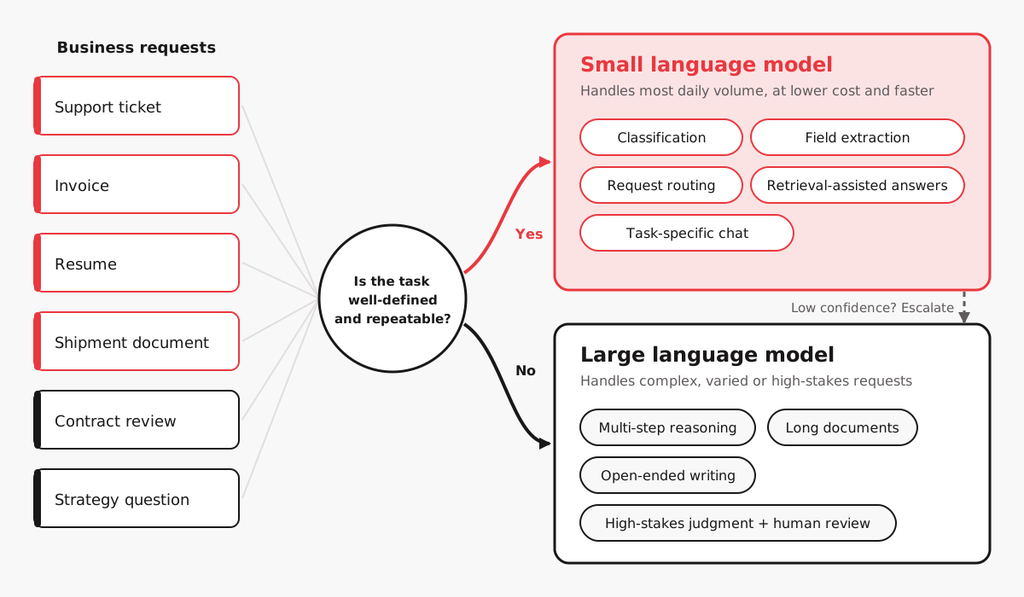
Across industries, the same five workload patterns show up again and again:
- Classification: Sorting tickets, documents, transactions, or customer queries into categories.
- Information extraction: Pulling specific fields from forms, invoices, contracts, or reports.
- Routing: Spotting intent and sending a request to the right team, workflow, or larger model.
- Retrieval-assisted answers: Answering focused questions from approved company knowledge sources.
- Task-specific chat: Handling repetitive conversations with a clearly defined scope, such as order status or policy questions.
Start with tasks where the input looks similar every time, the correct answer is easy to check, and the volume is high. These are potential applications, not guaranteed outcomes. Accuracy depends on the specific model, the quality of your data, and how well the task is defined.
What are the challenges and limitations of SLMs?
Small language models perform worse on complex reasoning. They may produce incorrect answers, have narrower knowledge, and also require high costs for fine-tuning and hosting.
- Limited complex reasoning: Some SLMs struggle with multi-step reasoning and ambiguous instructions.
- Accuracy and hallucinations: Smaller models can still produce incorrect or made-up information.
- Context and knowledge limits: The ability to handle long documents and broad topics varies by model.
- Domain adaptation: Reliable domain performance requires good training data and careful testing.
- Infrastructure economics: Self-hosting adds infrastructure, engineering, and maintenance costs that can offset inference savings.
Smaller doesn’t always mean more efficient, either. According to the same IJCAI 2026 study, smaller SLMs used more inference energy than larger SLMs in about 43% of pairwise comparisons on the MMLU-Redux general-knowledge benchmark.
One reason was that some smaller models wrote longer responses to finish the same tasks.
What should enterprises consider before choosing an SLM?
Before adopting an SLM, enterprises should consider three factors: cost, deployment requirements, and workload suitability.
- Cost and usage: Estimate expected request volume, inference expenditure, and total operating costs, including infrastructure and maintenance.
- Deployment requirements: Determine whether the model needs to run in a public cloud, private cloud, on-premises environment, or at the edge, based on infrastructure, data security, and operational requirements.
- Business workload: Identify the primary task the model needs to handle, such as query routing, retrieval-augmented generation (RAG), information extraction, classification, or conversational applications.
Finally, validate the model against your own business data. Assess task accuracy, response latency, and cost per successfully completed task to determine whether it meets your operational requirements.
Choosing the right model for the right task
Small language models give enterprises a practical way to run focused AI tasks at lower cost and latency, as long as the workload fits. The organizations that benefit most match each task to the smallest model that meets their accuracy target, then keep larger models for work that needs broader reasoning.
If you’re weighing which model fits your use case, budget, and goals, Softude can help you evaluate and build the right language model setup for your workloads.
FAQs
Can an SLM be fine-tuned using proprietary business data?
Yes. Fine-tuning an SLM trains it on your terminology, document formats, and specific tasks, usually on modest hardware. However, results depend on the quality and quantity of your data, how you protect sensitive records during training, and whether the model’s license allows commercial use.
Are SLMs cheaper to run than LLMs?
Usually per request, but not always in total. Lower inference cost is only part of total cost of ownership, which also includes hosting, GPU utilization, engineering, and maintenance. SLMs tend to save the most on steady, high-volume workloads, while low or uneven volumes may cost less through a hosted model.
Can SLMs replace LLMs in enterprise AI systems?
Not entirely. SLMs can take over many routine tasks, but LLMs remain stronger at complex reasoning, broad knowledge, and open-ended work. Most enterprises get better results by combining both, using a small model for routine volume and routing harder requests to a larger one.
Which enterprise tasks should not be handled by an SLM alone?
High-stakes tasks that need extensive reasoning, broad context, or nuanced judgment should not rely on an SLM alone. Examples include complex clinical decisions, sophisticated financial risk analysis, and legal interpretation. These usually need a more capable LLM and human review before any decision is made.