Softude

AI-based handwritten OCR can read checkboxes, dates, and clear handwriting on medical forms with good accuracy. It is less accurate on free-text notes, medication names, and faxed pages. Even the leading OCR models in 2026 can struggle with difficult handwriting. Healthcare teams should use human review for clinically important information before relying on OCR results.
Key highlights
- AI OCR reads handwriting in context and returns structured fields such as drug, dose, and date.
- Checkbox and date fields score high accuracy. Free-text notes and drug names score lowest.
- AI models can make fluent, plausible errors; therefore, output must be reviewed by a clinical reviewer.
- Test on 200+ of your own de-identified forms before trusting any accuracy claim.
Where does handwriting still slow down healthcare workflows?
Handwriting still enters US healthcare through faxed referrals, intake and consent forms, paper prescriptions, prior authorization requests, and legacy charts. Most of it arrives outside the EHR as a scanned image. Staff must read it, re-key it, and route it before anyone can act on the information.
That manual step is still common. According to Documo’s 2026 State of Healthcare Operations survey, 74% of organizations that handle more than half their document work outside the EHR say more than half of incoming documents need manual review.
Here is where OCR for handwritten documents does the most work, and where errors cost the most:
| Workflow | What is handwritten | What AI OCR should extract | Cost of an error |
| Faxed referrals | Reason for referral, notes, signatures | Patient, referring provider, urgency, diagnosis | Delayed or lost care |
| Intake and consent forms | Answers, checkboxes, signatures | Demographics, history, allergies, consent status | Wrong chart data |
| Prescriptions (fax or paper) | Drug, dose, frequency, prescriber | Structured medication data | Patient safety risk |
| Prior authorization forms | Clinical justification notes | Codes, dates, justification text | Claim delays |
| Legacy charts, home health notes | Free-text clinical notes | Searchable notes, key fields for the EHR | Missed history |
Handwritten OCR matters most where the extracted data triggers an action, such as a scheduled appointment, a dispensed drug, or an approved claim.
OCR vs ICR vs handwritten text recognition: where does AI OCR fit?
AI OCR, often called AI handwriting recognition, uses machine-learning models to recognize text in context, including surrounding words, field labels, and page layout. Traditional OCR is primarily designed for printed text. Handwriting recognition systems can handle some cursive and mixed-layout documents, but performance depends on the writing, image quality, and form design. With validation, extracted information can be organized into fields for downstream systems, including an EHR.
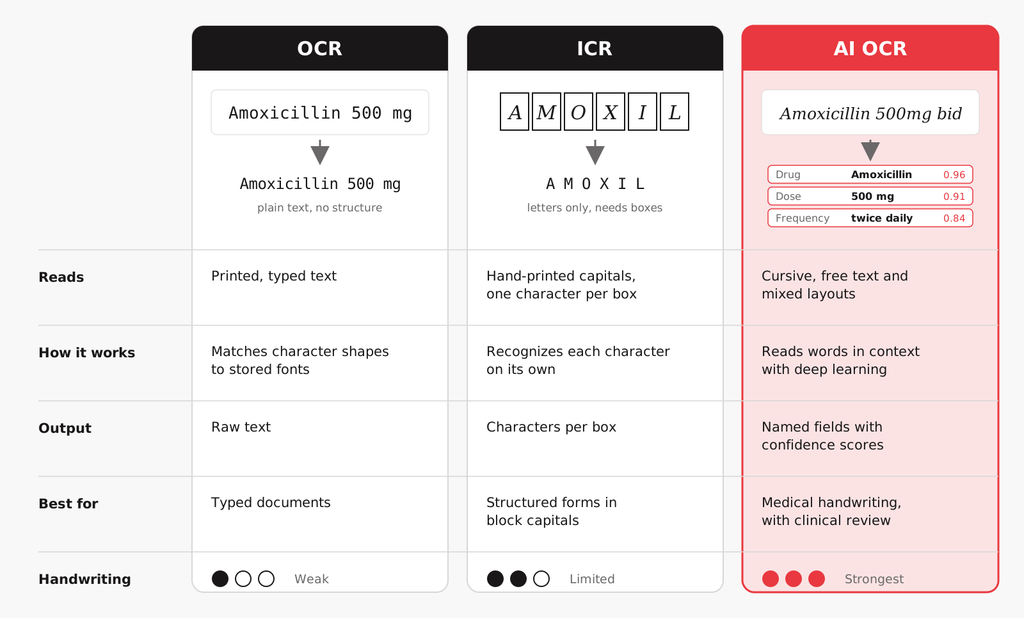
The four approaches below overlap, but they differ in what they can read:
- OCR (optical character recognition): Converts printed characters into text. Reliable on typed pages, weak on handwriting.
- ICR (intelligent character recognition): Reads hand-printed characters, usually one per box. Works on structured forms where people write in capitals.
- HTR (handwritten text recognition): Deep learning models that transcribe whole lines of handwriting, including cursive.
- Vision language models (VLMs): Multimodal models such as those behind GPT, Gemini, and Claude. They read a page image and can return named fields from a plain instruction.
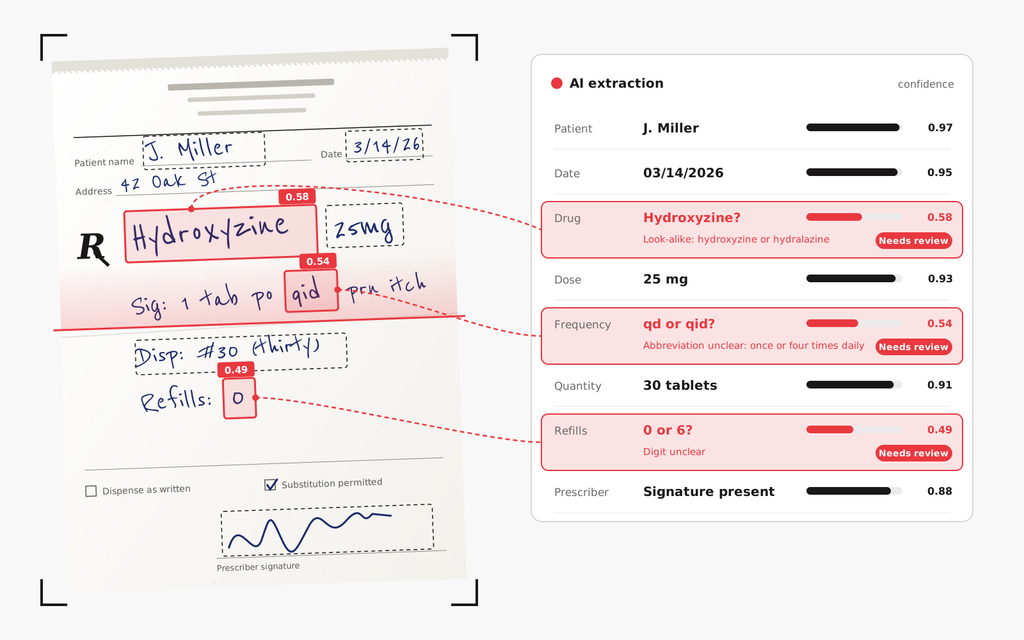
If you are working out how to extract data from handwritten forms, the setup matters as much as the model. In practice, AI OCR for forms combines a recognition model with a layout model. Each output carries a field name, a value, and a confidence score, which is the model’s estimate of how likely the reading is correct. That score is what makes targeted human review possible.
How accurate is OCR on handwriting in medical forms?
The best AI models read roughly 85% to 89% of fields correctly, and accuracy varies widely by field type. Checkboxes and structured fields score high, while free-text clinical notes score lowest. On messy handwriting in general, the strongest models still trail human readers.
According to the April 2026 benchmark, which tested 17 AI models on real handwritten maternity case records from a pregnancy exposure registry, discrete selection fields performed best. The free-text “other” field performed worst; every model produced some hallucinated content, and the top median accuracy reached 89% when empty fields were counted.
According to WildHandBench, an August 2026 benchmark of 18 models on 500 real handwritten documents including medical records, the best model scored 71.85% overall, against 77.09% for human readers.
Why do handwritten OCR accuracy claims vary so much?
Accuracy claims vary because vendors measure different things on different documents. A tool can report 98% character accuracy and still get one field wrong out of ten. Before you compare numbers, check which metric was used and what was tested.
- Character error rate (CER): The share of characters read wrong. Useful for transcription quality.
- Word error rate (WER): The share of words read wrong.
- Field-level accuracy: The share of fields with an exactly correct value. This is the metric that matters for forms.
Empty fields can inflate results too. According to the April 2026 benchmark, counting blank fields boosts scores because many medical form fields are left empty. Ask every vendor three questions: which metric, on which documents, and were empty fields included?
What lowers AI OCR accuracy on medical handwriting?
Medical abbreviations, look-alike drug names, rushed cursive, fax compression, and free-text fields lower handwriting OCR accuracy the most. AI OCR also adds a risk traditional OCR does not have. It can replace an unclear word with a plausible one, which produces an error that looks correct to a busy reviewer.
The main drivers:
- Abbreviations and shorthand: According to the April 2026 benchmark, models often missed medical abbreviations specific to the form.
- Look-alike drug names: Similar spellings let a model pick the more common drug.
- Fax and scan quality: Faxing blurs thin pen strokes, and handwriting suffers more than print.
- Field type: Constrained fields such as checkboxes and dates are easier than open text.
- Plausible substitution: According to WildHandBench, 63% to 91% of model errors came from language patterns rather than what was on the page, compared with 49% for humans.
That last point matters most in healthcare. According to WildHandBench, on one medical record a leading model wrote a completely different but medically plausible diagnosis, while the human reader marked unreadable words with a question mark.
Traditional OCR tends to produce garbled characters that a reviewer spots quickly. AI OCR can produce a clean, believable drug name that a reviewer may not question. Because these errors look like correct answers, extraction pipelines need the same checks used to detect LLM hallucinations: compare every critical value against evidence before it is accepted.
Which AI OCR options fit healthcare forms?
There is no single best handwriting OCR tool for healthcare. Google Document AI, Azure AI Document Intelligence, and Amazon Textract handle printed forms with handwritten entries, and all three return confidence scores. Vision-language models handle messy free text better but need extra validation.
A custom-trained model fits when your documents, vocabulary, or accuracy targets go beyond what general services cover.
| Option | Handwriting support | Form and field extraction | Confidence scores | Human review | Best fit |
| Google Document AI | Handwriting in 50 languages (Enterprise Document OCR) | Key-value pairs, checkboxes, tables | Yes | Build your own workflow | Google Cloud teams, multilingual forms |
| Azure AI Document Intelligence | Handwriting in English and a set of other languages | Prebuilt and custom models | Yes, per word | Build your own workflow | Microsoft-centric environments |
| Amazon Textract | Handwriting in forms and tables | Key-value pairs, queries | Yes | Built in through Amazon Augmented AI (A2I) | AWS teams, standard forms |
| Vision language models | Strong on cursive and free text | Fields returned from an instruction | Limited, needs added checks | Must be designed | Messy notes, varied layouts |
| Custom-trained model | Trained on your own documents | Built to your data schema | Yes, tuned to your data | Designed into the workflow | Prescriptions, specialty vocabulary, high volume |
For any workflow involving protected health information, HIPAA compliance depends on how a service is contracted, configured, and used. Confirm that the provider will sign a business associate agreement (BAA) and that the specific service is on its list of eligible services.
An off-the-shelf API is often enough for standard intake forms that are mostly checkboxes and dates. A custom model makes sense when drug names must be validated against a formulary, when faxes arrive from hundreds of sources, or when you need field-level accuracy targets the general services cannot meet.
How do you test AI OCR on your own medical forms?
Test AI OCR on your own documents before trusting any accuracy claim. Use at least 200 de-identified samples that reflect your real mix of forms, handwriting, and fax quality. Then score every extracted field against a verified answer key.
- Sample real documents. Include poor-quality faxes and rushed handwriting, not just clean examples.
- Build an answer key. Have two people key each form independently and resolve disagreements.
- Score by field type. Report drug names, dates, checkboxes, and notes separately, and report empty fields on their own, as you would when evaluating any AI model’s performance.
- Count invented values. Track every field where the model returned a value that is not on the page.
- Check the confidence scores. Confirm that low-confidence fields hold most of the errors. If they do not, thresholds will not protect you.
How should clinical review work around AI OCR?
Clinical review should focus human-in-the-loop approval steps on fields where an error can harm a patient or delay care. Route every drug name, dose, allergy, and low-confidence field to a reviewer, and let high-confidence administrative fields pass. Then audit a random sample of approved fields to catch confident errors.
What accuracy is acceptable for handwritten data entry depends on the field. A missed checkbox on an intake form can be caught later, so high-confidence administrative fields can flow through. A wrong dose cannot, so medication fields need a reviewer no matter what the model scores.
- Always-review fields: Medication, dose, frequency, allergies, and diagnosis go to a person every time.
- Field-specific thresholds: Set stricter confidence thresholds for critical fields. Amazon Textract with A2I, for example, sends any field below its threshold to human review.
- Reference checks: Validate drug names against your formulary, doses against expected ranges, and patient details against the existing record.
- Random audits: Sample auto-approved fields every week, since confident errors will not trigger a threshold.
- Feedback loop: Feed reviewer corrections back into training data so the model improves on your documents.
This is how roughly 90% accuracy becomes usable. The model handles volume, and trained staff handle the fields where a mistake carries real risk.
How did a healthcare provider reach 90% accuracy on handwritten prescriptions?

Softude used OCR and AI to digitize handwritten and faxed prescriptions for a healthcare provider, helping address medication errors caused by manual data entry.
We trained the model on handwritten and faxed prescriptions covering diverse writing styles, so it reads the variation between prescribers that template-based OCR can’t handle.
Every output was reviewed by an expert medical reviewer. As a result, our solution reached 90% accuracy.
“We also implemented robust AI security measures and healthcare protocols to ensure the solution never compromises patients’ details and works within regulatory standards. Softude has experience working with HIPAA compliance. ”
Making AI OCR safe for clinical documents
AI OCR can remove most of the re-keying from handwritten medical documents when you measure it field by field and keep clinicians on the fields that matter. Teams that test on their own forms first and design review around risk get the speed without the safety gaps.
Softude’s ML engineers can build and test a custom AI OCR model on a de-identified sample of your forms. Contact us to discuss your solution or explore our other AI-powered healthcare solutions.
FAQs
Can AI read doctors’ handwriting?
Yes, often, but not reliably enough to skip human review. Modern AI OCR reads many prescriptions and notes correctly, yet it struggles with abbreviations, look-alike drug names, and rushed cursive. According to Softude’s prescription digitization case study, AI OCR reached 90% accuracy with a medical professional verifying each output.
Is AI OCR HIPAA compliant?
No OCR tool is HIPAA compliant on its own. Compliance depends on a business associate agreement with the vendor, using a service the vendor lists as eligible, and safeguards such as encryption, access controls, and audit logs. Check these before any protected health information reaches the system.
Can ChatGPT read handwritten medical forms?
The vision models behind tools like ChatGPT can read many handwritten forms, but consumer handwriting-to-text AI apps are the wrong place for patient data. Use a deployment covered by a BAA, require structured output, and validate every critical field, since these models can return plausible values that are not on the page.
Does AI OCR work on faxed medical documents?
Yes, but faxing lowers image quality, and handwriting suffers more than print. Thin strokes blur, and small characters merge, which raises error rates on drug names and notes. Include faxed samples in your accuracy test and set stricter review thresholds for documents that arrive by fax.