Softude
AI moves fast. New models drop every few months, each claiming to be smarter, faster, and more capable than the last. But how do you actually know which one performs better for your needs? AI benchmarking is the way to do it.
But what is AI benchmarking, and why is it important?
What is AI Benchmarking?

AI benchmarking is the process to test AI systems using standardized tasks and metrics to measure and compare performance. Think of it like a standardized exam for AI models. Everyone takes the same test, and you compare the scores.
This is different from basic AI testing, where you might just check if a model works. Benchmarking goes further. It tells you how well it works, compared to other models or previous versions of itself.
For businesses adopting AI, benchmarking answers a critical question: Are we using the right model for the job?
Why AI Benchmarking Tests Have Become Essential
A few years ago, most businesses were still experimenting with AI. Now, they are building workflows around it. From customer support bots, code assistants, document processors, to internal search tools, AI is embedded in everyday operations.
That shift has made the stakes much higher.
When models from different vendors all claim top-tier performance, you need a way to cut through the noise. AI benchmarking gives you that objective comparison. Without it, you are essentially choosing an AI system based on marketing, which is a risky way to make a significant infrastructure decision.
There’s also the risk side. Deploying an untested AI system in a sensitive area, like healthcare or finance, can lead to real consequences. Benchmarking helps you catch problems before they become costly.
What Does an AI Benchmarking Test Measure?
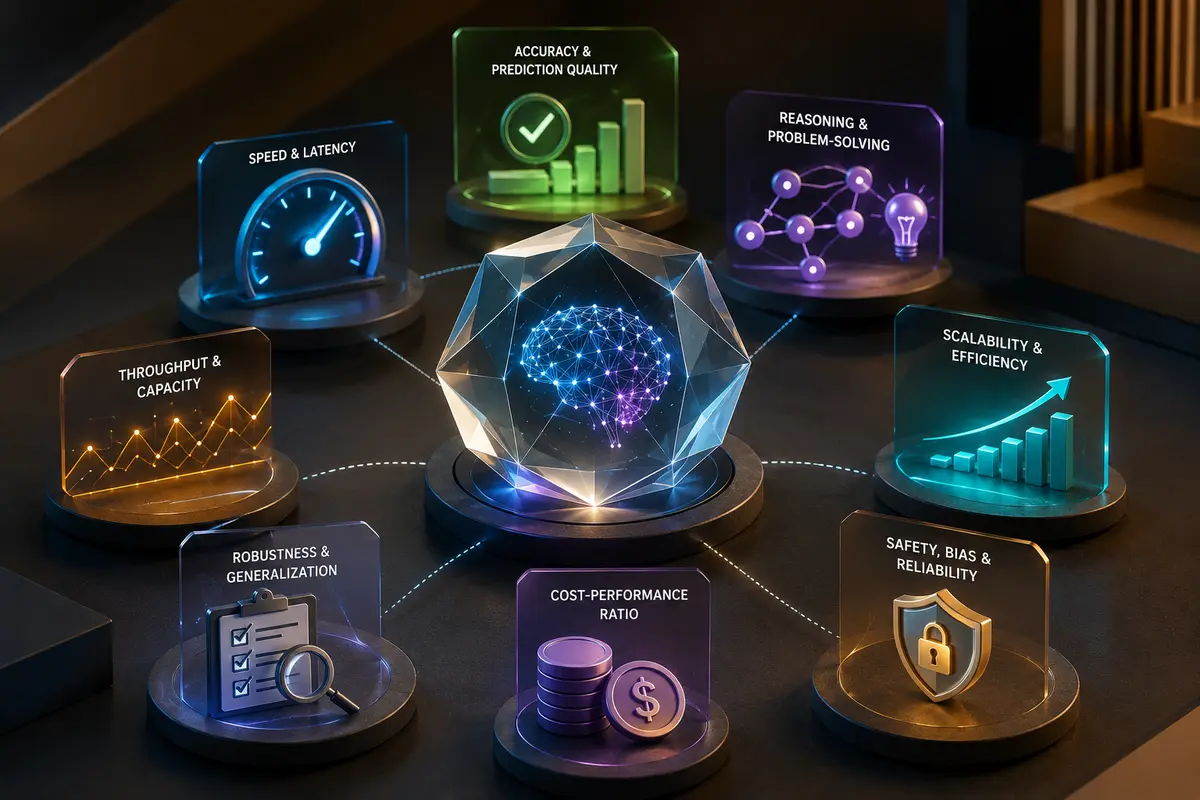
AI benchmarking doesn’t just measure one metric. Depending on your use case, you might care about several different dimensions.
- Accuracy and prediction quality are usually the starting point. Is the model giving correct answers? For a language model, this might mean testing how often it gets factual questions right or how well it follows instructions.
- Speed and latency matter a lot in production environments. A model that’s highly accurate but takes five seconds to respond might not work for a real-time customer support application.
- Reasoning and problem-solving ability are trickier to measure but increasingly important, especially with complex tasks like multi-step analysis or code generation.
- Scalability and efficiency look at how a model handles increasing load. Can it serve thousands of users at once without degrading in quality or speed?
- Safety, bias, and reliability checks whether the model produces harmful outputs, shows unfair bias across different user groups, or behaves unpredictably.
- Cost-performance ratio ties it all together. A model that scores well on everything but costs ten times more might not be the right fit. Benchmarking helps you see the full picture.
What Are The Different Types of AI Benchmarking
There are several ways to do AI benchmarking, depending on what you are trying to evaluate.
AI Model benchmarking is the most common type. You take multiple AI models and run them through the same set of tests to compare outputs directly.
AI Performance benchmarking focuses on speed, throughput, and efficiency. How many requests can a model handle per second? How does response time scale under heavy load?
Functional benchmarking looks at specific tasks. Can the model accurately summarize legal documents? Can it write working code in Python? This type is highly relevant for businesses with domain-specific needs.
Infrastructure benchmarking evaluates the hardware and deployment environment. The same model can give different outputs depending on how it’s hosted and configured.
Human vs AI benchmarking compares AI output against what a human expert would produce. This is useful for tasks where quality is harder to quantify, like writing or analysis.
How AI Benchmarking Works

The process isn’t complicated, but it does require some structure to get useful results.
- Start with your business goals. What problem are you solving? The benchmarks you use should reflect your actual use case. A customer support chatbot and a code review assistant need very different evaluations.
- Select relevant benchmark datasets. Use datasets that match the types of inputs your AI will handle in production. Generic benchmarks are a starting point, but domain-specific datasets give you more actionable insights.
- Run standardized evaluation tests. Apply the same tests across all models you’re comparing. Consistency matters here. If you test one model on harder prompts than another, the comparison is meaningless.
- Compare outputs across models. Look at the results side by side. Where does one model outperform another? Are there specific task types where performance drops?
- Analyze performance metrics. Go beyond raw scores. Look at where models fail and why. A model that fails on edge cases relevant to your business is a problem, even if it scores well overall.
- Monitor benchmark results continuously. AI models change over time. Providers update them, which can shift performance in either direction. One-time benchmarking gives you a snapshot, not a guarantee.
Key Metrics Used in AI Benchmarking
Here are the metrics that most often come up in AI benchmarking.
Precision and recall are common in classification tasks. Precision tells you how many of the model’s positive predictions were correct. Recall tells you how many actual positives the model caught.
The F1 score consists of precision and recall into a single number, which is useful when you want to balance both.
Latency is the time it takes to get a response. Lower is better for real-time applications.
Throughput measures how many tasks a model can complete in a given period, important for high-volume systems.
Hallucination rate has become a critical metric for language models. It tracks how often a model generates confident but incorrect information.
Token efficiency looks at how much output a model generates per token. More verbose models cost more to run.
Energy consumption is increasingly relevant for organizations with sustainability goals or tight infrastructure budgets.
ROI and business impact go beyond technical metrics. Are business outcomes actually improving because of the AI? This is harder to measure, but often the most important question.
What Are the Best Tools for AI Benchmarking

LLM & Generative AI Benchmarking Tools
MLPerf
One of the most recognized industry-standard benchmarking suites for AI hardware and model performance.
Best for:
- Training and inference benchmarking
- GPU and infrastructure comparison
- Enterprise AI performance testing
Key features:
- Standardized benchmarks
- Widely adopted by NVIDIA, Intel, AMD, and cloud providers
- Measures speed, throughput, and efficiency
HELM by Stanford
A comprehensive benchmark framework for evaluating foundation models and LLMs.
Best for:
- Comparing LLM capabilities
- Transparency and fairness testing
- Multi-metric AI evaluation
Key features:
- Evaluates accuracy, robustness, bias, toxicity, and efficiency
- Supports multiple benchmark datasets
- Strong focus on responsible AI
OpenAI Evals
An open-source evaluation framework designed for testing LLM performance.
Best for:
- Custom LLM benchmarking
- Prompt evaluation
- Task-specific AI testing
Key features:
- Community-driven benchmark creation
- Supports custom datasets
- Useful for regression testing AI applications
EleutherAI Language Model Evaluation Harness
A popular framework for benchmarking language models across many standard datasets.
Best for:
- Research benchmarking
- Comparing open-source LLMs
Key features:
- Supports dozens of benchmark tasks
- Easy integration with Hugging Face models
- Widely used in AI research communities
LangSmith
An observability and evaluation platform for LLM applications.
Best for:
- Production AI monitoring
- Agent evaluation
- Prompt and workflow testing
Key features:
- Trace-level monitoring
- Human feedback integration
- Continuous evaluation pipelines
Challenges and Limitations of AI Benchmarking
Benchmarking is useful, but it’s not perfect. There are some real limitations worth knowing.
Benchmarks often don’t reflect real-world conditions. A model might score well on a curated dataset but struggle with the messy, unpredictable inputs it encounters in production.
- There’s also the problem of overfitting to benchmark datasets. Some models are trained specifically to perform well on popular benchmarks, which inflates their apparent performance without actually making them more useful.
- AI capabilities are also changing rapidly. A benchmark that was cutting-edge 18 months ago might not capture what today’s models can or can’t do.
- There’s no universal standard either. Different organizations use different benchmarks, making cross-industry comparisons tricky.
- And some things are just hard to measure. Creativity, contextual understanding, and nuanced judgment don’t fit neatly into numerical scores.
Is AI Benchmarking the Same As AI Evaluation?
No, however, these two terms are often used interchangeably, but they are not quite the same thing.
AI benchmarking focuses on comparing models using standardized tests. It’s structured, repeatable, and produces scores you can compare across models.
AI evaluation is broader. It includes benchmarking but also covers real-world usability, user satisfaction, safety audits, regulatory compliance, and business outcomes.
Most businesses need both. Benchmarking AI models helps you pick the right model upfront. Evaluation helps you confirm it’s actually working the way you expected once it’s deployed.
Best Practices for Effective AI Benchmarking
A few things make benchmarking significantly more useful in practice.
- Use domain-specific benchmarks wherever possible. Generic benchmarks are a fine starting point, but they won’t tell you how a model handles your specific data and tasks.
- Combine automated and human evaluation. Automated metrics are efficient, but humans catch things that metrics miss, especially in language tasks where nuance matters.
- Benchmark continuously, not just at the start. Models get updated, use cases evolve, and what worked well at launch may not hold up six months later.
- Test under real-world conditions. Use actual production data where you can, and simulate realistic load patterns rather than idealized test conditions.
- Include security and compliance checks. Especially in regulated industries, a model that performs well technically but creates legal or security risk isn’t actually a good choice.
When to Use AI Benchmarking
In practice, businesses use AI model benchmarking for several concrete purposes.
When selecting an LLM for enterprise use, benchmarking helps narrow down options before committing to a vendor or building infrastructure around a particular model.
When comparing AI copilots and chatbots, functional benchmarks help teams evaluate which tool actually performs better on the tasks their employees use most.
For optimizing AI infrastructure costs, performance benchmarking reveals whether a smaller, cheaper model can handle the workload just as well as a larger one.
Monitoring for model drift is another use case. When a model’s performance gradually declines due to changes in user behavior or data patterns, continuous benchmarking catches it early.
Finally, businesses use AI performance benchmarking to evaluate vendor claims. When a vendor says their model is 30% more accurate, benchmarking lets you verify that on your own data rather than taking it at face value.
Future Trends in AI Benchmarking
The field is evolving quickly. A few trends are worth watching.
Real-world agent benchmarking is becoming more relevant as AI systems move from answering questions to taking actions, like browsing the web, writing code, and managing workflows.
Multimodal AI evaluation is growing as models that handle text, images, audio, and video become more common. Benchmarks need to keep up.
AI safety and alignment benchmarks are getting more attention, particularly as AI is used in higher-stakes contexts where harmful outputs carry serious consequences.
Industry-specific benchmark standards are emerging in healthcare, legal, and finance, where generic benchmarks don’t capture domain-specific requirements.
Continuous benchmarking for live AI systems is becoming the norm as businesses recognize that AI performance isn’t static.
Wrapping Up
AI benchmarking is no longer just for researchers. It’s a practical tool businesses need to make informed decisions about which models to use, how to deploy them, and when to replace them.
The core idea is straightforward: measure performance in a consistent, comparable way. The details get complex, but the goal is simple. You want to know that the AI you’re relying on actually does what you need it to do, not just in theory, but in practice.
FAQs
What is AI benchmarking in simple terms?
It’s the process of testing AI systems with standardized tasks to measure and compare how well they perform.
Why is AI benchmarking important?
It helps businesses evaluate accuracy, speed, reliability, and efficiency before committing to a model or vendor.
What are common AI benchmarking metrics?
Accuracy, latency, precision, recall, F1 score, throughput, and hallucination rate are among the most used.
What’s the difference between AI benchmarking and AI evaluation?
Benchmarking compares AI models using standard tests. Evaluation is broader and includes real-world usability, safety, and business outcomes.
Which industries use AI benchmarking?
Healthcare, finance, retail, SaaS, manufacturing, and technology are among the most active users of AI benchmarking.