Softude
Pharma 4.0 is about applying connected technologies, real-time data, automation, and AI to pharmaceutical manufacturing without losing sight of what makes pharma different: GxP, data integrity, validation, quality, and regulatory control.
For a mid-size manufacturer, it does not mean replacing your MES, ERP, or existing equipment. It means connecting what you already have, getting reliable real-time data out of it, and layering AI on top to catch problems earlier and use production data more usefully. AI is one part of that layering, not the whole strategy.
Key Highlights
- Mid-size pharma manufacturers do not need to replace working legacy assets; they can achieve Pharma 4.0 capabilities through retrofitted IoT edge sensors and a unified integration layer.
- Unlike standard Industry 4.0 setups, Pharma 4.0 places data integrity (ALCOA+), automated audit trails, and GxP validation at the center of every digital rollout.
- Machine learning tools and predictive maintenance models fail without clean, structured, and contextualized data feeds.
- Starting with high-constraint use cases, such as predictive maintenance or machine vision inspection, yields faster financial returns without disrupting continuous operations.
What Is Pharma 4.0 and What Constraints Do Mid-Size Manufacturers Face?
At its core, Pharma 4.0 is an operational framework formalized by industry organizations like the International Society for Pharmaceutical Engineering (ISPE) to bring digital maturity, connectivity, and continuous process verification into life science manufacturing. Unlike generic digital initiatives, Pharma 4.0 aligns advanced digital capabilities directly with GxP regulatory frameworks.
Mid-size pharmaceutical manufacturers run into three major operational constraints when adopting digital strategies:
- Isolated Data Silos: Plant data is often scattered across standalone SCADA systems, paper batch logs, disconnected LIMS, and standalone QMS tools. Without a unified data spine, staff spend hours manually reconciling batch records and investigating deviations.
- Legacy Machinery Dependencies: Mid-market plants rely heavily on validated, long-serving tablet presses, granulators, and packaging lines. Ripping out functional machinery to buy native digital assets is capital-prohibitive.
- Validation and GxP Compliance Overhead: Introducing new technologies into a regulated environment requires strict validation, continuous audit trail logging, and adherence to ALCOA+ data integrity rules.
How Does Pharma 4.0 Differ From Standard Industry 4.0?
To build an effective modernization roadmap, leadership must understand why generic manufacturing frameworks fall short when applied to life sciences.
Industry 4.0 in pharma introduces high-speed industrial IoT connectivity, edge sensors, and predictive analytics to the factory floor. In automotive, consumer electronics, or heavy industrial manufacturing, these tools focus almost entirely on operational throughput, overall equipment effectiveness (OEE), physical assembly speed, and direct unit cost reduction.
Pharma 4.0 takes those underlying technology enablers and grounds them inside a strict, highly regulated life sciences envelope. In pharmaceutical manufacturing, speed without validation and data integrity is an expensive liability.
Industry 4.0 vs. Pharma 4.0 Comparison
| Operational Area | Standard Industry 4.0 | Pharma 4.0 Smart Manufacturing |
| Primary Driver | Throughput speed, asset utilization, and operational cost reduction | Quality, process repeatability, patient safety, and compliance integrity |
| Data Governance | Operational dashboards, real-time telemetry, informal logging | Strict ALCOA+ data integrity, validated audit trails, electronic batch records (EBR) |
| Validation Overhead | Low friction; iterative software and hardware tweaks deployed quickly | Continuous Process Verification (CPV) and structured GxP validation guardrails |
| Change Management | Fast deployment cycles with frequent operational adjustments | High-rigor change control requiring systematic quality impact assessments |
| System Architecture | Isolated operational technology (OT) optimization | Holistic integration across OT, IT, Quality Management Systems (QMS), and Enterprise Resource Planning (ERP) |
While generic Industry 4.0 prioritizes sheer production efficiency, Pharma 4.0 smart manufacturing focuses on holistic compliance, deep process understanding, and continuous risk mitigation.
What Does Pharma 4.0 Look Like on the Shop Floor?
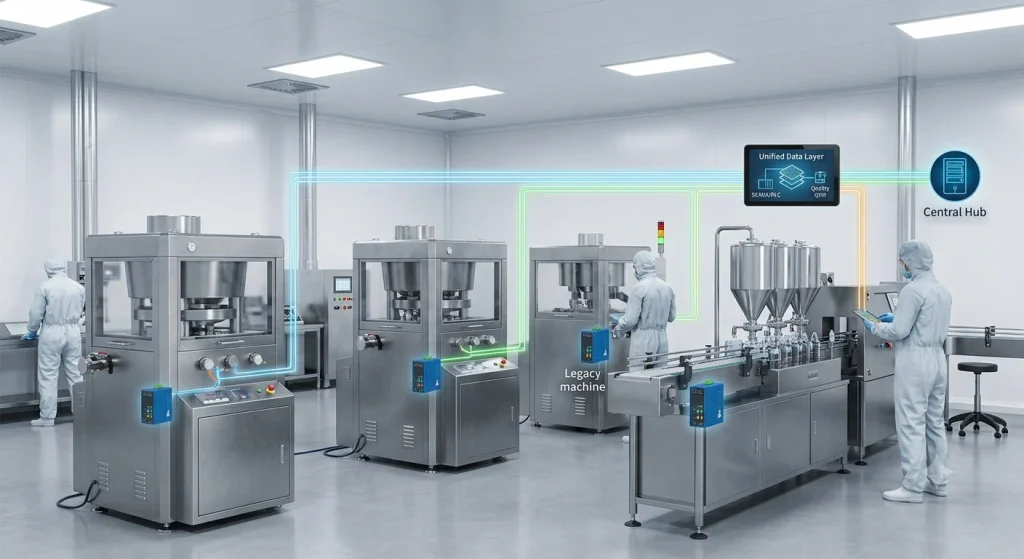
For a mid-sized operator, adopting Pharma 4.0 does not mean commissioning a brand-new, greenfield facility. Instead, it looks like targeted, highly effective digital upgrades applied directly to daily production routines across four core operational pillars.
1. Connected Equipment and Edge Data Sensors Function
Legacy tablet presses, fluid bed dryers, and liquid filling lines rarely need to be scrapped. Non-invasive industrial IoT sensors measuring vibration, surface temperature, differential pressure, motor load, and humidity can be retrofitted directly onto existing machinery.
Instead of machine operators walking the floor with physical clipboard logs to manually record gauge readings every two hours, operational telemetry streams automatically into a central, time-series database. This eliminates transcription errors, ensures data integrity at the point of origin, and frees skilled operators to focus on process performance rather than administrative paperwork.
2. Real-Time Production Visibility
Plant managers and floor supervisors gain access to unified, real-time production dashboards across every active manufacturing line.
If Line 3 experiences micro-stoppages during a critical fill-finish run, the system immediately flags the root cause (such as subtle torque spikes on a capping head or minor vacuum drops on a packaging feeder) before an entire batch is ruined or delayed. Operational bottlenecks are resolved in minutes rather than discovered days later during post-batch record reviews.
3.Smart Machine Vision
High-speed camera systems combined with edge processing perform inline quality inspection at full production speed. Automated vision systems verify:
- Foreign particulate contamination in liquid vials or ampoules.
- Surface flaws, color variations, and chips on compressed tablets.
- Pinholes, seal integrity issues, and missing units in blister packaging.
- Serialization data, 2D matrix readability, and label print alignment.
To dive deeper into how automated visual inspection elevates quality standards across modern manufacturing, read more about how AI machine vision is unlocking Industry 4.0’s full potential.
4. Predictive Maintenance
Unscheduled downtime is one of the single largest drainers of operating margin in mid-size pharmaceutical plants. A catastrophic pump failure or tablet press jam during a live production run not only damages the asset but can also result in lost batches worth tens or hundreds of thousands of dollars.
With predictive maintenance, continuous vibration analytics and thermal telemetry detect subtle mechanical degradation weeks before a failure occurs. Maintenance teams can proactively order replacement parts and schedule servicing during planned line changeovers, converting chaotic emergency repairs into predictable, routine maintenance windows.
How Can Pharma Manufacturers Modernize Without Replacing Machinery?

Mid-size pharmaceutical companies cannot afford to pause plant operations for six months to rip out working machinery. Insights from industry research sources, including publications by MasterControl, emphasize that successful digital transformation relies on building modern software interfaces upon existing equipment assets rather than replacing them.
Step 1: Overlay Edge Connectivity
Keep your core process equipment. Attach industrial IoT gateways and external sensors to harvest critical operational telemetry without disturbing machine control logic or invalidating established equipment qualification (IQ/OQ/PQ) baselines.
Step 2: Unify the Data Layer
Break down internal data silos. Connect isolated systems, such as legacy PLCs, Laboratory Information Management Systems (LIMS), Quality Management Systems (QMS), and Enterprise Resource Planning (ERP) platforms, into a unified data integration layer. Establishing a single source of truth preserves ALCOA+ data integrity and simplifies compliance reporting.
Step 3: Scale High-Impact Use Cases
Avoid the trap of attempting a plant-wide overhaul all at once. Identify your plant’s most costly operational bottlenecks or high-risk quality exposure points, such as recurring packaging line downtime or manual batch record reconciliations, and deploy targeted digital tools to address those specific constraints first.
Why Is AI One Layer of a Strategy Rather Than the Whole Strategy?
Artificial intelligence receives significant industry attention, often presented as an all-in-one fix for manufacturing challenges. However, in a regulated life sciences environment, AI is simply an advanced analytical engine; it cannot deliver value without a structured digital foundation beneath it.
Deploying AI models on top of fragmented, uncontextualized, or unvalidated plant data produces unreliable predictions and regulatory exposure. True operational intelligence requires building each underlying layer of the technology stack deliberately:
- Physical Equipment: Reliable machinery performing mechanical operations.
- Connectivity: Edge sensors capturing physical telemetry in real time.
- Data Integration: Clean, contextualized, and compliant data structures.
- Orchestration: Dashboards providing immediate visibility to floor teams.
- AI Layer: Machine learning models delivering predictive maintenance, automated vision analysis, and continuous process optimization.
By treating AI as the top layer of a broader strategy, mid-size decision-makers ensure their investments yield reliable, compliant, and measurable operational returns.
How Can AI Help Overcome Specific Manufacturing Constraints?
When placed on top of a mature digital foundation, Artificial Intelligence addresses core plant constraints directly:
- Bridging Data Silos: AI-driven data harmonization layers pull raw telemetry from disparate systems, automatically organizing and contextualizing production feeds into a single, compliant audit trail.
- Extending Legacy Asset Life: Machine learning models analyze non-invasive IoT sensor feeds (vibration, heat, power draw) from legacy equipment. This enables predictive maintenance without modifying underlying machine control software or invalidating existing qualifications.
- Automating Compliance Verification: Natural language and computer vision models automatically audit electronic records, flagging deviations in real time during batch processing rather than days later during post-run manual reviews.
What Are the Highest-ROI Use Cases for Mid-Size Pharma Leaders?
To maximize return on investment and build momentum across the organization, mid-size pharmaceutical manufacturers should focus initial digital initiatives on high-value, practical use cases:
- Automated Environmental Monitoring: Continuous IoT tracking of cleanroom differential pressure, humidity, and temperature. Automated deviation logging eliminates manual paper logs and reduces batch release delays.
- Inline Packaging & Label Inspection: High-speed vision inspection systems that verify 2D matrix codes, lot numbers, expiration dates, and package seal integrity at maximum line speed.
- Continuous Process Verification (CPV): Automated aggregation of process parameters during wet granulation, blending, and compression to ensure Critical Quality Attributes (CQAs) remain within statistical control limits.
- Yield Optimization Analytics: Correlating historical batch parameters with raw material analytical attributes to optimize process settings and improve yield across variable raw material lots.
Conclusion
Building a modern, highly efficient, and fully compliant pharmaceutical manufacturing facility does not require enterprise-scale budgets. By focusing on connected assets, unified data layers, and targeted AI applications, mid-size manufacturers can eliminate operational constraints, protect their profit margins, and maintain uncompromised GxP compliance.
Softude helps manufacturers plan and build the AI layer of a Pharma 4.0 roadmap, turning your legacy machinery into connected, high-performing assets.
FAQs
Not necessarily. By using non-invasive edge IoT sensors and external data gateways, you can gather real-time performance telemetry without modifying the underlying Programmable Logic Controller (PLC) or machine control code. This approach avoids triggering full equipment re-qualification (IQ/OQ/PQ) cycles.
Pharma 4.0 replaces manual paper logging with automated, time-stamped digital data capture. Systems automatically tag every data point with user credentials, time markers, and asset IDs, creating immutable, fully auditable digital records that comply with FDA 21 CFR Part 11 and ALCOA+ standards.
Yes. Modern Pharma 4.0 implementations utilize pre-built, domain-specific AI engines (such as vision inspection models or predictive vibration algorithms) that integrate into existing QMS or SCADA systems. External implementation partners help configure and validate these models, allowing existing plant engineering teams to manage daily operations easily.
When focusing on high-impact constraints, such as reducing unscheduled line downtime or automating packaging inspection, mid-size manufacturers typically see measurable returns within 12 to 18 months through batch yield improvements and reduced deviation investigation costs.