Softude
Choosing an IoT platform is a decision you will live with for five to ten years. It sets what your devices can do, how much you pay per device per month, how hard it is to leave, and whether you pass the next security audit. This guide is for technology and operations leaders who have to make that call. It covers what an enterprise platform must do, how to evaluate one, how the main platforms compare, and which one fits which kind of business. If you want help running the evaluation or building on the platform you pick, see our IoT development services.
Choosing the right IoT platform is getting harder because many powerful new technologies are coming together quickly:
- Smarter AI (Artificial Intelligence): AI is moving into the main parts of IoT platforms, allowing devices to make decisions on their own (autonomy) and predict problems before they happen.
- Faster Networks (5G/6G): Super-fast, low-latency connections are enabling critical applications, such as remote control of machinery and massive sensor networks.
- Edge Computing: Processing power is shifting closer to the devices (the “edge”). This saves bandwidth, improves response times, and keeps operations running even when the internet connection is weak.
- Focus on Sustainability: Governments and customers require proof of sustainability. IoT platforms are now the main tool for checking and reducing environmental impact, such as tracking energy use and carbon emissions.
Choosing an IoT platform in 2027 is no longer just an IT department task; it is a fundamental decision that shapes your business strategy. Your platform determines your ability to grow, your security level, your readiness for new regulations (like the EU’s CRA/Data Act), and your competitive advantage for years to come.
What is an Enterprise IoT Platform

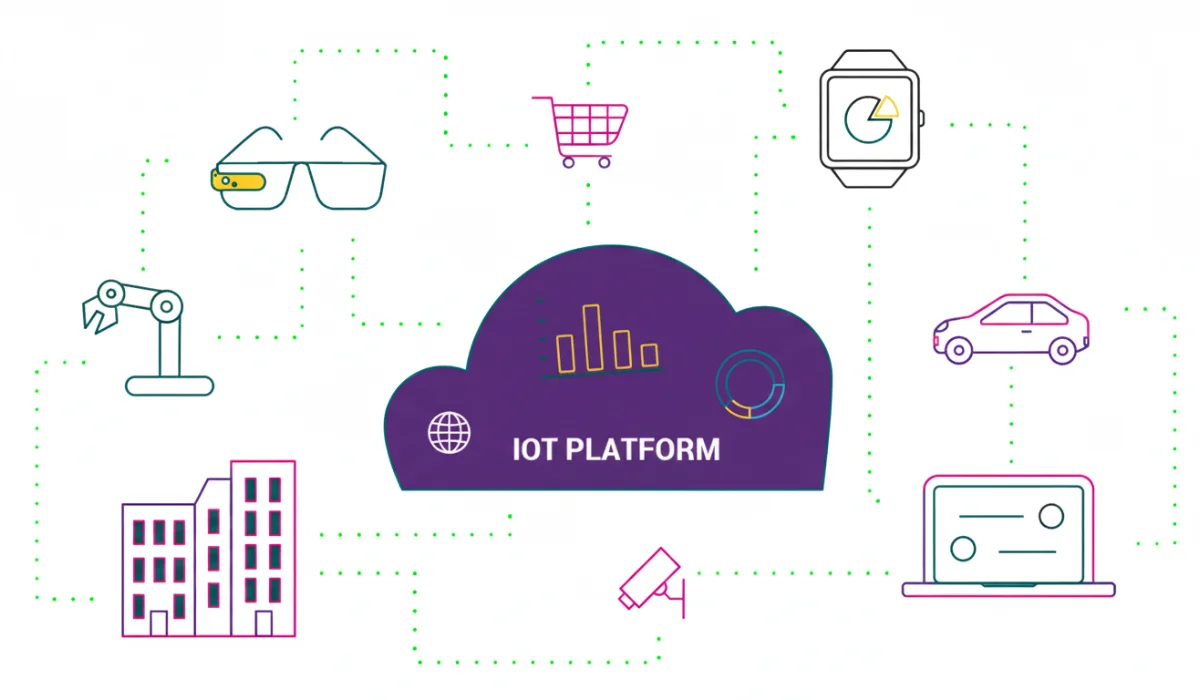
An IoT platform acts as the central software that connects, manages, and gets value from your physical devices and sensors. It serves as the link between the Operational Technology (OT) of machines and the Information Technology (IT) of business software.
Any strong business-focused platform must handle these six core functions:
- Device Management: This capability is crucial for managing the lifecycle of a large, diverse group of connected devices. It includes the ability to automatically add, set up, check the health of, secure, and update devices. Essential features here are firmware over-the-air (OTA) updates, bulk provisioning, and the ability to diagnose and fix issues remotely.
- Connectivity & Standards: The platform must be agnostic to various communication protocols (MQTT, HTTP, 5G, LoRaWAN) and handle them all seamlessly. It ensures data flows securely and reliably, enabling crucial bidirectional communication for remote command and control.
- Data Ingestion & Storage: This job involves safely collecting millions of real-time data streams at high speed. The data must be organized efficiently, typically in optimized time-series databases, for both immediate stream processing and long-term historical analysis.
- Data Analysis & Viewing: The platform must transform raw data into actionable insights. This is achieved by using Machine Learning (ML) to find patterns, spot unusual activity, and predict when equipment needs maintenance, moving beyond simple reporting.
- Security & Identity: Complete end-to-end security is non-negotiable. This involves encryption for data in transit and at rest, strong device authentication using certificates (e.g., X.509), controlling who can access data through Role-Based Access Control (RBAC), and continuous system vulnerability management.
- Application Enablement (AEP): To unlock the value of the collected data, the platform must provide tools (like drag-and-drop dashboards and low-code/no-code environments) that allow non-developers and domain experts to build the user interfaces and applications quickly. This significantly accelerates time-to-value.
What are the Different Types of IoT Platforms
1. Connectivity Platforms
These platforms are designed to enable devices to communicate with each other. They manage how sensors, machines, and applications connect across different networks, whether that’s Wi-Fi, 5G, LPWAN, or Bluetooth. Their main job is to ensure smooth, secure, and scalable communication across the entire IoT ecosystem.
2. Device Management Platforms
Think of these as the “control centers” for IoT hardware. They handle the setup, monitoring, and maintenance of devices throughout their lifecycle. From provisioning new sensors to pushing firmware updates and troubleshooting remotely, these platforms make sure devices stay healthy and reliable.
3. Application Enablement Platforms (AEPs)
This type of IoT platform provides businesses with the building blocks to quickly create IoT solutions for enterprises. They provide APIs, SDKs, and ready-to-use modules so developers don’t have to start from scratch. By simplifying integration with enterprise systems like ERP or CRM, AEPs help companies turn raw IoT data into useful business applications.
4. Analytics Platforms
Data is the real gold of IoT, and analytics platforms are the miners. They collect, process, and analyze streams of information from connected devices. Using AI and machine learning, they uncover patterns, predict outcomes, and deliver actionable insights through dashboards and reports.
Also Read: How to Build IoT Software for Connected Experiences
How to Evaluate an IoT Platform
To navigate the market, you need a structured checklist based on your specific business requirements. Failure to address these points is the top cause of early platform replacement.
1. Ability to Grow (Scalability)
An enterprise solution must handle massive growth effortlessly. Look beyond simple device count:
- Device Volume and Velocity: Can the platform scale easily from a few hundred devices to tens of millions? Demand vendor benchmarks for throughput (messages per second). For critical use cases, the platform must guarantee millisecond latency for streaming data processing.
- Global Reach: Ensure the vendor has a global network that supports your expansion plans and minimizes costly data transfer fees (ingress/egress) between regions.
2. Security and Regulatory Readiness
Security must be strong at every layer, adhering to a Zero Trust Architecture principle.
- Device Identity and Management: The platform must reliably handle complex key and certificate rotation (e.g., X.509) at scale for authentication.
- Data Residency vs. Sovereignty: Understand the crucial difference: Data Residency is the physical location of the data, while Data Sovereignty is the legal control over that data. Your platform must support both if required by law.
- Compliance Features: Look for pre-built compliance dashboards, robust audit logs, and support for secure over-the-air (OTA) updates with rollback capabilities, vital for EU CRA readiness.
3. Connection to Other Systems (Integration)
IoT data only creates value when it connects to your wider business software. This is the OT/IT Convergence challenge. The platform should offer deep, native connectors to systems like MES, ERP (e.g., SAP), and CRM (e.g., Salesforce), which are far superior to simple, generic APIs.
A modern platform must adhere to an API-First Design, offering complete, well-documented REST and streaming APIs for real-time data sharing with external and legacy applications.
4. Data Management and Advanced Analysis
The platform’s analytical power determines how useful it is. The system must support two distinct Processing Modes:
- Streaming/Real-time: Needed for immediate actions (safety cut-offs, fast control loops).
- Batch: Used for deep learning, historical analysis, and long-term planning.
- Data Contextualization: This is key for creating truly actionable insights. The platform must enrich raw time-series data (a temperature reading) with rich business details (asset type, warranty status, and last service date). Ensure the AI/ML Integration enables you to deploy models built with various frameworks (TensorFlow, PyTorch) to the cloud and the edge.
5. Total Cost of Ownership (TCO)
TCO extends beyond the monthly subscription. You must evaluate the full cost over a 3-5 year period.
- Pricing Model: Avoid pricing based purely on message volume if your devices are chatty; costs become hard to predict. Per-device or per-use-case pricing is usually easier to budget over three to five years.
- Hidden Costs: Factor in the cost of specialist hiring (e.g., specific cloud architects), intensive developer training, fees for moving data out of the cloud, and managing non-native third-party integrations.
6. Support and Ecosystem
A platform is stronger when supported by a robust community and partner network.
- Vendor Lock-In Risk: Evaluate how easily you could migrate your device identities, data, and application logic if you needed to switch vendors. Be wary of highly customized, proprietary tools that drastically increase lock-in.
- Hardware Support: Does the platform support a wide variety of IoT hardware and chip providers? A broad partner ecosystem reduces dependency on single-component suppliers and increases long-term flexibility.
Which is the Best IoT Platform for Businesses
Major cloud providers dominate the market due to their massive AI and cloud ecosystems, but industrial players also offer strong, specialized platforms, and a few smaller vendors fill gaps the big ones leave. Understanding the specific strategic fit of each platform is essential for evaluation.
1. AWS IoT Core
AWS IoT Core is defined by its Customization and Scale. It is not a single platform but a suite of modular services that give architects the most granular control over their environment.
- Strategic Fit: Best for organizations that require a highly customized, open-source-friendly, multi-vendor solution and have the internal expertise (cloud architects and specialized developers) to integrate the vast array of services. Softude is an AWS partner and builds on IoT Core and Greengrass for clients who want this control without hiring the architects themselves.
- Key Services: AWS focuses heavily on extending cloud intelligence to the edge via Greengrass (enabling local compute and ML inference) and on offering specialized services for industrial monitoring, such as IoT SiteWise (collecting and structuring industrial data).
- Considerations: The high degree of modularity requires deep technical skills and significant architectural planning. This complexity often leads to a slower initial setup and demands specialized cloud architecture talent to manage effectively in the long term.
2. Microsoft Azure IoT
Microsoft Azure IoT excels in Easy Business Integration, leveraging Microsoft’s dominant position in the enterprise software ecosystem.
- Strategic Fit: The ideal choice for enterprises already deeply invested in the Microsoft stack (e.g., using Dynamics 365, Power BI, or Office). It provides a seamless path for integrating OT data directly into existing IT business processes.
- Key Services: Azure is a leader in Digital Twins capability (Azure Digital Twins) for holistic system modeling, and Azure IoT Operations for edge-first deployments on Azure Arc. Note that Microsoft has announced the retirement of Azure IoT Central, so new projects should not start there.
- Considerations: While providing exceptional integration, the pricing can become complex depending on which specific services (Hub, Edge, Operations, Digital Twins) are utilized. It may also feel less open to non-Microsoft technologies compared to AWS.
3. PTC ThingWorx
ThingWorx is an industrial IoT platform built around application enablement: dashboards, mashups, and workflows that plant engineers can build without a development team.
- Strategic Fit: Manufacturers and equipment makers who want to get from connected machine to usable application quickly, especially where PTC’s Kepware is already handling PLC connectivity.
- Key Services: Kepware for industrial protocol connectivity, ThingWorx Analytics for anomaly detection and prediction, and tight integration with PTC’s CAD and PLM products.
- Considerations: Licensing is enterprise-priced and opaque; expect a sales process rather than a price list. Less suited to consumer products or very large fleets of simple sensors.
4. Siemens Insights Hub (formerly MindSphere)
Insights Hub, renamed from MindSphere in 2023, is Siemens’ dedicated platform for the Industrial Internet of Things (IIoT) within the Siemens Xcelerator portfolio. It was built specifically for manufacturing and industrial control environments.
- Strategic Fit: The natural choice for companies heavily involved in the Siemens ecosystem (using Siemens PLM, controllers, or machinery). It specializes in deep Industry 4.0 & Machine Integration, where the goal is to optimize factory floor performance.
- Key Focus: Insights Hub offers specialized, pre-built applications for asset performance management, predictive maintenance, and process optimization in factory settings. It speaks the language of the operational technology (OT) expert.
- Considerations: It is significantly less flexible for non-industrial or consumer products. Relying on an industrial specialist often results in deeper vendor lock-in within the Siemens software and hardware ecosystem.
5. Software AG Cumulocity IoT
Cumulocity is a complete, vendor-neutral IoT platform with device management, rules, and dashboards available out of the box.
- Strategic Fit: Enterprises that want one platform to cover connectivity, device management, and applications, with the option to run it on their own cloud or on premises.
- Key Services: Built-in device management, a streaming rules engine, Thin Edge for edge deployments, and ready-made dashboards.
- Considerations: Smaller partner ecosystem than the hyperscalers. Pricing is per device and climbs with volume.
6. Particle
Particle combines hardware modules, cellular and Wi-Fi connectivity, and a device cloud in one offering.
- Strategic Fit: Product companies building new connected hardware from scratch who want one vendor for modules, connectivity, and cloud.
- Key Services: Particle hardware, managed connectivity with global SIMs, OTA updates, and a device cloud with basic dashboards.
- Considerations: You are buying Particle hardware. Not a fit for retrofitting existing equipment or for fleets built on other modules.
7. Losant
Losant is a low-code application enablement platform that sits on top of whatever device fleet you already have.
- Strategic Fit: Mid-size companies that want dashboards and workflows built quickly by a small team, without a hyperscaler learning curve.
- Key Services: Visual workflow builder, dashboards, Edge Agent, and connectors to common cloud services.
- Considerations: Analytics depth is limited compared with the hyperscalers. You will export data for serious ML work.
8. ThingsBoard (Open Source)
ThingsBoard is an open-source IoT platform you can self-host, with a paid Professional Edition if you want support.
- Strategic Fit: Teams that want full control, no per-device licence, and the option to run everything on their own infrastructure, and that have the engineering capacity to do it.
- Key Services: Device management, a rule engine, dashboards, and an edge version.
- Considerations: You own the operations, scaling, and security. The savings on licence fees are spent on people.
In addition to these platforms, many businesses use a multi-cloud or hybrid strategy to get the best features from different platforms while mitigating vendor risk.
Also Read: Challenges with IoT Networks and Low-Code Development
Comparing the Best IoT Platforms
| Platform | Best for | Device management | Edge | Analytics and ML | Pricing model | Lock-in risk |
|---|---|---|---|---|---|---|
| AWS IoT Core | Custom builds at any scale | Strong (Device Management, Jobs) | Greengrass | Via AWS analytics and SageMaker | Pay per message and connection | Medium |
| Microsoft Azure IoT | Microsoft-stack enterprises | Strong (IoT Hub) | IoT Edge, IoT Operations | Digital Twins, Fabric, Azure ML | Per IoT Hub unit plus services | Medium |
| PTC ThingWorx | Industrial application building | Via Kepware | Kepware Edge | Built-in ThingWorx Analytics | Enterprise licence, quote-based | High within PTC ecosystem |
| Siemens Insights Hub | Siemens-equipped factories | Via MindConnect | Industrial Edge | Pre-built asset performance apps | Subscription, quote-based | High within Siemens ecosystem |
| Cumulocity IoT | Vendor-neutral enterprise IoT | Strong, built in | Thin Edge | Built-in rules and streaming analytics | Per device, tiered | Low to medium |
| Particle | New connected products | Built in for Particle hardware | Limited | Basic, export to external tools | Per device per month | High, hardware is Particle |
| Losant | Low-code dashboards on any fleet | Good | Edge Agent | Workflow-based, basic | Per device and payload, tiered | Low |
| ThingsBoard | Self-hosted, full control | Good | Edge available | Rule engine, basic dashboards | Free Community, paid Professional | Low |
Which IoT Platform Should You Choose
The right answer depends on what you already have and who will run it.
- You run factories with Siemens or PTC equipment already: start with Insights Hub or ThingWorx. The protocol connectivity is already solved, and the pre-built asset performance applications will get you to results faster than a hyperscaler build. Our predictive maintenance work in automotive shows what this looks like in production.
- You are a Microsoft shop and want IoT data in Power BI and Dynamics: Azure IoT. Nothing else gets OT data into your existing business processes with less friction.
- You want full control, have cloud architects, and expect to scale past a million devices: AWS IoT Core.
- You are deploying a fleet of low-power sensors in the field and want dashboards quickly: Cumulocity or Losant, depending on whether you want a complete platform or a low-code layer on your own devices. The smart dustbin deployment is a typical example.
- You are building a new connected product from scratch: Particle, unless your volumes justify designing your own hardware.
- You have the engineering team and want to pay nothing per device: ThingsBoard, self-hosted, with your eyes open about the operations cost.
If none of these fits cleanly, you probably have a multi-vendor situation, and the integration criteria in the evaluation section matter more than the platform choice.
Frequently Asked Questions
How long does it take to choose and deploy an IoT platform?
Four to six weeks for evaluation and a paid pilot on one use case, then three to six months to production for the first deployment. Pilots that skip defined success metrics take longer because nobody can agree when they are done.
What does an enterprise IoT platform cost?
Hyperscaler platforms bill by messages, connections, and the services you attach, and typically land between $0.50 and $3 per device per month at scale depending on how chatty the devices are. Industrial platforms such as ThingWorx and Insights Hub are enterprise-licensed and quote-based. Open-source platforms are free to license but you pay for the people who run them. Budget for data egress and integration work in every case.
Can I use more than one IoT platform?
Yes, and many enterprises do: a hyperscaler for data and ML, an industrial platform for the shop floor. The cost is integration and two sets of security controls, so only do it when each platform solves a problem the other cannot.
Should I build my own IoT platform instead?
Only if your device fleet or data model is unusual enough that no platform fits, and you have a team to maintain it for a decade. For most businesses, building on AWS IoT Core or Azure IoT with custom application layers is the practical middle ground.
Strategic Blueprint for a Successful IoT Platform Rollout
Choosing your IoT platform in 2027 is a critical moment for your business’s digital transformation. The successful business will view this choice not just as picking a vendor, but as forming a vital, long-term partnership.
Your simple plan for success should include three main steps:
- Match Needs to Platforms: Start by identifying your high-value business problems (e.g., “Reduce unexpected machine downtime by 20% by Q3”) and choose the platform that directly solves those needs, not just one with the most features. This ensures ROI.
- Test Before You Commit: Never deploy a system widely without successful, measured pilot projects. Use free tiers or Proof-of-Concept services to test device setup, data flow, and performance with real data loads. Define success metrics before the pilot begins.
- Plan for the Future: Select platforms that are built with long-term security (CRA readiness), data control, and seamless data access (Data Act readiness) in mind. Ensure the platform can grow not just in device number, but in the complexity of the autonomous services it will eventually run.
A carefully chosen IoT platform is the key to achieving real business intelligence, system resilience, and sustainable growth in the connected world.
Talk to Our IoT Team
Not sure which row of the table you fall into? Book a 30-minute platform selection call with our IoT team and bring your device count, your existing systems, and your first use case. We will tell you which two platforms to pilot and why.