Softude
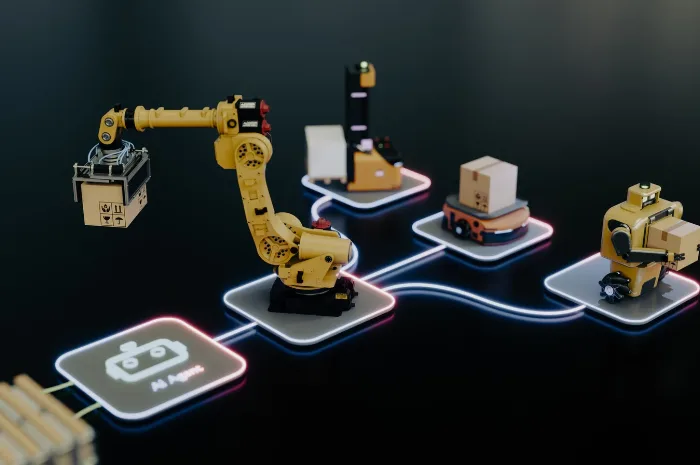
PO follow-up, MRP exception triage, invoice and contract exceptions, and supplier paperwork are a few use cases of AI agents in procurement where automation actually pays off. If properly deployed, these AI agents can save 30% to 40% of operational costs in manufacturing. Other use cases simply show theoretical efficiency.
Key highlights
- Agents pay off fastest on chasing work like PO confirmations and invoice exceptions, not on big sourcing decisions.
- Do not apply AI agents in areas where one small error can put your entire line at risk.
- Use AI agents only where data is reachable, rather than sitting across fragmented systems.
- Do not use AI agent forecasts as final; always verify.
When AI Agent Automation in Procurement and Supply Chain Pays Off
An AI agent pays off in manufacturing procurement when five conditions hold together: the work repeats hundreds of times a month, the agent’s authority can be capped by clear policy, the data it needs is in systems it can reach, mistakes are reversible, and people currently spend hours chasing information across email, portals, and the ERP.
Most failed AI agent pilots break one of these rules, usually by pointing an agent at a rare, high-stakes decision such as a sole-source casting award. A decision made four times a year can’t pay back an integration project.
So, deploy AI agent only where you have:
- Volume. PO confirmations, invoice exceptions, and MRP messages arrive daily, not annually.
- Bounded authority. “Accept a price variance up to 2% if the contract allows escalation” is a rule an agent can follow. “Pick the best supplier” is not.
- Reachable data. Apply AI agent where it can reach the data required to function, not where it cannot see the data. For example, contract price living in a PDF on someone’s laptop.
- Reversible errors. Deploy agents where you can undo the error, for example, a wrong follow-up email. Applying to irreversible use cases like awarding a contract to an unqualified supplier can stop a line.
- Chasing work today. The best targets are tasks where buyers and planners act as human routers between systems.
Gartner’s October 2026 research on CPOs points to middle-skilled procurement roles as the most exposed to AI, because so much of that work follows standard steps. Standardized, repetitive work is exactly where agents belong.
How Are AI Agents Different From RPA and Procurement Software?
RPA follows fixed steps and stops when something doesn’t match. An AI agent reads the exception, works out the likely cause, pulls what it needs from the ERP, email, or supplier portal, and then acts within limits you set or hands a prepared case to a person.
That matters because manufacturing procurement is mostly exceptions. Agents also differ from chatbots and retrieval tools, which answer questions but don’t execute work.
Gartner ranked agentic AI among its top supply chain technology trends for 2026, so expect the label on everything. Judge a tool by what it does with an exception, not by its brochure.
Where Procurement AI Agent Payoff Fastest for Manufacturers?
The fastest payback comes from removing manual chasing: PO follow-up, invoice exceptions, contract price compliance, and supplier documents. Tail-spend negotiation and requisition intake pay off too, mainly on indirect and MRO spend.
1. PO acknowledgment and delivery-date follow-up
PO follow-up is the most underrated AI agent use case in manufacturing. Buyers chase suppliers for days to confirm quantity and date, then re-key the answer into the ERP. When a date slips, nobody notices until the planner finds a shortage.
An agent can own that loop from start to finish:
- Send the PO and follow up by email or portal until the supplier confirms
- Read the confirmation, even as a free-text email or a scanned PDF
- Update the promised date in the ERP
- Compare that date against the MRP need date and flag only the lines that put production at risk
The buyer stops being a mail clerk and works only the few lines that threaten the schedule.
2. Invoice exceptions involving goods receipts, partial shipments and substitute parts
Manufacturing invoice exceptions need operational context that finance systems don’t have. A three-way match fails because the dock received 4,650 units against an order for 5,000, or because the supplier shipped an approved substitute after an engineering change. Standard AP automation flags it and stops, and someone walks between receiving, quality, and engineering to sort it out.
A procurement AI agent can do that walking. It pulls the goods receipt, checks quality holds, reads the engineering change record for approved substitutes, and either resolves the exception within policy or routes a complete case to the right person.
3. Contract compliance and price leakage
Contract leakage is money already negotiated and never collected: missed volume tiers, early price escalations, and unclaimed rebates.
An agent can check every invoice against the active contract, not a spot-checked sample. The prerequisite is blunt: contract prices and terms must exist as structured data, not only as signed PDFs. If they don’t, fixing that comes first.
4. Supplier compliance document collection
Certificates expire on their own schedule. ISO certifications, RoHS and REACH declarations, conflict-minerals reports and insurance certificates all need chasing, checking and filing. An agent can request the document, confirm it is current and complete, and escalate only when a supplier stops responding.
5. Tail-spend and spot-buy negotiation for MRO and indirect spend
Tail spend is the long list of small purchases no buyer has time to negotiate. Procurement AI agents can run short, policy-bound negotiations with those suppliers at a scale no team could match.
6. Requisition intake for indirect spend
Intake AI agents turn an email or chat request into a compliant requisition and route it to the right catalog, contract, and approver. The value is real for indirect spend but limited in a plant, where MRP already drives most direct-material demand.
Where Supply Chain AI Agents Pay Off?

On the supply chain side, AI agents pay off where signals outnumber the people reading them: MRP exception triage, inbound shipment exceptions, and freight invoice audit.
1. MRP exception message triage
Every MRP run produces a pile of reschedule-in, reschedule-out, cancel, and shortage messages. Planners can’t act on all of them, so they work the ones they know about and hope the rest don’t matter. Sometimes they do.
A supply chain AI agent ranks each message by production impact, meaning the work orders and customer orders behind it and the buffer left, then drafts the action, such as an expedite request or a schedule change, for planner approval. The planner still decides.
This use case only works if MRP parameters are reasonably clean. If lead times and safety stocks are years out of date, the agent will faithfully prioritize bad messages.
2. Inbound shipment exceptions tied to production orders
A late truck matters only if it carries something the line needs before the next delivery. An agent links the delay to the PO, the work order, and the ship date, then escalates only the delays that will stop production.
The dependency is data: a carrier feed, EDI 214 status messages, or a visibility platform. Many manufacturers don’t own inbound freight data because suppliers book the carrier, so fix that access before buying the agent.
3. Freight invoice audit
Carrier bills often carry fuel surcharges, detention, and other accessorial charges that don’t match the rate agreement. An agent checks every bill against contracted rates and shipment records, then disputes or routes the mismatches. The work is repetitive, rule-heavy, and auditable, which is why it pays off.
Where to Avoid Using AI Agents for Full Automation?
Avoid using procurement and supply chain AI agents for strategic sourcing, supplier qualification, direct-material reordering, and supplier risk response. These decisions are rare, high-stakes, or hard to reverse.
- Supplier risk monitoring. Risk scoring is analytics. Use AI agents to automate vendor risk management at key steps like mapping exposed parts and work orders, shortlisting qualified alternates, and drafting the RFQ. When to switch suppliers should remain a human call.
- Supplier qualification. First-article inspection, PPAP, and quality sign-off can’t be delegated. An agent can gather documents and track status, not approve a new source.
- Direct-material reordering. An agent placing POs for a long-lead, single-source casting with minimum order quantities can damage working capital and supplier relationships. Agents propose orders. Planners release them.
- Strategic sourcing awards. Few decisions, heavy judgment, long consequences. Use agents for bid analysis, not the award.
- Demand forecasting. This is a machine learning problem. An agent can deliver the forecast, but it isn’t the forecasting engine.
The rule: the more a decision depends on judgment, relationships, or engineering approval, the more the agent should act as an analyst, not an operator.
Comparing Main Payoff Drivers of AI Agent Use Cases
The use cases that pay back fastest let the agent act on its own within tight limits and rely on data that already sits in the ERP. The slower ones depend on external data or on decisions that must stay with people.
| Use case | What the agent does | Main payoff driver | Data it needs | Relative time to value |
| PO acknowledgment follow-up | Acts | Buyer hours, fewer surprise shortages | ERP POs, supplier email or portal | Faster |
| Invoice exceptions (GR, partials, substitutes) | Acts within tolerance, routes the rest | AP and buyer hours, on-time payment | PO, goods receipt, quality and ECO records | Faster |
| Contract price compliance | Acts | Recovered leakage | Structured contract terms | Faster, once contracts are structured |
| Supplier compliance documents | Acts | Admin hours, audit readiness | Supplier records, document requirements | Moderate |
| MRP exception triage | Drafts actions for approval | Planner focus, fewer line stoppages | Clean MRP parameters | Moderate |
| Tail-spend negotiation | Acts within limits | Savings on unmanaged spend | Price targets, supplier contacts | Moderate |
| Requisition intake | Acts | Less maverick spend | Catalogs, approval rules | Moderate |
| Inbound shipment exceptions | Recommends | Avoided expedite costs and downtime | Carrier or visibility feed | Slower |
| Freight invoice audit | Acts | Recovered overbilling | Rate agreements, shipment records | Moderate |
| Supplier risk response | Recommends | Faster reaction to disruption | Risk signals, BOM and supplier links | Slower |
“Relative time to value” is a directional judgment based on integration effort and data readiness, not a benchmark. Your own baseline numbers will decide the real payback.
What Manufacturers Should Do Before Deploying Procurement AI Agents?
Before deploying AI agents in procurement, manufacturers need usable ERP and MRP data, contract terms in structured form, written authority limits, clear human approval points, and a full audit trail of every agent action. Without these, an agent automates confusion.
- Clean ERP data. Supplier masters, lead times and part numbers must be close to right. Spend classification belongs here too: it rarely pays off alone, but agents can’t reason about spend they can’t categorize.
- Structured contracts. Prices, tiers, and escalation clauses need to be fields, not paragraphs.
- Written authority limits. Define what the agent does alone, drafts, or escalates, using dollar thresholds and tolerance bands.
- Governed system access. Many teams use the Model Context Protocol for enterprise AI to connect agents to the ERP, email, and supplier portals without custom point-to-point integrations.
- Monitoring and audit. Log every agent action for internal control and auditors.
The people side matters as much. Gartner’s May 2026 CPO survey found that only 36% of CPOs feel very confident about redesigning roles and processes around AI, and that individual productivity gains weren’t yet reaching team results. An agent that frees up hours of a buyer’s week pays off only if someone decides what that buyer does with those hours.
How Should Manufacturers Decide Their First AI Agent Use Case?
Manufacturers should choose a first AI agent use case that passes the five-condition test, has a measurable baseline today, and sits inside one team’s control. For most plants, that points to PO follow-up or invoice exceptions, not supplier risk or freight.
Run each candidate through five questions:
- Does this task happen at least daily?
- Can we write the agent’s limits on one page?
- Is the data already in systems we control?
- If the agent gets it wrong, can we fix it within a day?
- Can we measure today’s cost, in hours, errors, or late lines, before we start?
Five yeses make a pilot. Three or fewer make a research project. Pick one workflow, measure it for a month, deploy with tight limits, and widen the agent’s authority only when the numbers support it.
This is also where a partner who understands both the AI and the plant matters. Softude’s AI agent development team builds agents that connect to the ERP, MRP, and supplier systems manufacturers already run, starting with the workflow that will pay back first rather than the one with the best demo.
The AI Agent Automation Payoff is in the Chasing, not the Deciding
AI agents pay off in manufacturing procurement and supply chain when they take over the high-volume follow-up, matching, and triage work that keeps buyers and planners away from real decisions. That is the work that eats a team’s week, and it is the work an agent can do safely today. Before your next AI conversation, list the three tasks your buyers chase most often and test each one against the five questions above. Start where the chasing is worst.
FAQs
Can AI agents replace procurement buyers in manufacturing?
No, but they change what buyers do. Agents take over confirmation chasing, document collection, and exception matching. Buyers keep supplier relationships, critical-part negotiations, and risk calls. Teams that plan that shift deliberately get far more from it than teams that add an agent and wait.
Are AI agents safe to connect to SAP or Oracle ERP?
Yes, when access is governed. Give each agent its own credentials, limit it to the transactions it needs, log every action, and require approval above set thresholds. Most deployments start read-only or draft-only, then gain write access to specific fields, such as promised dates, once results hold up.
Should we start with invoice exceptions or PO follow-up?
Start where the pain is easiest to measure. If AP backlogs and late-payment complaints dominate, begin with invoice exceptions. If buyers spend their days chasing confirmations and planners keep finding surprise shortages, begin with PO follow-up.
How do you measure ROI from an AI agent in procurement?
Measure the workflow before go-live: hours spent, exceptions per week, time to resolve, late or short lines, and recovered dollars. Compare the same measures after deployment, and count only what changed in numbers you already track.