Softude
Traditional AI analyzes historical data to predict outcomes, classify information, and automate decisions. Generative AI learns patterns from massive datasets to produce new content, including text, images, code, and audio, that didn’t exist before. Both are valuable. They solve different problems, and increasingly enterprises use both together rather than choosing one.
Mixing up the two leads to bad investment decisions. Enterprises either overpay for genAI capabilities they don’t need or underuse predictive systems that would have solved their problem faster and cheaper.
This guide breaks down generative AI vs traditional AI, how each type of AI works, and how to decide which one, or which technology, is right for your business.
What Is Traditional AI and How Does It Work?
Traditional AI refers to systems trained to perform a specific, well-defined task, usually prediction, classification, or decision automation, based on patterns learned from labeled, historical data. It doesn’t create anything new. It recognizes patterns and applies them to new inputs.
How Does Traditional AI Work and Make Decisions?
Traditional AI, also called predictive AI or analytical AI, is built to do one job well. It takes an input and returns a prediction, a category, or a score. It doesn’t create anything. It recognizes a pattern it has already seen and applies it to something new.
It follows a fairly linear process to make decisions
- Data collection. Historical, structured data is gathered from a specific domain, such as transaction records, sensor readings, or customer behavior logs.
- Feature engineering. Analysts identify which variables actually influence the outcome the model needs to predict.
- Model training. The algorithm learns the relationship between those variables and known outcomes using labeled examples.
- Prediction or classification. Once trained, the model applies what it learned to new, unseen data to produce a prediction, score, or category.
- Continuous improvement. Performance is monitored, and the model is retrained periodically as new data comes in or as accuracy drops.
This is why traditional AI works best in stable, well-understood environments where the relationship between inputs and outputs doesn’t change much over time.
What Are the Most Common Traditional AI Techniques?
- Rule-based AI. Follows fixed, hand-coded logic. If X happens, then Y follows. There’s no learning involved.
- Expert systems. Rule-based AI is built on top of a large knowledge base, often used in early diagnostic or compliance tools.
- Decision trees. Split data into branches based on variable values to arrive at a decision.
- Regression models. Predict continuous numerical outcomes, such as revenue forecasts or demand levels.
- Classification models. Sort data into set categories, such as fraud or not fraud, churn or retain.
- Recommendation engines. Predict what a user is likely to want next based on past behavior.
- Predictive analytics. Broader statistical modeling used for forecasting trends and risks.
Also Read: Agentic AI vs. Traditional AI
What Is Generative AI and How Does It Work?
Generative AI refers to systems trained on large volumes of data that learn underlying patterns well enough to produce new, original output, rather than just analyzing or classifying existing data. It writes, designs, codes, and converses in ways that feel human-created.
How Does Generative AI Actually Work?
Generative AI works by training on huge datasets to learn the patterns between them. And use that knowledge to produce new content. The process involves six key components:
- Foundation model. A large model pre-trained on massive, diverse datasets, built to be adapted for many tasks instead of just one.
- Large Language Model (LLM). A foundation model trained specifically on text, used to understand and generate human language.
- Transformer architecture. The mechanism that lets the model weigh how relevant different words or data points are to each other. This is what keeps output coherent across long passages instead of falling apart after a few sentences.
- Embeddings. Numerical representations of words, images, or concepts that let the model understand meaning and relationships, such as knowing “car” and “vehicle” are related even though they’re different words.
- Fine-tuning. Training a pre-trained model further on domain-specific data, like a company’s own support tickets or product documentation, so it performs better for that specific business use case.
- Prompt engineering. Giving custom inputs or instructions to an AI model to generate more accurate, relevant output.
What Are the Different Types of Generative AI?
Different generative AI systems use different model architectures depending on the type of content they generate. While users often interact with them in similar ways, the underlying technology varies significantly.
Types of Generative AI by Architecture
Large Language Models (LLMs)
- Designed to understand and generate human language.
- Built on Transformer architecture.
- Best for text generation, summarization, question answering, and coding assistance.
- Examples: ChatGPT, Claude, Gemini, Llama.
Diffusion Models
- Generate images or videos by progressively refining random noise into realistic outputs.
- Widely used for creative design and visual content generation.
- Examples: Stable Diffusion, Midjourney, DALL·E.
Generative Adversarial Networks (GANs)
- Use two neural networks that compete during training to produce realistic synthetic data.
- Commonly used for image enhancement, synthetic data generation, and deepfake technology.
Variational Autoencoders (VAEs)
- Learn compressed representations of data and reconstruct new variations from them.
- Often used in anomaly detection, image generation, and scientific research where controlled generation is important.
Types of Generative AI by Output
- Text
Covers chatbots, content drafting, summarization, and report generation. It’s the most widely adopted form of generative AI in enterprise settings because it applies directly to customer support, internal documentation, and knowledge work.
Examples: ChatGPT, Claude, Gemini
- Images
Used for product mockups, marketing visuals, and design concepts. Enterprises use this to speed up creative iteration, generating multiple visual directions before a design team commits time to one.
Examples: DALL·E, Midjourney, Stable Diffusion
- Audio
Includes voice synthesis, music generation, and audio transcription. In business contexts, this shows up most in automated customer service voice systems and in converting recorded meetings or calls into text.
Examples: ElevanLabs, Whisper
- Video
Covers short-form video creation, animation, and synthetic training content. This is gaining traction in corporate training and marketing, where producing custom video used to require a full production team.
Examples: Runway, Veo, Synthesizer
- Code
Includes auto-generated functions, test cases, and technical documentation. This is one of the fastest-growing enterprise applications, since it directly reduces development time.
Examples: Amazon Q Developer, GitHub Copilot,
These five categories are collectively referred to as GenAI capabilities. Enterprises are applying them well beyond content creation, using them for internal knowledge assistants, customer support automation, and accelerating software development.
Also Read: Generative AI Development Cost: Complete Pricing Guide
Generative AI vs Traditional AI: What Are the Key Differences at a Glance?
Here’s a direct comparison of how the two approaches differ across the factors that matter most to a business decision.
| Feature | Traditional AI | Generative AI |
| Primary goal | Predict, classify, or automate decisions | Create new content or output |
| Learns from | Labeled, task-specific datasets | Massive, diverse, often unlabeled datasets |
| Output | Predictions, scores, categories, forecasts | Text, images, audio, video, code |
| Training approach | Trained for one specific task | Pre-trained broadly, then fine-tuned for specific tasks |
| Examples | Fraud detection models, demand forecasting | ChatGPT, DALL-E, GitHub Copilot |
| Best use cases | Risk scoring, forecasting, and recommendation systems | Content creation, copilots, conversational assistants |
| Industries | Finance, insurance, logistics, manufacturing | Marketing, software development, customer service, media |
| Human involvement | Reviews model accuracy and retrains periodically | Reviews and edits the generated output before use |
Generative AI Vs Traditional AI Architecture Comparison
The technology decision between traditional AI and generative AI isn’t really about which one is “smarter.” It’s about which pipeline your business problem needs, and that pipeline determines your infrastructure cost, your latency requirements, and where governance has to sit in the workflow.
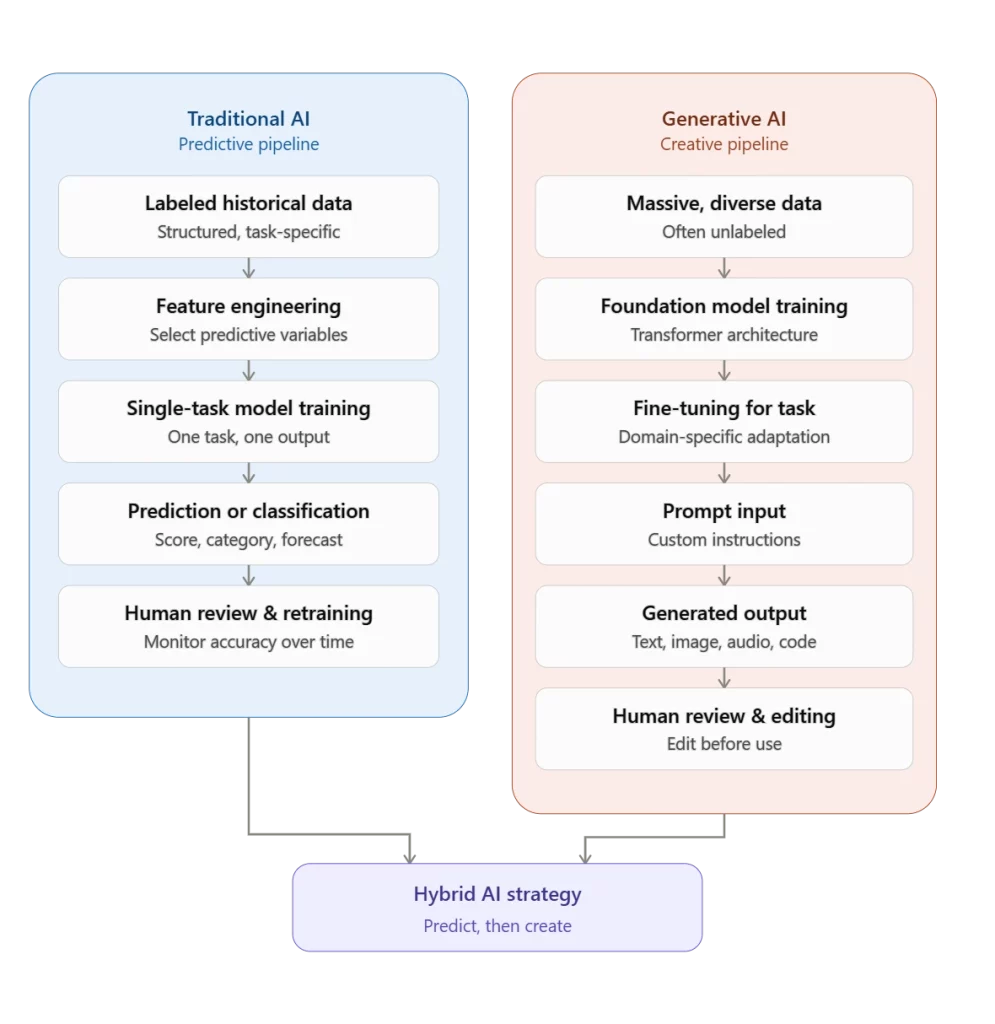
- Traditional AI runs a narrow, closed-loop pipeline
Structured, labeled data feeds a model built for one job. That model is trained once, deployed, and monitored. The only recurring cost is retraining as data drifts. Because the model is narrow, inference is fast and inexpensive.
The tradeoff is coverage. A traditional credit risk scoring model can’t be used to draft a contract. Each new use case means a new model, built and trained from scratch.
- Generative AI runs a broader, layered pipeline
A foundation model is pre-trained once on massive, diverse data, then adapted through fine-tuning for a specific business context. Every request passes through a prompt layer, generates output, and — in a well-run deployment — a review layer before that output reaches a customer or employee.
This architecture is what makes one model reusable across content drafting, summarization, and customer support simultaneously. It’s also what makes generative AI more expensive per inference and harder to govern: more compute per request, and a mandatory human-in-the-loop step that traditional AI’s pipeline doesn’t require.
What this means for planning an AI investment
The architecture, not the marketing label, tells you what you are actually budgeting for.
A traditional AI initiative is largely a data and model-training cost, with inference costs that stay flat once deployed.
A generative AI initiative carries an ongoing inference cost tied to usage volume, plus the infrastructure and process cost of the review layer, a cost many enterprises leave out of their first-year budget and then get surprised by in production.
Scoping infrastructure and governance around the actual pipeline, rather than the AI category, is what keeps either investment predictable.
Most enterprises don’t need help picking a model. They need help mapping which pipeline their specific use case actually requires before infrastructure gets provisioned.
Softude’s AI Consulting team starts there, working backward from the business outcome to the right architecture rather than the other way around. If the answer is a traditional AI pipeline, that scoping keeps the build lean and the inference cost predictable.
If it’s generative AI, our team builds the fine-tuning and review layer into the deployment from the start, so the architecture is right-sized to the use case instead of over- or under-built for it.
How Does the ROI of Traditional AI Compare to Generative AI?
Traditional AI generally delivers predictable, steady financial returns, typically between 5% and 13% for enterprise-wide deployments, by optimizing existing, rules-based workflows.
Generative AI offers a much higher, more volatile potential return, often averaging 340% within 18 months for highly focused use cases, but it suffers from a steep drop-off in value if it fails to move past the initial pilot phase.
“Generative AI attracts attention because it creates content, but traditional AI still delivers some of the highest business value in enterprise environments through prediction and optimization. Organizations that understand where each technology fits build AI systems that are both innovative and operationally reliable.”
— Softude AI Team
If you are trying to work out where each approach fits inside your own operations, Softude’s team can help map the right mix of predictive and generative AI to your actual business goals, and our Generative AI Development team can build it once that strategy is set.
Generative AI Vs. Traditional AI: Use Cases Across Industries
- Healthcare
Traditional AI supports disease prediction and patient risk scoring, helping clinicians flag high-risk cases earlier.
Generative AI handles clinical documentation, patient communication drafts, and medical assistant tools that summarize patient history for faster review.
- Manufacturing
Traditional AI drives predictive maintenance and automated quality inspection on production lines.
Generative AI is used to generate SOP documentation, power maintenance copilots that guide technicians through repairs, and draft engineering documentation.
- Banking and Finance
Traditional AI remains the backbone of fraud detection and credit scoring, where accuracy and explainability are non-negotiable.
Generative AI supports financial assistants, automated report generation, and customer support at scale.
- Retail and Ecommerce
Traditional AI powers recommendation engines and demand forecasting.
Generative AI is used to write product descriptions, personalize marketing content, and run shopping assistants that guide customers through purchase decisions.
- Software Development
Traditional AI supports bug prediction and static code analysis.
Generative AI is used for code generation, automated test creation, and technical documentation, cutting development time on routine tasks.
When Should Enterprises Choose Traditional AI?
Traditional AI is the better investment when:
- Your data is structured and historical, with clearly labeled outcomes to train on.
- The task demands high prediction accuracy over creative flexibility.
- Regulatory compliance requires explainable decisions.
- Business processes are stable and don’t change dramatically year to year.
- The core need is forecasting, such as demand, revenue, or churn prediction.
- Risk assessment is central to the task, such as credit or fraud scoring.
In short, if the problem is well-defined and the data is clean, traditional AI usually delivers better accuracy at lower cost than a generative approach.
When Should Enterprises Choose Generative AI?
Generative AI makes sense when the goal shifts from prediction to creation or assistance:
- Knowledge assistants that help employees find answers across internal documentation.
- Content generation at a volume or speed that manual processes can’t match.
- Internal copilots that support employees on repetitive drafting or research tasks.
- Customer service automation that handles routine queries conversationally.
- Document automation, including contract drafting, summarization, and reporting.
- Software development support through code generation and testing.
- Enterprise search that understands natural language queries instead of exact keyword matches.
The business value here comes from time saved on knowledge work, not from replacing prediction-based systems. Enterprises evaluating this path often start with a scoped pilot.
Can Traditional AI and Generative AI Work Together?

Yes. Most mature enterprise AI strategies now combine both rather than picking one. Traditional AI handles the prediction, and generative AI acts on that prediction to produce something a human can immediately use.
For example, a manufacturing company can use traditional AI to flag a manufacturing defect and generative AI to draft the incident report.
In the banking industry, traditional AI can help score loan risk, and generative AI can help explain how AI reaches that decision for the customer.
In each case, neither system replaces the other. Each handles the part it’s actually good at.
How Should You Choose the Right AI Approach for Your Business?
To choose whether to work with traditional AI or generative AI, enterprises should think strategically and get clear answers to the following questions:
- Is your data structured? Structured, labeled data favors traditional AI. Unstructured data, like documents or conversations, favors generative AI.
- Do you need prediction or creation? If the output is a score or forecast, go traditional. If the output is content someone will read or use directly, go generative.
- Is explainability critical? Regulated decisions need traditional AI’s clearer reasoning trail.
- Is regulatory compliance required? Compliance-heavy processes usually require traditional AI or generative AI under strict human review.
- Will humans review outputs before they’re used? Generative AI output should almost always pass through human review before it reaches a customer or a regulator.
- What is your AI maturity? Organizations early in their AI journey often get faster wins from a well-scoped traditional AI use case before layering in generative capabilities.
A quick decision matrix for enterprises:
| If your priority is… | Choose |
| Accurate forecasting or risk scoring | Traditional AI |
| Explainable, auditable decisions | Traditional AI |
| Content creation at scale | Generative AI |
| Conversational customer or employee support | Generative AI |
| Prediction followed by personalized action | Both, in combination |
If more than one row applies to your business, which is common, a hybrid approach is usually the right answer, not a compromise.
Conclusion
Traditional AI and generative AI aren’t competing technologies. They are built for different jobs. Traditional AI predicts, classifies, and automates decisions using structured data. Generative AI creates new content by learning patterns across massive datasets.
There’s no universal “better” option here, only the right fit for your specific business objective. A growing number of enterprises are moving toward hybrid strategies that combine predictive intelligence with generative capabilities, using traditional AI to make the call and generative AI to act on it.
If you are evaluating where either approach, or both, fit into your enterprise AI roadmap, Softude’s Generative AI Consultants can help map the right strategy to your actual business problem, not just the latest trend.
FAQs
Traditional AI is trained on labeled, task-specific datasets. Someone has to tag the data first, such as marking past transactions as fraudulent or legitimate, before the model can learn from it.
Generative AI is pre-trained on massive, general datasets, often without manual labeling, and can then be fine-tuned for a specific task afterward. This is why one generative model can be adapted to draft emails, summarize contracts, and answer support queries, while a traditional model is usually built to do just one of those things.
Discriminative models, which include most traditional AI techniques like logistic regression and decision trees, learn to distinguish between categories, such as separating fraud from non-fraud. Generative models, like the ones behind generative AI, learn the underlying structure of data well enough to produce new examples of it, rather than just sorting existing ones.
ChatGPT is generative AI. It’s built on a large language model that generates new text responses based on patterns learned during training, rather than classifying or predicting from labeled data.
Generative AI is generally more expensive to build and run, due to higher compute requirements and larger models. Traditional AI models are typically cheaper to train and maintain, especially for narrow, well-defined tasks.