Softude
A raw LLM API call returns one response and then forgets everything. To build an AI agent that takes multiple steps, calls tools, remembers what it did, and recovers when a step fails, you have to write all of that connective logic yourself.
Agentic AI frameworks exist to provide that logic as reusable abstractions instead of code you maintain by hand. That is the entire reason the category exists: the gap between “call a model once” and “run a reliable multi-step agent” is large, and frameworks fill it.
However, each framework fills that gap with its own assumptions about how an agent should be built. You adopt those assumptions along with the conveniences. This is why choosing the right framework matters.
What is an Agentic AI Framework?
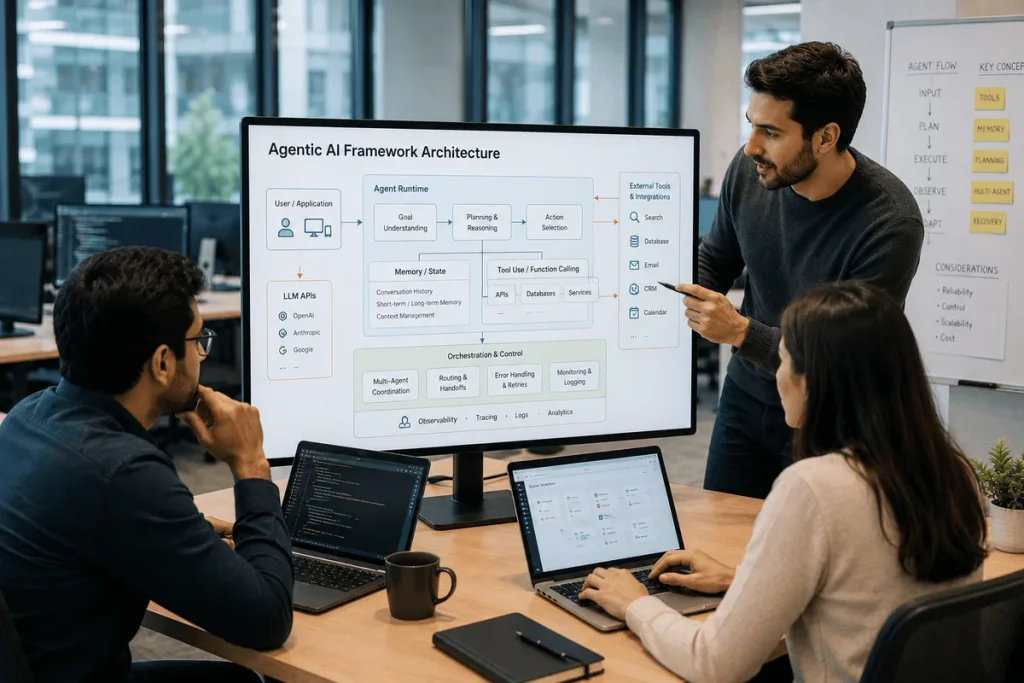
An agentic AI framework is a library that sits between your application and one or more LLM APIs to manage the parts that raw API calls don’t: deciding what step comes next, calling tools, retaining state across steps, coordinating multiple agents, and recovering from failures.
If you call an LLM API directly, you get a single response. You’re responsible for everything else, looping, parsing tool calls, tracking conversation history, retrying, and routing logic.
A framework gives you abstractions for those concerns. The trade-off is that you adopt the framework’s assumptions about how an agent should be structured, and you inherit its limitations along with its conveniences.
That trade-off is the entire decision. The frameworks below differ mostly in what assumptions they impose and how much control they give back.
How Agentic AI Frameworks Work
Most frameworks are built from the same core components. Understanding them tells you what you’re actually evaluating when you compare options, because the difference between two frameworks is usually how they implement these five parts.
- Orchestration is the control layer that decides what runs next. Some frameworks make this explicit through a graph or state machine you define, which gives predictable, inspectable flow. Others drive it through conversation between agents or let the model route autonomously, which is faster to set up but harder to constrain. This is the single biggest design difference between frameworks.
- Planning is how the agent breaks a goal into steps. Some frameworks impose a planning model; others leave it to your prompts and logic. The more open-ended your task, the more this matters.
- Memory is what the agent retains. Short-term memory holds context within a single run; long-term memory persists across sessions. Frameworks differ in whether memory is built in, pluggable, or entirely your responsibility.
- Tool calling is how the agent acts on the outside world, defining tools, invoking them, and handling the results, including malformed or failed calls. This is the component that turns a model that talks into an agent that does things.
- State management is how the framework tracks where a run is, persists it, and resumes it after a pause or failure. This is the component most teams underestimate, and it’s where most production agent failures actually originate.
When Do You Need an Agentic AI Framework?
Not every AI application needs an agentic AI framework. If your application simply sends a prompt to an LLM and returns a response, adding a framework can introduce unnecessary complexity. The real value of a framework appears when your AI application needs to make decisions, use tools, remember context, or coordinate multiple steps or agents.
Here’s a simple way to decide:
- Simple AI chatbot: If your application answers questions or generates content with minimal logic, calling an LLM API directly is usually enough.
- AI agent: If your AI needs to decide what to do next, call external tools, or complete a task over multiple steps, an agentic AI framework can simplify development.
- Multi-agent system: If multiple AI agents need to collaborate, for example, one agent researches, another analyzes, and a third reviews, a framework helps manage communication and coordination.
- Complex workflows: If your application includes long-running processes, approvals, retries, or workflows that need to pause and resume, choosing a framework with strong state management and orchestration becomes essential.
- A good rule of thumb: Start without a framework if your AI agent is simple. Introduce one only when your workflows become too complex to manage with direct API calls. This keeps your architecture simpler and avoids unnecessary maintenance.
What Should You Evaluate Before Choosing a Framework?
Before choosing a framework, evaluate these key factors. They can make a big difference when your application moves from prototype to production.
- Orchestration: How does the framework decide what runs next? Explicit graphs and state machines give you control and predictability. Conversation-driven or fully autonomous routing is faster to prototype but harder to constrain.
- Planning: Does the framework support multi-step planning, or do you build that yourself? Some impose a planning model; others stay out of the way.
- Memory: Short-term (within a run) and long-term (across sessions). Check whether memory is built in, pluggable, or your responsibility.
- Tool calling: How tools are defined, validated, and invoked. Look at how it handles malformed tool calls and parallel tool use.
- Human-in-the-loop: Can execution pause for human approval and resume cleanly? This is non-negotiable for anything touching money, customer data, or irreversible actions.
- Observability: Can you see what every agent did, why, and with what inputs? Without this, debugging multi-step agents is guesswork.
- Debugging: Step-through, replay, and the ability to inspect intermediate state. The harder your control flow, the more this matters.
- Scalability: Concurrency model, async support, and how it behaves under load and with long-running tasks.
- Enterprise integrations: Connectors, identity, and how it fits your existing stack (cloud provider, data sources, auth).
- Documentation: Whether the docs reflect the current version. Fast-moving frameworks often have docs that lag behind API changes.
- Community support: Issue response times, real production users, and whether your edge case has likely been hit before.
- Production readiness: Deployment story, stability of the public API, and whether the framework has been used beyond demos at the scale you need.
Which Are the Best Agentic AI Frameworks
1. LangGraph
A graph-based orchestration framework from the LangChain team that models an agent as a set of nodes and edges, with built-in state persistence and checkpointing.
Best suited for: Long-running workflows, agents that need durable state, and applications requiring human approvals or resumable workflows.
Strengths
- Built-in state persistence and checkpointing for pausing and resuming workflows
- Strong support for human-in-the-loop approvals
- Explicit graph-based control flow makes debugging and monitoring easier
- Good observability through the LangChain ecosystem
- Well-suited for complex, production-grade agent workflows
Limitations
- Requires more upfront development than role-based frameworks
- Steeper learning curve due to its graph and state-based architecture
- The large and rapidly evolving LangChain ecosystem can add complexity
- May be overkill for simple AI agents or quick prototypes
Learning curve. Moderate to steep. The graph and state concepts are not hard, but they require thinking about your agent differently than a simple loop.
Also Read: Top LangChain Alternatives for Building LLM Applications
2. CrewAI
An open-source framework for building multi-agent systems using a role-and-task approach, where each agent is assigned a specific responsibility.
Best suited for: MVPs, prototypes, and applications where agents have clearly defined roles (such as researcher, writer, and reviewer).
Strengths
- Quick to build and prototype multi-agent applications
- Simple, declarative setup with minimal boilerplate
- Easy-to-understand role-based architecture
- Low learning curve, making it beginner-friendly
Limitations
- Limited flexibility for complex orchestration
- Basic state management compared to graph-based frameworks
- Teams may outgrow it as workflows become more complex
- Better suited for prototypes than highly complex production system
3. AutoGen
A Microsoft framework for building multi-agent applications where agents collaborate through conversations.
Best suited for: Research projects and experimental multi-agent applications that require flexible agent interactions.
Strengths
- Flexible conversation-driven collaboration
- Strong support for experimenting with complex agent interactions
- Backed by Microsoft and an active research community
- Supports asynchronous, event-driven workflows
Limitations
- Frequent API changes can make older examples outdated
- Conversation-based orchestration is harder to control than graph-based workflows
- Documentation sometimes lags behind new releases
- Microsoft’s evolving agent strategy means long-term direction may change
4. Semantic Kernel
A Microsoft SDK for integrating LLM capabilities into enterprise applications using plugins and connectors.
Best suited for: Organizations already using Azure, .NET, or the Microsoft ecosystem.
Strengths
- Strong integration with Azure and .NET applications
- Mature plugin and connector architecture
- Designed with enterprise governance and security in mind
- Production-ready for Microsoft-based environments
Limitations
- More complex than lightweight alternatives
- Best experience is within the Microsoft ecosystem
- Newer agent capabilities are still evolving
- Less attractive if your organization isn’t invested in Microsoft technologies
5. OpenAI Agents SDK
A lightweight, open-source framework from OpenAI for building AI agents with tool calling, guardrails, tracing, and agent handoffs.
Best suited for: Teams looking for a simple framework, especially those already using OpenAI models.
Strengths
- Lightweight and easy to understand
- Built-in tracing improves debugging and observability
- Native support for guardrails and agent handoffs
- Minimal abstraction gives developers greater control
Limitations
- Smaller ecosystem than more mature frameworks
- Less suitable for highly complex orchestration
- Best experience is within the OpenAI ecosystem
- Still relatively new compared to established alternatives
6. LlamaIndex Workflows
An event-driven workflow framework built by the LlamaIndex project, designed for retrieval-heavy AI applications.
Best suited for: RAG applications and AI systems that rely heavily on proprietary or enterprise data.
Strengths
- Excellent support for retrieval-augmented generation (RAG)
- Strong data indexing and retrieval capabilities
- Flexible event-driven workflow model
- Well-suited for knowledge-intensive AI applications
Limitations
- Not primarily designed for complex multi-agent orchestration
- Lower-level workflow abstraction than dedicated agent frameworks
- Better for retrieval-centric applications than autonomous agents
7. Google ADK (Agent Development Kit)
Google’s framework for building and deploying AI agents within the Google Cloud and Gemini ecosystem.
Best suited for: Organizations already using Google Cloud, Vertex AI, and Gemini models.
Strengths
- Native integration with Vertex AI and Gemini
- Built-in support for multi-agent applications
- Managed deployment capabilities
- Good fit for Google Cloud environments
Limitations
- Newer framework with a smaller ecosystem
- Limited production track record compared to established frameworks
- Strong dependency on the Google Cloud ecosystem
- Best validated through pilot projects before enterprise-wide adoption
Also Read: AI Agent Testing Frameworks to Validate AI Systems
Comparing All The Agentic AI Frameworks
| Framework | Best For | Multi-Agent | Learning Curve | Enterprise Ready | Open Source | Key Strength |
| LangGraph | Stateful, long-running workflows | Yes | Moderate–Steep | Strong | Yes | Explicit state and durable control flow |
| CrewAI | Fast multi-agent MVPs | Yes | Low | Moderate | Yes | Speed to a working prototype |
| AutoGen | Multi-agent experimentation | Yes | Moderate | Evolving | Yes | Flexible conversational coordination |
| Semantic Kernel | Microsoft-stack enterprise apps | Yes | Moderate | Strong (MS stack) | Yes | Enterprise integration and plugins |
| OpenAI Agents SDK | Lightweight OpenAI-based agents | Yes (handoffs) | Low–Moderate | Moderate | Yes | Minimal abstraction, built-in tracing |
| LlamaIndex Workflows | RAG and data-centric agents | Partial | Moderate | Good (data use cases) | Yes | Retrieval and data foundation |
| Google ADK | Google Cloud / Gemini agents | Yes | Moderate | Evolving | Yes | Vertex AI integration |
Which Framework Should You Choose?
Depending upon what you are building, these are the best frameworks to choose from
- Startup building an MVP: CrewAI or the OpenAI Agents SDK. Both get you to a working result quickly. Accept that you may migrate later as requirements sharpen; that’s a reasonable trade for early speed.
- Enterprise automation: Semantic Kernel if you’re on the Microsoft stack; LangGraph if you need explicit, auditable control flow regardless of cloud.
- Customer support agents: LangGraph, specifically for its human-in-the-loop and resumability when an agent needs to escalate to or wait on a human.
- Research agents: AutoGen for flexible multi-agent experimentation, or LangGraph if the research involves stateful, multi-step processes you’ll want to inspect.
- Internal copilots: OpenAI Agents SDK or CrewAI for speed; Semantic Kernel if it must integrate with internal enterprise systems.
- Multi-agent orchestration: LangGraph for explicit control, CrewAI for the role-based model, AutoGen for conversation-driven coordination. The right pick depends on how much control you need over the coordination.
- Regulated industries: Prioritize observability, human-in-the-loop, and auditability over convenience. LangGraph and Semantic Kernel are the stronger candidates because they make execution inspectable and controllable.
Common Mistakes When Choosing an Agentic AI Framework
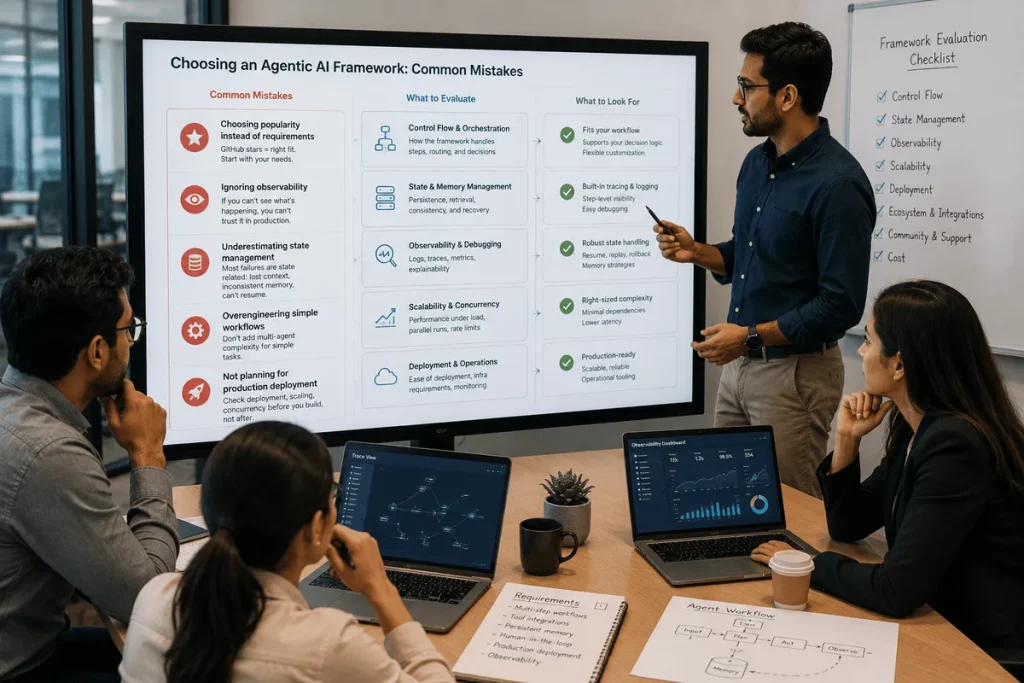
- Choosing popularity instead of requirements. A framework’s GitHub star count tells you nothing about whether it fits your control-flow and state needs. Start from your requirements checklist, not the trending list.
- Ignoring observability. Teams pick for ease of prototyping, then discover they can’t see why an agent did what it did in production. By then, retrofitting observability is painful.
- Underestimating state management. Most agent failures in production are state problems such as lost context, inconsistent memory, and runs that can’t resume. Frameworks with thin state handling look fine in demos and fail under real workloads.
- Overengineering simple workflows. Pulling in a full multi-agent framework for a task that needs one LLM call and one tool adds dependencies, latency, and maintenance for no benefit. Match the tool to the actual complexity.
- Not planning for production deployment. “It runs on my machine” is not a deployment strategy. Check how the framework deploys, scales, and handles concurrency before you build on it, not after.
Conclusion
The best agentic AI framework depends on what you are building, not what’s most popular. Before making a choice, consider your application’s workflow complexity, scalability, integration needs, and long-term maintenance. A framework that fits your architecture today will make it much easier to build, deploy, and scale reliable AI agents tomorrow.
FAQs
There isn’t a single answer. If you’re on the Microsoft stack, Semantic Kernel fits naturally. If you need explicit, auditable control flow and resumability regardless of cloud, LangGraph is a strong default. The deciding factors for enterprise are observability, human-in-the-loop, and how well it integrates with your existing systems — not raw capability.
They optimize for different things. LangGraph gives you explicit control over state and flow at the cost of more upfront work. CrewAI gets you a working multi-agent system faster at the cost of control. For long-running, stateful, or high-stakes applications, LangGraph is usually the better fit. For quick prototypes that map onto a team of roles, CrewAI wins. Neither is universally better.
CrewAI for multi-agent work, or the OpenAI Agents SDK for single agents with minimal abstraction. Both let you produce a working result without deep framework knowledge. Be aware that easy-to-start frameworks can be harder to scale, so factor in where you’re headed.
Most of the major ones do: LangGraph, CrewAI, AutoGen, Semantic Kernel, the OpenAI Agents SDK (via handoffs), and Google ADK. They differ in how they coordinate agents — explicit graphs, role-based tasks, or conversation — which matters more than whether the feature exists.
Yes, but it’s not free. Your tool definitions and prompts usually port with moderate effort; your orchestration and state logic generally do not, because that’s where frameworks differ most. This is why choosing on control-flow needs matters early. Migration is most painful when you’ve built complex stateful coordination against one framework’s specific model.
No. If your agent makes a single LLM call and uses one tool, a direct API call with your own thin wrapper is simpler and easier to maintain. Adopt a framework when you have genuine multi-step control flow, persistent state, or multi-agent coordination — not before.