Softude
AI doesn’t work for every business. That may sound uncomfortable, but it’s true.
According to a 2025 MIT report, 95% of generative AI pilots are failing. Though AI deployment surged by 400% across enterprises during 2024 and 2025, only 12–18% of businesses achieved meaningful ROI from those investments.
Why?
Many businesses rushed into AI adoption without a clear strategy. They invested heavily in AI experimentation. But we are no longer in the pilot phase. Boards don’t want more AI trials; they want measurable business outcomes.
The right AI consulting services provider helps here. They help businesses focus on aligning AI with strategy and invest in the right areas, so returns are guaranteed and measurable.
What AI Strategy Consulting is And What It Isn’t
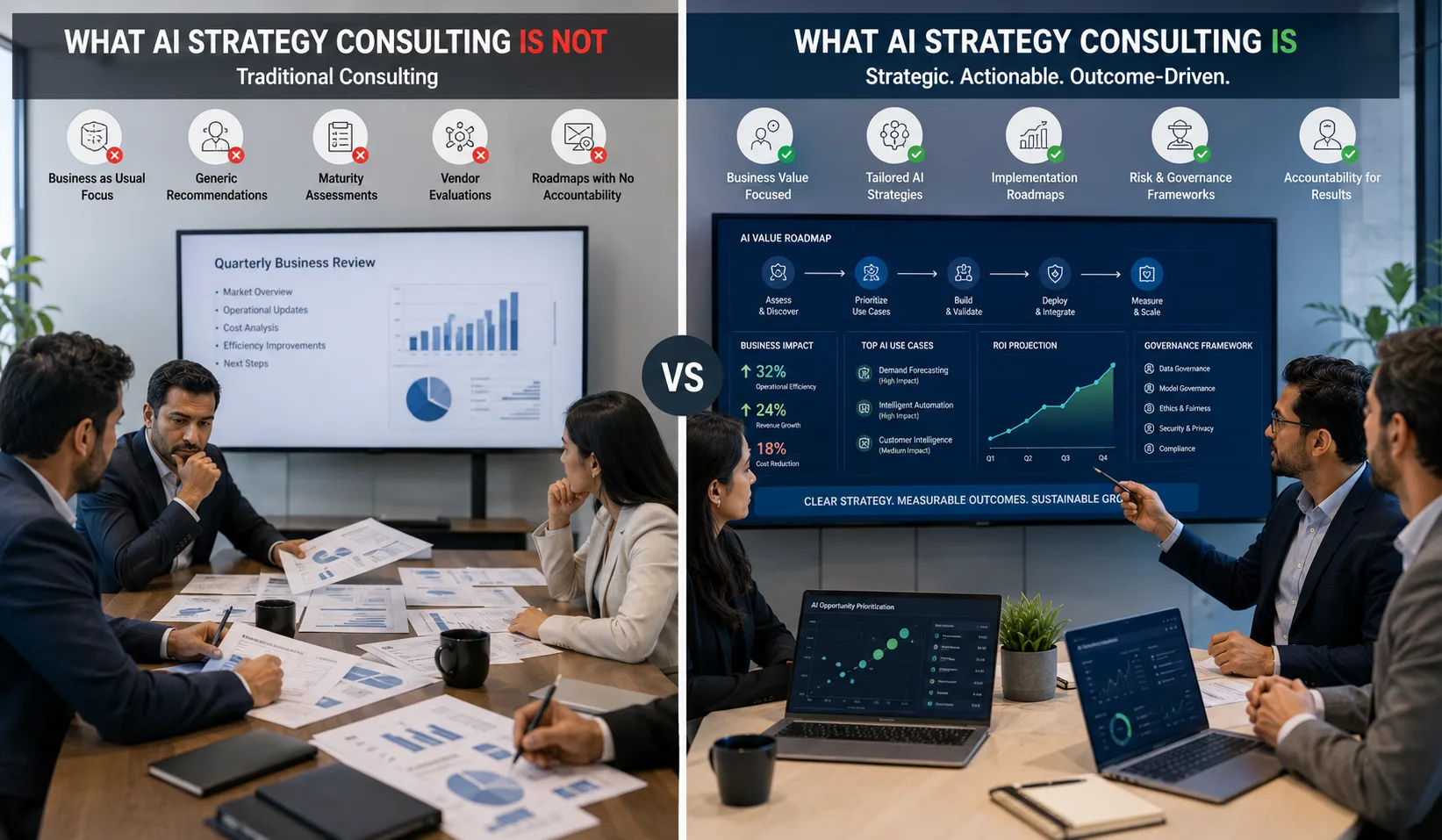
First, understand what it’s not.
AI strategy consulting is not traditional consulting, where the focus is on business processes and structures. It is also not a maturity assessment, vendor evaluation, or creating a roadmap that no one is accountable for execution.
The best AI consultants are both business and tech experts who help with strategy, implementation, tool selection, risk assessment, and much more. In other terms, they help organizations to answer these questions and act on them:
- Where does AI create measurable business value in our specific operating context, not the industry generally, but our business?
- What is actually preventing us from getting there? Is it data infrastructure, governance gaps, organizational fragmentation, or something else?
- How should we invest, and when should we stop?
- How do we build internal capability so we are not dependent on external consultants for the same problem 18 months from now?
Three Scenarios Where AI Consultants Help the Best
Any industry, whether BFSI, manufacturing, or logistics, is stuck in AI, mostly in these three cases:
Pilot purgatory. The pilot worked. The demo was good. Then six months later, the AI tool is deployed successfully, but no one is actually using it. AI engineers are still resolving integration issues. And without proof of value, AI spend starts to look like a cost center, and cost centers get cut.
Fragmented investment across business units. Multiple teams are working on their own AI initiatives using different tools and data sources, with no shared infrastructure. So, success is happening, but on the surface, not on the ground. Overall, the ROI does not meet expectations.
Reactive investment driven by competitive pressure. Many leaders are motivated by the fear of falling behind the AI race rather than a clear view of where AI creates value for their specific business model. As a result, investments are made under pressure.
Most organizations either recognize themselves in more than one of these or have no idea that they are stuck. AI consultants help identify and overcome these patterns.
What Can Businesses Expect in AI Strategy Consulting?
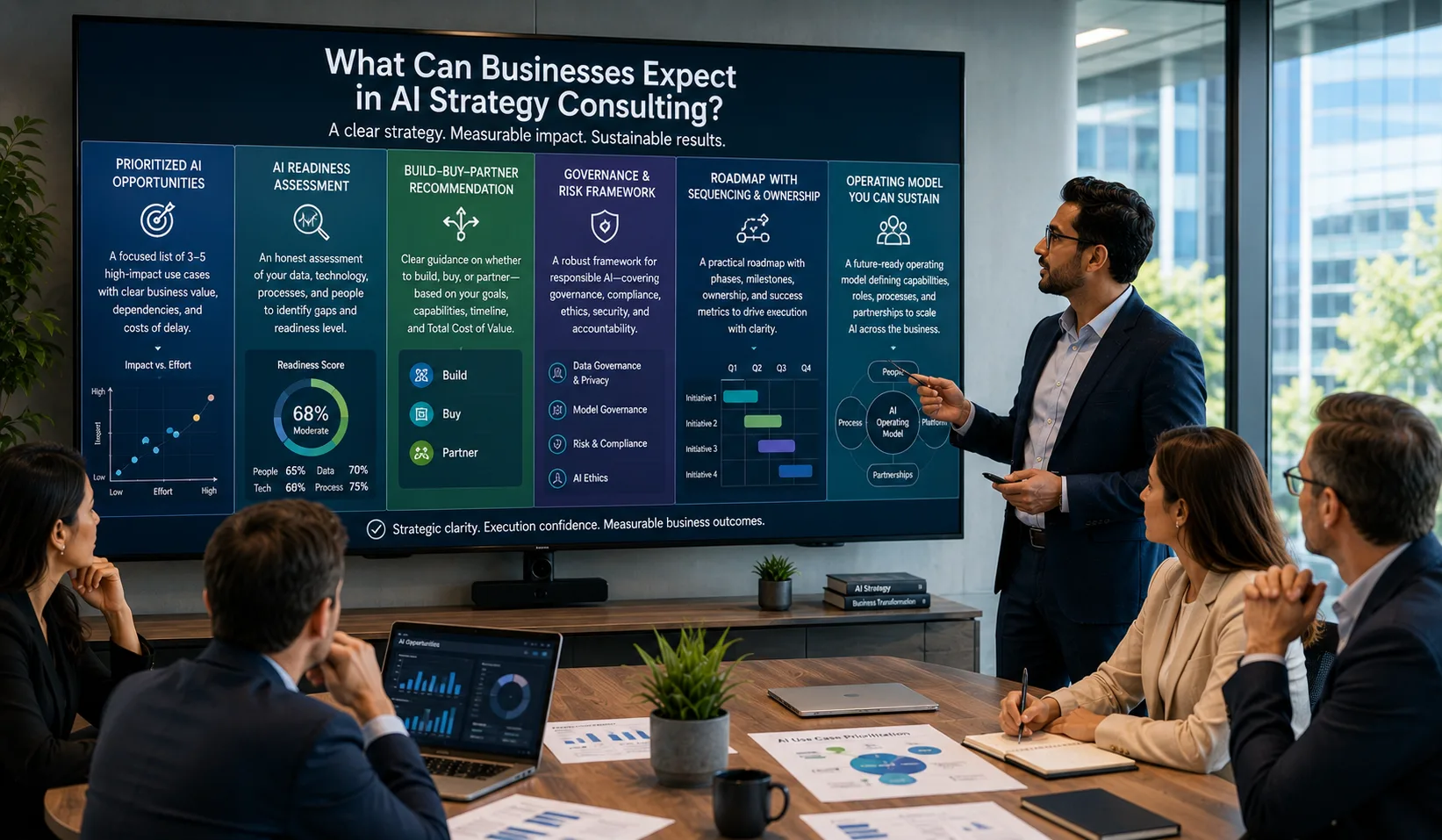
AI strategy consulting is not a one-size-fits-all service. What a manufacturer needs is different from what a bank or a healthcare organization needs. That said, the core AI consulting services include .
A prioritized list of AI opportunities, not a wishlist. The expert AI consultant reviews your operations, identifies where AI can move a business metric, and narrows it down to three to five high-impact use cases of AI. Each one comes with a business case: what value it creates, what it depends on, and what it costs to delay.
An honest assessment of where you stand today. Before any roadmap is built, the top AI consultant will tell you the truth about your data infrastructure, technology readiness, and internal capability. If your data is fragmented or your systems are not integration-ready, that needs to be resolved before AI can deliver anything reliable. AI readiness assessment prevents organizations from investing in the wrong layer of the problem.
A clear build-buy-partner recommendation. Should you build a custom AI solution, purchase an existing tool, or work with a specialized partner? This decision has long-term cost and capability implications. A good strategy engagement gives you a reasoned answer based on your specific context, not a vendor preference.
A governance and risk framework. Who approves AI deployment in your organization? Who is accountable when a model produces the wrong output? What data is permitted to flow into which systems? These questions need answers before you scale, not after something goes wrong. The right strategy engagement defines these boundaries clearly.
A roadmap with sequencing and ownership. Not a slide with arrows and timelines. A practical plan that specifies what gets done first, why that sequence makes sense, who owns each initiative, and what success looks like at each stage. Ownership without clarity is how initiatives stall.
An operating model you can sustain. What internal capabilities do you need to build? What do you continue to source externally? How does your team structure need to evolve as AI becomes part of core operations? A strategy engagement answers these questions so that AI does not remain dependent on a consulting firm to function.
When You Need AI Strategy Consulting And When You Don’t
Most firms won’t say this, but not every organization needs AI strategy consulting right now. Here is how to tell the difference.
You likely need it if:
- AI initiatives exist across multiple teams with no central prioritization, and leadership cannot agree on what to fund next.
- You have completed pilots, but business and technology stakeholders are not aligned on where to go from here.
- You are facing a competitor move, a regulatory shift, or a change in customer expectations, and need to make a clear decision rather than run more experiments.
- Your leadership team understands AI broadly but cannot evaluate vendor claims, architecture options, or what production deployment actually requires.
You likely don’t need it if:
- You have a single, well-defined problem and internal engineering capability. You need execution, not strategy.
- You completed a strategy exercise in the last 12 months, and the real issue is implementation speed.
- You are an early-stage business where budget constraints make strategy consulting impractical. Direct product development is a better use of capital.
Getting this wrong is costly either way. When you take AI consulting services to solve an execution problem, you get frameworks that actually work for your business. But when you focus on execution without strategic alignment, you get the wrong outcomes.
How to Choose the Right AI Strategy Consulting Partner
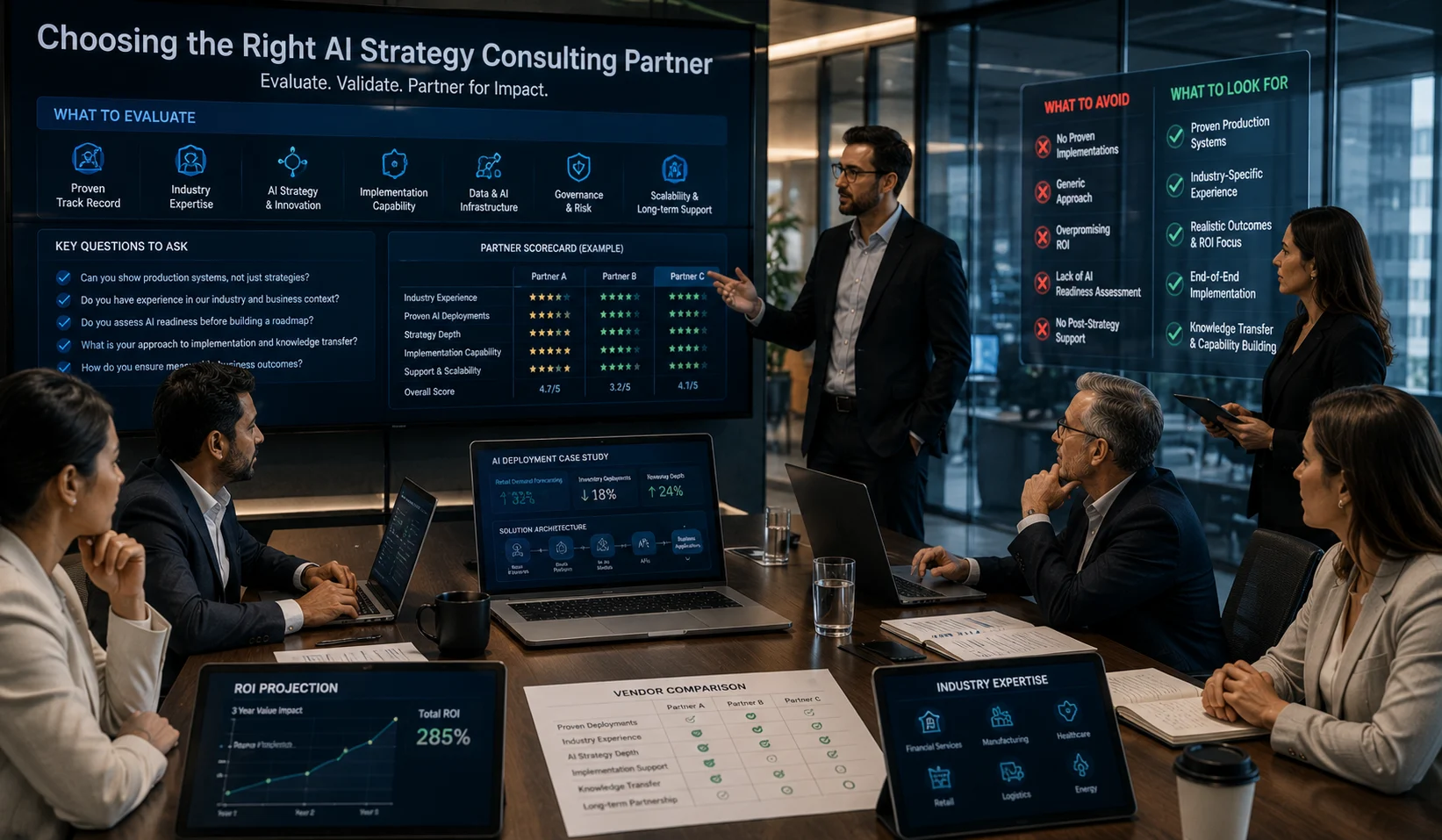
Asking the right questions can only help you with the vendor selection. Here’s what to ask from the AI consulting services provider before signing the NDA.
Can you show production systems, not just the strategies? If a firm cannot point to AI systems they helped build and deploy for other clients, they are selling advice without accountability for outcomes.
Do you have experience in my sector? AI strategy in manufacturing involves different data environments, integration constraints, and operational dynamics than AI strategy in BFSI or healthcare. Generic AI strategy consulting produces generic results.
Do you perform an AI readiness assessment? Some organizations need to fix their data foundation or resolve internal ownership questions before implementing any AI strategy. A consulting partner who does not assess your business first is not advising you honestly.
What happens after the strategy is done? Does the engagement include implementation support or knowledge transfer to your team? A strategy that requires the same firm to execute it creates ongoing dependency, not capability.
What is actually hard? Most organizations are not failing at AI because of technology. They are failing to define clear ownership, perform data cleaning, and design custom workflows. A partner who leads with that reality is more useful than one who leads with a service pitch.
How Softude Approaches AI Strategy Consulting
At Softude, we believe one thing: a strategy that doesn’t lead to desired outcomes isn’t strategy, it’s documentation.
Here’s how we are different from other AI consulting service providers:
- We start with AI readiness assessment. Every engagement begins with a discovery phase focused on understanding your operations, competitive pressures, AI readiness, and where AI can genuinely move the needle.
- We close the strategy-execution gap. Our team includes AI strategists, data engineers, machine learning engineers, and product managers. We can take a use case from prioritization to production. Our strategy recommendations are grounded in what’s actually buildable.
- We’re honest about what AI can’t do. If a simpler automation or process improvement will solve your problem better than a machine learning model, we’ll tell you. Our goal is business outcomes, not AI projects for their own sake.
- We build for scale, not just proof of concept. It’s easy to build an AI demo. It’s hard to deploy a model that’s reliable, maintained, and integrated into your workflows at scale. Our engineering standards are built for production.
- We work across the full stack. From data infrastructure and MLOps to generative AI applications and AI governance frameworks, we bring end-to-end capability to every engagement.
Connect with our AI experts to learn more about how we can help to invest in AI correctly and deliver measurable ROI.
The Bottom Line
Most organizations will not fail at AI because they chose the wrong model or the wrong vendor. They will fail because they could not answer a simpler question: what problem are we actually solving, and are we organizationally ready to solve it?
If you are at that point, the next step is not another AI pilot. It is a clear decision about where AI fits in your business and what it will take to get there.
Frequently Asked Questions
What is the difference between AI consulting and AI strategy consulting?
AI consulting is broad. It can mean anything from building a model to selecting a tool. AI strategy consulting is specifically about deciding where AI fits in your business, in what priority order, and how to structure the investment before any building begins.
How much does AI strategy consulting cost?
It varies based on scope and firm. What matters more than the cost is whether the engagement produces decisions that prevent misallocated capital. A poorly directed AI investment typically costs far more than the consulting engagement that could have redirected it.
We already have an internal data science team. Do we still need AI strategy consulting?
Possibly. Internal teams are typically strong at building. AI strategy consulting addresses a different question: which problems are worth building for, in what sequence, and whether the organizational conditions exist to support deployment.
What if we are not ready for AI yet?
That is a legitimate outcome of a strategy engagement. A good consultant will tell you what needs to be resolved first, whether that is data infrastructure, internal alignment, or governance, rather than push you toward implementation you are not set up to sustain.
How do we measure ROI from AI strategy consulting?
The clearest measure is decision quality. Did the engagement help you avoid a bad investment? Did it accelerate alignment among leadership? Did it produce a roadmap that held up in execution? These outcomes have financial value even when they are not immediately visible on a dashboard.
Is AI strategy consulting only relevant for large enterprises?
No. Mid-market businesses often need it more, because they have less margin for misallocated investment and fewer internal resources to course-correct. The scope of the engagement adjusts to the size of the organization.