Softude
Most businesses are already experimenting with AI in some way. Some teams are testing copilots. Others are automating workflows or trying AI tools for content, analytics, customer support, or operations.
At first, this usually feels productive. Teams move quickly, people explore ideas independently, and leadership sees early signs of potential.
But after a while, AI spending increases without a measurable impact. At that point, the challenge is no longer the technology itself. The challenge is organizational.
An AI CoE helps organizations bring structure, consistency, and direction to solve this problem. It creates a central approach to deciding where AI should be used, how it should be governed, and how successful initiatives can scale across the business rather than remain isolated experiments.
Quick Summery
- An AI Center of Excellence (AI CoE) is a dedicated internal function that helps organizations govern, standardize, and scale AI adoption.
- Businesses usually need an AI CoE when AI initiatives begin creating fragmentation, duplicated effort, unclear ownership, or inconsistent results.
- An AI CoE helps align AI projects with business goals while reducing operational, compliance, and governance risks.
- Without a structured AI strategy, many organizations struggle to generate long-term ROI from their AI investments.
What is an AI Center of Excellence?

An AI Center of Excellence or AI COE is a dedicated internal function responsible for guiding the adoption, management, and scaling of AI across an organization.
It is not simply a technical team building models in isolation. And it is not a research department focused only on experimentation.
Instead, the AI CoE acts as a central coordination layer between business teams, technical teams, leadership, and operational functions.
The purpose of AI COE is to help the organization make smarter decisions about AI investments, establish common standards, reduce duplication, and ensure AI projects create measurable business value.
Some businesses build a formal AI CoE with full-time employees and defined reporting structures. Others operate it as a cross-functional working group made up of leaders from technology, operations, data, compliance, and business units.
The structure may vary, but the objective is the same: helping the organization adopt AI in a consistent, scalable, and responsible way.
By bringing together business stakeholders, data teams, AI specialists, and operational leaders, an AI CoE allows organizations to experiment with AI while maintaining governance, reducing risk, and building internal capability over time.
What is the Purpose of an AI Center of Excellence?
The main purpose of an AI CoE is to ensure AI works for the entire organization, not just for a few teams with strong technical knowledge or early access to tools.
Without coordination, AI adoption often grows unevenly. One department may move quickly while another struggles to get started. Different teams may purchase overlapping tools, create disconnected workflows, or solve the same problems independently.
Over time, this creates inefficiency, inconsistent results, and rising costs. An AI CoE helps solve these problems by creating a shared framework for AI adoption across the business.
More specifically, it helps organizations:
- Build an AI strategy connected to real business priorities.
- Create alignment between departments using AI.
- Develop internal AI knowledge and reduce overdependence on external vendors.
- Establish governance standards for privacy, security, ethics, and compliance.
- Track business impact and measure return on AI investments.
- Create repeatable processes for evaluating and deploying AI solutions.
How the AI Center of Excellence is Different From Traditional Innovation Teams

At first glance, an AI CoE seems the same as a traditional innovation or digital transformation team. But their responsibilities are usually very different.
A traditional innovation team is typically focused on exploring new ideas, identifying trends, and testing emerging technologies. Their role is often experimental and future-focused.
An AI Center of Excellence, on the other hand, focuses on operationalizing AI across the organization.
Traditional Innovation Teams Usually:
- Explore new technologies and emerging opportunities.
- Run experimental or exploratory projects.
- Prototype ideas before handing them off to business teams.
- Focus on long-term innovation initiatives.
- Work broadly across multiple areas beyond AI.
AI Centers of Excellence Usually:
- Focus specifically on AI systems, governance, data, and adoption.
- Support real business use cases tied to measurable outcomes.
- Help teams deploy and scale AI solutions effectively.
- Establish organization-wide standards and policies.
- Act as the internal authority on AI-related decisions.
The two functions can complement each other very well. Innovation teams often identify opportunities worth exploring, while the AI CoE helps determine how to implement those solutions responsibly and scale them across the business.
Why Does Your Organization Need an AI CoE?
In the early stages of AI adoption, every team experimenting with AI tools seems like a good idea. Teams can explore use cases of AI as per their goals and the problem they want to solve, and move quickly.
But as adoption grows enterprise-wide, coordination seems a problem. For example:
- AI pilots in some teams show promise but never make it into production.
- Multiple departments purchase similar AI tools independently, raising the cost of AI adoption.
- Teams use disconnected systems that do not integrate properly.
- Leadership struggles to understand which AI initiatives are delivering value.
- No clear ownership exists for AI governance, compliance, or risk management.
- Only a few individuals or teams gain expertise in AI, failing the goal of AI adoption across the organization.
- Employees across the organization adopt AI at very different speeds.
These signs don’t indicate that AI has failed but show that there’s a need for an operational framework for evaluating, governing, and scaling AI initiatives. An AI CoE provides that framework.
Benefits of the AI Center of Excellence

The biggest advantage of an AI CoE is that it turns scattered AI activity into a long-term organizational capability. Instead of treating AI as isolated experiments, the business develops systems, standards, and processes that improve over time.
Here are some of the most important benefits.
Faster Decision-Making
Teams no longer need to start from scratch every time they want to explore AI. The center of excellence creates shared frameworks for evaluating use cases, selecting tools, assessing risk, and deploying solutions. This speeds up both technical and business decisions.
Reduced Duplication Across Teams
Maybe your sales and marketing team is using AI for the same problem. This creates duplication of efforts and waste of money. The AI center of excellence helps you identify the right business problem to address with AI. It also helps in creating a shared infrastructure across the organization, reducing unnecessary spending and duplicated effort.
More Consistent AI Outcomes
When every team follows different practices, AI performance becomes unpredictable. An AI CoE helps standardize areas such as:
- Data quality requirements
- Model evaluation processes
- Deployment practices
- Security controls
- Monitoring frameworks
This creates more reliable outcomes when AI solutions move into production.
Stronger Governance and Risk Management
AI introduces important questions around privacy, bias, security, compliance, and accountability.
An AI CoE helps organizations proactively establish governance policies before problems arise. This is especially important in industries such as healthcare, finance, insurance, manufacturing, and retail.
Better Internal Capability Development
Organizations that rely entirely on external vendors often struggle to build long-term AI maturity. A CoE helps create internal knowledge through:
- Training programs
- Documentation
- Shared playbooks
- Cross-functional collaboration
- Internal support systems
Over time, this builds stronger internal confidence and reduces dependency on outside providers.
Clearer ROI Visibility
Leadership teams often struggle to understand whether AI investments are actually generating business value. An AI CoE provides centralized reporting and measurement frameworks that make it easier to track outcomes, compare initiatives, and prioritize future investments.
What Does an AI CoE Do?
An AI CoE operates as a cross-functional strategy, governance, and enablement function.
Rather than sitting inside a single department, it works across the organization to support AI adoption at multiple levels. Its day-to-day responsibilities often include the following:
Strategy and Prioritization
The CoE helps identify where AI can create the greatest business impact. This includes evaluating:
- Operational inefficiencies
- Automation opportunities
- Customer experience improvements
- Data readiness
- Potential ROI
- Organizational risk
Based on this, the CoE helps build a practical AI roadmap aligned with business priorities.
Standards and Governance
The CoE establishes guidelines for:
- AI tool selection
- Data usage
- Model monitoring
- Security practices
- Compliance requirements
- Responsible AI policies
This creates consistency across teams and reduces governance gaps.
Project Support and Enablement
Many AI CoEs function like internal advisory teams. They help business units:
- Evaluate use cases
- Scope AI projects
- Select vendors or platforms
- Deploy solutions
- Measure performance
This support helps teams move faster while avoiding common implementation mistakes.
Capability Building
AI adoption depends heavily on your people, not just technology. A CoE often leads:
- AI literacy programs
- Internal workshops
- Enterprise AI training sessions
- Documentation initiatives
- Change management activities
The goal is to help employees across departments understand how AI can support their work.
Vendor and Tool Management
As organizations adopt more AI tools, visibility becomes increasingly important. The CoE helps evaluate vendors, manage contracts, standardize platforms, and maintain oversight of which tools are being used across the business.
Measurement and Reporting
The CoE tracks AI outcomes and communicates results back to leadership. This may include:
- Cost savings
- Productivity improvements
- Adoption rates
- Operational efficiency gains
- Risk reduction metrics
- Revenue impact
Over time, this helps leadership make better investment decisions.
How Do You Set Up an AI Center Of Excellence?
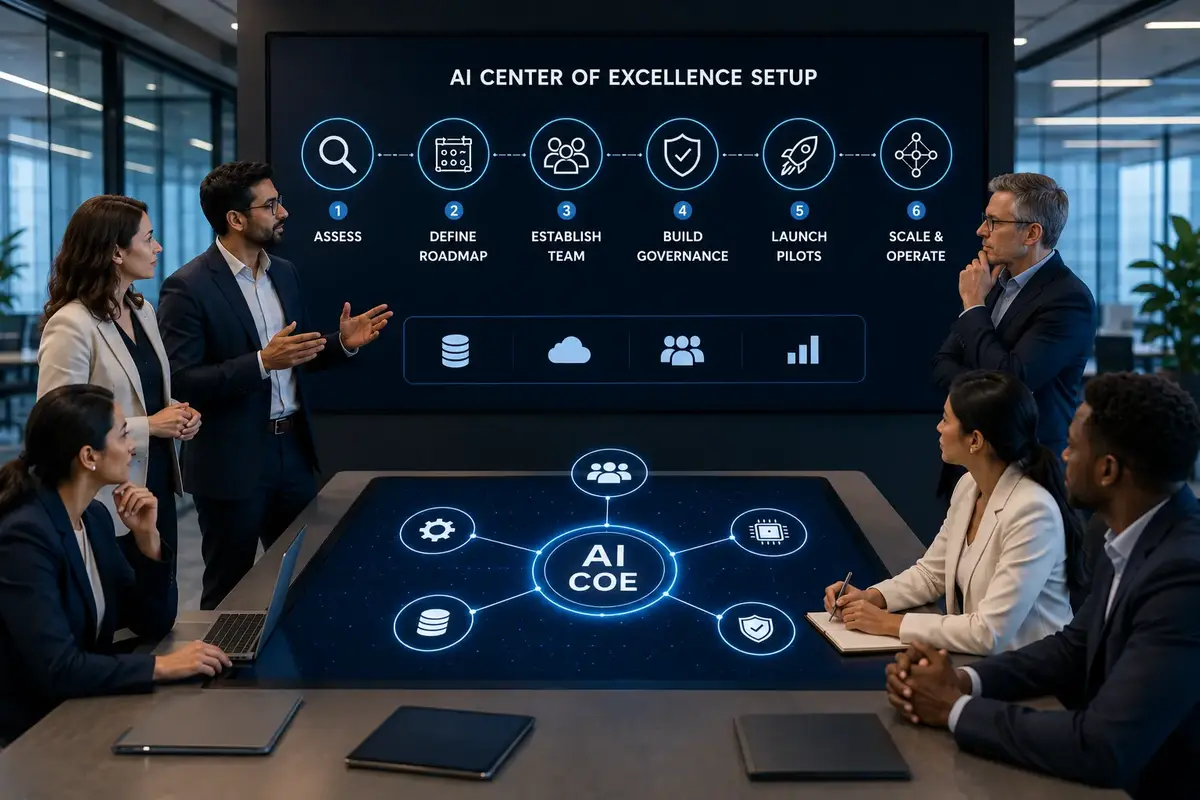
Setting up an AI CoE doesn’t require a massive upfront investment but following the right stages:
- Assess your current state. Understand what AI efforts are already underway, where the gaps are, and what capabilities you have in-house. (An AI Maturity Index is a useful starting point for this.)
- Define the mandate. Be clear about what the center of excellence would do and what it won’t. Avoid scope creep from the start.
- Appoint a leader. This person needs executive backing and the credibility to work across business units. Without that, the CoE will struggle to gain traction.
- Start with a small core team. You don’t need 20 people. A lean team with the right mix of technical and business skills can move faster and prove value more quickly than a large group trying to coordinate.
- Pick an early win. Identify one high-visibility AI use case that the CoE can support from start to finish. A tangible, successful project builds credibility and internal momentum.
- Build governance early. Even a simple governance framework covering how tools are approved, how data is managed, and who is accountable for outcomes saves a lot of headaches later.
- Communicate broadly. The CoE only works if the rest of the organization knows it exists and what it offers. Regular updates, internal newsletters, and open office hours go a long way.
The Key Roles in the AI Center of Excellence
An effective AI CoE requires a mix of technical, strategic, and operational expertise. It is not made up only of data scientists or engineers.
Here are some of the most common roles found within an AI CoE.
CoE Lead / Head of AI
This person owns the vision and strategy. They need to speak both business and technology — translating AI possibilities into business outcomes, and business needs into AI requirements. Often reports to the CTO, CDO, or a senior business executive.
AI/ML Engineers and Data Scientists
The technical core of the team. They evaluate tools, build prototypes, support business units with implementation, and maintain shared AI infrastructure.
Data Engineers
AI is only as good as the data behind it. Data engineers ensure data pipelines are reliable, accessible, and well-governed, a foundation that the whole organization depends on.
Business Analysts / Domain Experts
These are the bridge-builders. They understand specific business functions well enough to identify where AI can help and translate technical outputs into decisions that business units can act on.
AI Ethics / Responsible AI Lead
An increasingly important role, especially as regulations tighten. This person ensures AI use is fair, transparent, and compliant, and helps the organization navigate the nuanced questions that come with deploying AI at scale.
Change Management / Training Lead
AI adoption is as much a people challenge as a technical one. This role owns the internal communications, training programs, and cultural change work that helps employees embrace AI rather than resist it.
Conclusion
An AI Center of Excellence helps organizations bring structure, accountability, and long-term direction to AI adoption. Without that structure, AI initiatives often become fragmented, difficult to scale, and hard to measure.
A well-designed AI CoE lays the foundation for organizations to move faster over time, as teams no longer repeatedly solve the same problems or operate without shared standards.
If your organization is beginning to feel the complexity of scaling AI, an AI CoE may be the next logical step. Our AI Maturity Index can help you assess your current readiness and identify what type of AI CoE structure makes the most sense for your stage of growth.
FAQ
When should a business establish an AI Center of Excellence?
A business should consider building an AI CoE when AI adoption expands across departments and becomes difficult to manage informally.
Is an AI Center of Excellence only for large enterprises?
No. While large enterprises often build formal AI CoEs, mid-sized businesses can also benefit from a smaller, more focused structure.
How is an AI CoE different from an IT department?
An IT department primarily manages infrastructure, systems, security, and operational technology support. An AI CoE focuses specifically on AI adoption, governance, business use cases, implementation frameworks, and organizational enablement.
Should an AI CoE manage all AI projects directly?
Not necessarily. In many organizations, the CoE typically sets standards, provides support, establishes governance frameworks, and helps teams scale AI responsibly, while individual business units continue managing their domain-specific initiatives.