Softude
Most manufacturers should buy AI demand forecasting software first, because planning suites already cover forecasting, inventory planning, and S&OP workflows. A custom ML model adds value when an existing tool fails on important demand segments or when your own data gives you a forecasting edge. Decide based on tested accuracy, data quality, ERP fit, and business needs.
Key highlights
- Buy first when your forecasting needs are standard, and your team has limited ML expertise.
- Consider a custom model when software fails on key demand segments, such as spare parts.
- AI demand forecasting isn’t automatically more accurate than statistical methods; it depends on the demand pattern.
- Judge demand forecasting software vendors on a backtest of your own data, not on popularity or cost.
Should you buy demand forecasting software or build a custom ML model?

Most manufacturers should start by checking whether an existing planning suite meets their needs. Buying gives you proven forecasting methods, planning workflows, and ERP connectors faster than a build.
Building from scratch makes sense only when you can show a specific capability gap or a competitive advantage that off-the-shelf tools can’t deliver.
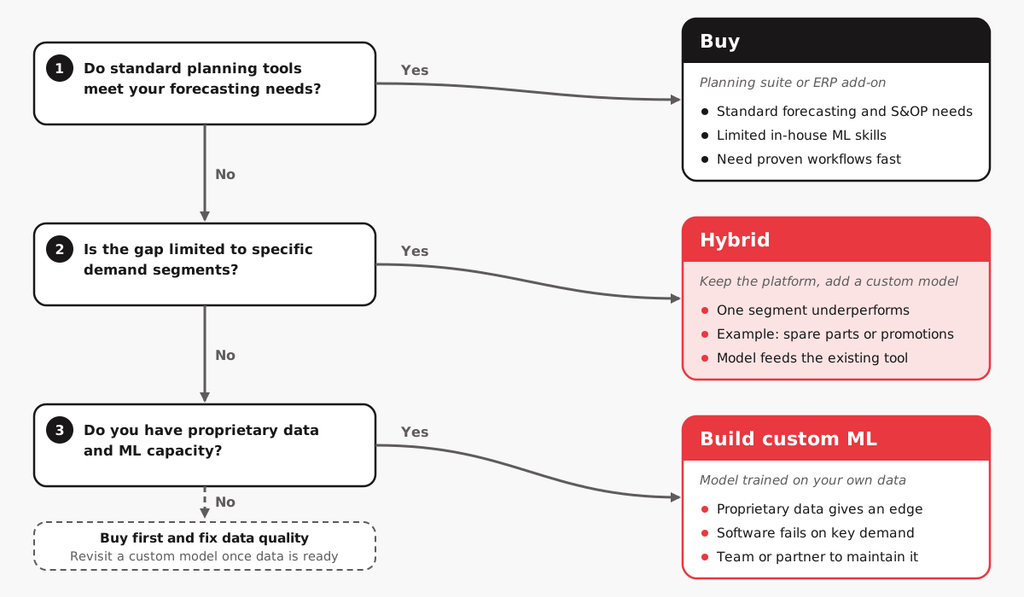
The right choice depends on a handful of factors:
- Forecasting and S&OP needs: How much of your process a standard tool already supports.
- Demand complexity: How many SKUs, locations, and demand patterns you forecast.
- ERP fit: Whether the tool works with SAP, NetSuite, Microsoft Dynamics, or your current inventory system.
- In-house skills: Whether you have data scientists and ML engineers to build and maintain a model.
- Total cost: Licensing compared with developing and maintaining a model over time.
- Special demand signals: Whether your business relies on data or logic a standard tool can’t use.
What does demand forecasting software actually do?
Demand forecasting software analyzes past demand to predict future demand, usually down to the SKU and location level, and then helps planners turn those forecasts into inventory and production decisions. Most demand planning software also adds review workflows, S&OP collaboration, and data exchange with your ERP.
A typical platform covers:
- Historical demand analysis and time-series forecasting.
- Forecasts at SKU and location level, adjusted for seasonality, trends, and variability.
- Statistical and machine learning forecasting methods.
- Inventory and replenishment planning, including safety stock recommendations.
- Forecast review, manual adjustments, and S&OP workflows.
- Data exchange with your ERP.
Manufacturers often confuse demand forecasting and demand planning. Both are different and matter to your buy or build decision. Demand forecasting means predicting the future demand of your products. Whereas demand planning turns that forecast into planning and operations. In short, how to prepare for that forecast and respond to any unpredictable demands that even AI can’t suggest.
A forecasting model on its own doesn’t give you inventory planning or planner workflows. A complete platform does.
Planning suites vs. custom ML models: what’s the difference?
A planning suite gives you ready-made forecasting methods, workflows, and integrations that the vendor maintains. A custom ML model gives you control over features, logic, and design, but your team or an ML development partner has to build, connect, and maintain it. The trade-off is speed and convenience against control and fit.
| Factor | Planning suite | Custom ML model |
| Forecasting methods | Vendor-supported statistical and ML methods | Methods chosen and trained for your specific problem |
| Customization | Limited to supported configuration and extensions | Full control over features, logic, and model design |
| Data requirements | Depend on the platform and methods used | Depend on the model, demand patterns, and available features |
| ERP integration | Existing connectors may be available; verify compatibility | Must be designed and maintained |
| Planning workflows | Usually includes planning, review, and collaboration | Must connect to your current workflow or be built separately |
| Maintenance | Vendor maintains the platform; you manage configuration and data | Your team or partner maintains the model and data pipeline |
| Ownership and control | Governed by the vendor’s product and contract | More control over model code and architecture, subject to contract terms |
| Cost | Subscription, licensing, configuration and integration | Development, infrastructure, integration and ongoing maintenance |
Large planning suites such as Kinaxis, o9, and Blue Yonder suit complex, multi-site operations. Many mid-size manufacturers start with forecasting built into their ERP or a lighter add-on tool, which matters for demand forecasting for manufacturers on ERP.
Is AI demand forecasting better than statistical forecasting?
Not automatically. AI demand forecasting helps most when demand depends on many interacting factors. Statistical methods such as ARIMA often work just as well for stable or seasonal demand. The best approach can differ from one SKU group to the next.
In a typical manufacturing portfolio:
- Stable, recurring demand for standard components is often handled well by statistical models.
- Seasonal demand for certain product lines can be modeled with statistical methods or tools such as Prophet.
- Irregular demand for spare parts needs methods built for intermittent demand, and is often where general tools struggle.
- Demand shaped by promotions, customer orders, or external factors is where machine learning demand forecasting, such as gradient boosting, can add value.
Compare methods fairly by testing them on the same historical data, forecast horizon, and level of detail.
How should you measure demand forecasting accuracy before buying?

Measure accuracy on your own historical data, at the level you actually plan, using more than one metric. A single headline accuracy number hides where a forecast fails. Ask each vendor to run a backtest on representative history and compare the results against your current forecasts.
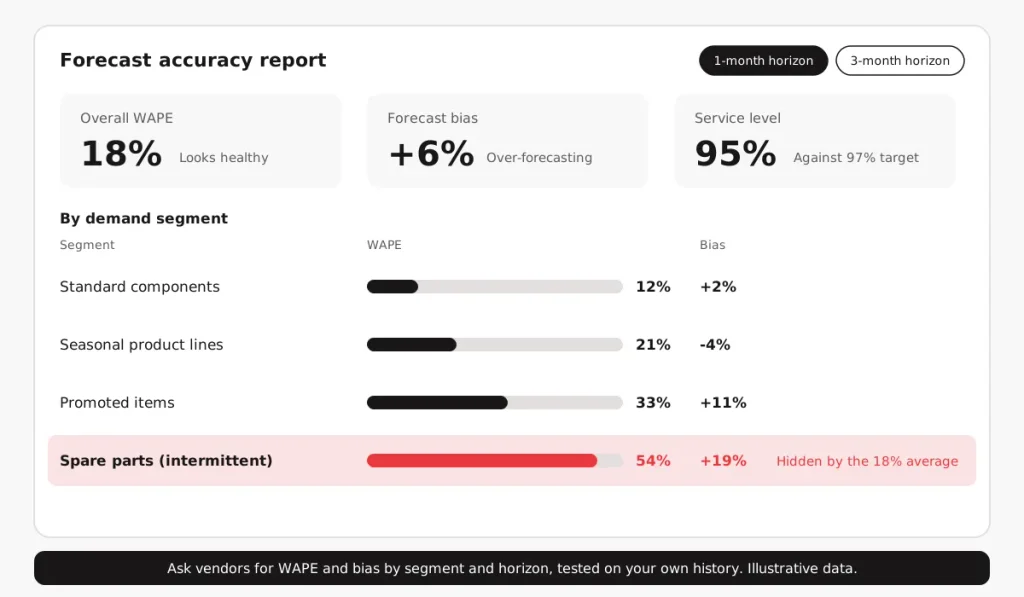
Here are all the key metrics to measure the accuracy of AI demand forecasting software you are planning to purchase:
| Metric | What it tells you | What to watch |
| MAPE | Average percentage forecast error | Becomes misleading when actual demand is zero or very low |
| WAPE | Total absolute error relative to total actual demand | Good for overall comparisons, but can hide poor results on individual SKUs |
| Forecast bias | Whether forecasts consistently run high or low | Both directions cost money, through excess stock or stockouts |
| Service level | Whether inventory meets customer demand | Links forecast quality to fulfillment |
| Stockouts and excess inventory | The operational result of forecasting decisions | Shows business value beyond model accuracy |
What MAPE is good for demand forecasting?
There’s no single target. An acceptable MAPE depends on how variable demand is, the product category, the forecast horizon, and how much an error costs your business. A fast-moving standard part and a rarely ordered spare part shouldn’t be held to the same number.
Before you buy, ask vendors to show:
- Accuracy by SKU, product family and location.
- Accuracy across different forecast horizons.
- Results on intermittent and seasonal demand.
- Forecast bias, not just error.
- Results against your existing baseline.
- The effect on stockouts, excess inventory, and service levels.
To go further, see how teams reduce demand forecasting errors once a model is in place.
How much data do you need for machine learning demand forecasting?
There’s no universal minimum number of months or records you need for machine learning forecasting. It depends on how often demand occurs, seasonality, the forecast horizon, data quality, and the model you test. Data quality usually matters as much as volume.
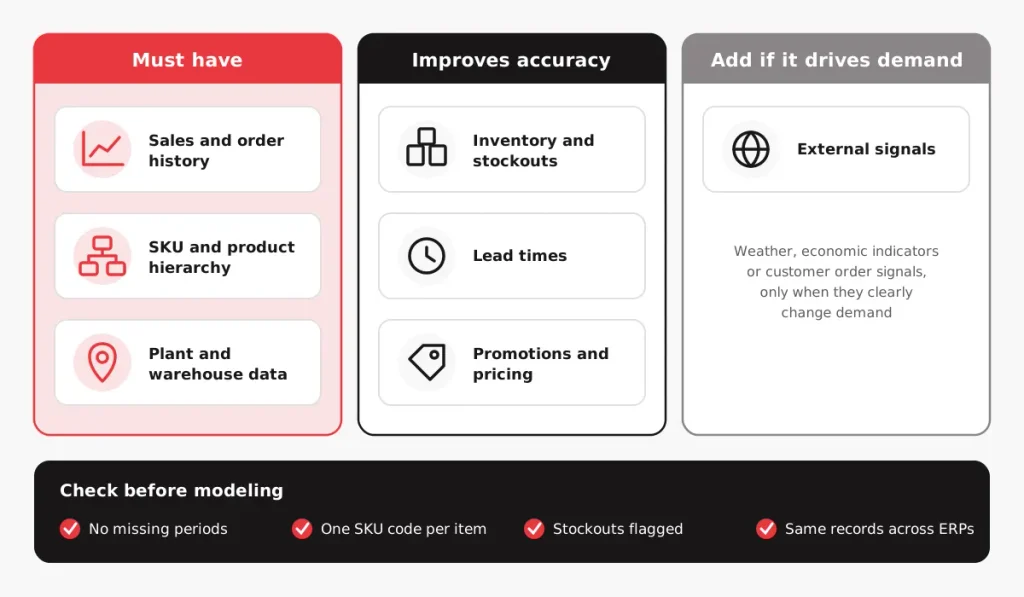
Data worth assessing includes:
- Historical sales and order data.
- SKU and product hierarchy.
- Plant, warehouse and location information.
- Inventory and stockout history.
- Lead times and replenishment records.
- Promotions, pricing and customer order patterns, where relevant.
- External factors, if they clearly influence demand.
Common data problems can distort a forecast:
- Missing periods and inconsistent SKU codes.
- Stockouts that make recorded sales look like lower demand.
- Product launches and discontinued SKUs.
- Changes in product mix or operations.
- Records that don’t match across ERP systems.
Can manufacturers use existing ERP data for demand forecasting?
Yes, as a starting point. Check whether it captures true demand, stockouts, lead times, and the other inputs the forecast needs. An ERP connection doesn’t make the data forecasting-ready.
What does it take to build a custom ML demand forecasting model?
Building a custom demand forecasting model means defining a clear forecasting problem, proving a model beats your current baseline, and then running it inside your planning process for the long term. The model is only part of the work. Data preparation, integration, and ongoing monitoring take as much effort.
A typical build follows seven stages:
- Define the problem and the demand segments where current tools fall short.
- Audit historical data and identify usable demand signals.
- Set a baseline using a statistical method or your current forecast.
- Test ML methods against that baseline.
- Evaluate accuracy, bias, and operational outcomes.
- Connect the chosen model to your ERP and planning workflow.
- Monitor performance and retrain as demand changes.
Plan for feature engineering, backtesting, ERP integration, model monitoring, and clear internal ownership. Timelines depend on data readiness, the number of demand segments, and integration complexity, so scope them after a data audit rather than accepting a fixed estimate.
Softude creates custom machine learning models for production planning and forecasting. For a global truck and bus manufacturer with more than 100 spare-parts warehouses, we built an AI model that forecasts demand for each spare part. As a result, their inventory holding costs reduced from $25 million to $9 million within a few months, and stock forecasting errors dropped up to 50%.
Choosing the right demand forecasting path
The right choice starts with evidence, not a preference for buying or building. Most manufacturers get the fastest value from a proven planning tool and add custom models only where their own data shows a real gap.
If you’re unsure where your forecasts fall short, Softude’s data science and machine learning consulting can assess your forecasting problem and test a model on your own sales history.
FAQs
What is the best demand forecasting software for a mid-size manufacturer?
There’s no single best tool, but most mid-size manufacturers shortlist from three groups. ERP-native options include NetSuite Demand Planning and Microsoft Dynamics 365 Supply Chain Management. Mid-market add-ons include Netstock, GMDH Streamline, Smart IP&O, John Galt Atlas Planning, and Logility. Larger suites such as SAP IBP, Kinaxis Maestro and o9 usually suit bigger, multi-site operations. Compare a shortlist of demand forecasting tools by backtesting each on your own history.
How accurate is AI demand forecasting?
Accuracy of AI demand forecasting depends on your data and demand patterns, not the label. It can outperform simpler methods on complex demand but may add little for stable products. Measure it with MAPE, WAPE, and bias on your own history.
When should a manufacturer replace spreadsheet-based forecasting?
Replace your spreadsheets when SKU and location counts grow, planners spend more time updating files than reviewing forecasts, or accuracy stalls despite effort. Moving to dedicated software also adds bias tracking, audit trails, and S&OP workflows that spreadsheets lack.
Can AI help with inventory forecasting, not just demand?
Yes. AI inventory forecasting uses demand forecasts to recommend reorder points, safety stock, and replenishment quantities. It works best when inventory, lead time, and stockout data are accurate.
Do we need a data science team to build an AI forecasting model?
Yes, you need data science and ML engineering skills, in-house or through a partner, to build and maintain a custom model.