Softude
Agentic AI for accounts payable, fraud investigation, and credit and insurance underwriting are the most production-ready AI use cases in financial services. Each combines high volumes of document-heavy decisions with measurable unit costs. Agents deliver returns when connected to systems of record, with human supervision on regulated decisions, and governed under 2026 rules.
Key highlights
- Fintech AI agents add value after an alert, application or invoice arrives: investigating, verifying and preparing the decision.
- 72% of surveyed Australian lenders use agentic AI to support underwriters, yet only 3% say their data is fully ready.
- The average invoice costs $9.90 to process, while best-in-class AP teams reach $2.67, so unit costs set the ROI.
- SR 26-2 excludes agentic AI, so govern agents through existing risk practices and keep humans on regulated decisions.
- Start with accounts payable or fraud triage; add underwriting once data quality, governance, and audit logging are proven.
Which AI agent use cases in financial services are most proven?
Fraud investigation, underwriting support, and accounts payable (AP) are a few top-tier AI agent use cases in financial services. Each pairs high volumes of repetitive, document-heavy work with a clear unit cost, whether per alert, per loan file, or per invoice. That makes a baseline easy to measure and a return easy to test.
The surveys show strong appetite. NVIDIA’s 2026 State of AI in Financial Services survey of 800+ professionals reports that 89% say AI has increased revenue or decreased costs, with fraud detection among the most common use cases.
Experian’s January 2026 report found 84% of surveyed financial institutions rate AI as critical or a high priority over the next two years, and 89% expect it to play a critical role across the lending lifecycle.
| Use case | What the agent does | Regulatory exposure | Data complexity | Time to value | Typical first deployment |
| Fraud investigation | Investigates flagged alerts, drafts the case, recommends an action | Medium: upstream scores fall under model risk rules; account actions need human sign-off | High: payment streams, device, KYC and case data | Fast to medium | Alert triage and case summaries, read-only |
| Underwriting support | Assembles and verifies the file, checks policy, drafts the credit memo | High: fair lending, adverse action, GSE and EU AI Act rules | Medium to high: unstructured documents plus bureau and bank data | Medium to slow | Document intake and file summaries for underwriters |
| Accounts payable | Captures invoices, matches to POs and receipts, resolves exceptions, verifies vendor changes | Lower: internal controls and third-party risk | Medium: depends on PO and vendor data quality | Fast | Invoice capture and exception handling, with payment release left to the existing approval workflow |
How do fintech AI agents improve fraud detection in financial services?

AI agents improve fraud detection by taking over the investigation that follows an alert. They pull account, device, and transaction history, link related activity, draft the case, and recommend an action. Existing machine learning models still flag the risk; the agent shortens the time and analyst effort between a flag and a decision.
What capabilities does a fraud detection AI agent need?
A production AI agent for fraud detection needs five capabilities: alert triage, evidence gathering, link analysis, case drafting, and recommended actions.
- Alert triage that ranks cases by exposure and confidence.
- Evidence gathering across core banking, card, device, KYC, and payment data.
- Link analysis to spot mule accounts, shared devices, and synthetic identities.
- Case narratives and draft suspicious activity reports for analyst review.
- Recommended actions, such as a hold or a step-up authentication challenge on the customer’s next session or transaction, within set thresholds.
Can fintech AI agents help with scams and money laundering investigations?
Yes. Agents suit scams and anti-money laundering (AML) work because both depend on assembling evidence from several systems quickly. Scam payments are hard for transaction scores to catch when the customer approves the payment, so agents add value by combining payee history, recent account changes, and behavioral signals to prioritize cases for intervention.
According to Australian cybersecurity magazine, Commonwealth Bank of Australia deployed an agent that detects emerging fraud and scam patterns and proposes detection rules. The bank reported that its fraud detection technology helped cut fraud losses by more than 20% in the first half of FY2026.
What are the risks of AI agents in fraud detection?
The biggest risk is an agent acting on a false positive and blocking a genuine customer. Confidence thresholds and human sign-off on account actions contain most of the others.
- Wrongly freezing legitimate accounts or payments.
- Over-permissioned tools that let the agent act beyond its role.
- Prompt injection through free-text fields such as payment memos.
- Drift as fraud patterns change.
What integration does an AI agent need for fraud detection?
A fraud agent needs live access to real-time payment streams (card, ACH, instant payments), the transaction monitoring system, case management, core banking, and identity data. Start with read-only access and add narrowly scoped write actions later. The agent should work after the risk score, not inside the sub-second authorization path, so any action on a live transaction stays with the scoring layer.
What are the compliance requirements for fintech AI agents in fraud detection?
AI agents for fraud detection need the same controls as the people and systems they work alongside. Five matter most:
- SOC 1 and SOC 2: any vendor that supplies or hosts the agent should hold a current SOC 2 Type II report, and a SOC 1 Type II where the agent touches financial reporting. These are independent attestations, not certifications, and Type II shows controls worked over a period.
- Separation of duties: the agent that investigates a case should not also approve the action. Flagging, investigating, and releasing funds stay separate roles with separate permissions.
- Human-in-the-loop thresholds: set limits on what the agent may decide alone, by amount, risk score, and customer impact. Account freezes, large holds, and suspicious activity report (SAR) filings stay with people.
- SAR confidentiality: if the agent drafts SARs, restrict who and what can read that content and set log retention for its prompts and outputs with your compliance team.
- Audit trails and data residency: log every data source read, tool called, and recommendation made, and keep sensitive personal and transaction data within the regions and models your privacy obligations allow.
How do insurance AI agents speed up credit and insurance underwriting?
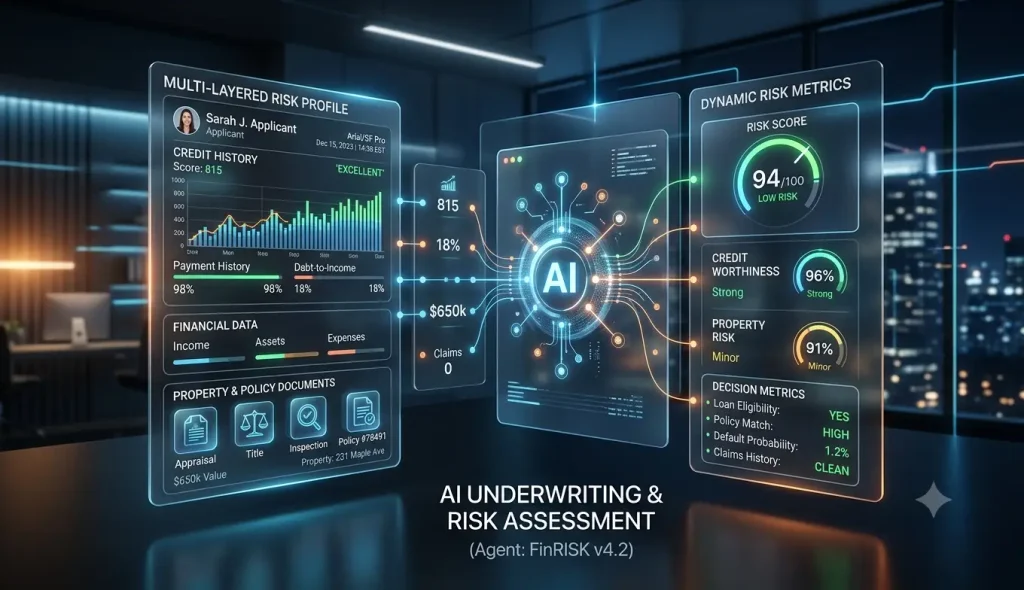
AI underwriting agents assemble and verify the file. They extract income, asset, and business data from documents, check it against bureau and bank data, apply the lending or underwriting policy, screen for origination fraud, and draft the credit memo. A human underwriter still decides, but works from a complete, pre-checked file.
Lenders are moving, but data readiness lags. Experian’s August 2026 Connected Intelligence research found that 72% of 102 surveyed Australian lenders use agentic AI for underwriting decision support, while only 11% say AI is widely implemented across underwriting. Only 3% say their data is fully ready for AI-driven decisioning. Insurers follow the same pattern, using agents for submission intake, risk data gathering, and underwriting summaries.
How do AI underwriting agents compare with traditional underwriting?
Traditional underwriting pairs rules-based automated systems with manual document review. Rules engines handle clean, standard files well but push anything unusual back to people, such as self-employed income, thin credit files, or complex commercial risks. Insurance AI agents for underwriting read unstructured documents, reconcile conflicting figures, and explain what they found, so fewer files stall waiting for a human to start from scratch.
What can an AI underwriting agent do?
An underwriting AI agent covers five tasks, from document intake to the draft credit memo:
- Document intake and classification: reads and sorts pay stubs, bank statements, tax returns, financial statements, and insurance submissions.
- Income, cash-flow and asset verification: checks applicant figures against third-party data.
- Policy and guideline checks: tests each file against the current, versioned rulebook.
- Origination fraud screening: catches altered documents and synthetic identities before approval.
- Credit memo and summary drafting: prepares a draft with a clear reason and source document for each finding.
The value is highest where files are messy: small business and commercial lending, self-employed borrowers and complex insurance submissions.
A Canadian bank launched an agentic AI model for mortgage and HELOC applications that prepares summary memos for underwriters, reducing pre-adjudication time from an average of 15 hours to under three minutes, while improving accuracy and lowering the unit cost of adjudication. These are bank-reported figures for one stage of one process. The agent classifies documents, extracts data, validates it against policy, and flags discrepancies, and human underwriters still make the decision.
What are the risks of insurance AI agents in underwriting?
The main risks of using insurance AI agents for underwriting are inaccurate outputs, unfair outcomes, and decisions no one can explain. They matter more than in back-office work because credit and coverage decisions directly affect people and carry legal obligations.
- Invented or wrong figures: an agent can misread a document or fill a gap with a plausible but false number. Every figure in the memo should link back to its source document.
- Biased outcomes: an agent trained or prompted on skewed historical data can treat similar applicants differently, so outcomes need regular fairness checks.
- Unexplainable denials: lenders must give specific reasons when they decline credit, and an agent that cannot show its reasoning leaves the lender unable to meet that duty.
- Outdated policy checks: underwriting guidelines change often, so policy sources need version control.
- Too much autonomy: an agent that approves or declines on its own removes the human judgment that supervisors expect. Keep agents in an assist-and-recommend role, with a named human decision-maker.
What integration does an AI underwriting agent need?
An insurance AI agent for underwriting needs connections to the loan origination system, core banking, credit bureaus, cash-flow data providers, and document management. Insurers add the policy administration system and underwriting workbench. Start with read access to these sources and write back only summaries and flags into the underwriter’s existing workbench.
How does agentic AI for accounts payable cut costs and payment fraud?

Agentic AI for accounts payable reads invoices in any format, matches them to purchase orders and receipts, resolves mismatches by checking records or contacting vendors, and routes only true exceptions to people. Because it also verifies vendor bank-detail changes, it closes a common route for payment fraud: the fake request to update payment details.
AP belongs in a financial services discussion for two reasons. Banks, insurers and lenders run AP as their own back office, and fintechs that sell payables products manage the same invoice-to-payment workflow for their customers.
Ardent Partners’ AP Metrics that Matter in 2026, a cross-industry survey of 194 AP, finance, and procure-to-pay leaders, reported that 58% of AP teams use or pilot AI, while just 1% run it as a core capability. That gap is where the return sits.
How does agentic AP compare with traditional AP automation?
Traditional AP automation relies on template-based capture and fixed matching rules. It works for known vendors and clean invoices, then breaks on new formats and sends every variance to a human queue. An AP agent handles format changes, reasons through price or quantity mismatches, follows up with vendors, and escalates only what needs judgment.
What can an AP AI agent do?
An AP agent covers six tasks, from invoice capture to payment scheduling:
- Invoice capture from email, portals, and paper, in any layout.
- Two- and three-way matching at line level against purchase orders and goods receipts.
- Exception resolution for price, quantity, and missing-receipt variances.
- Vendor communication for missing data and payment status queries.
- Independent verification of any vendor bank-detail change.
- Payment scheduling within approval limits and discount windows.
What are the risks of agentic AI in accounts payable?
A poorly controlled agentic AI for accounts payable can pay the wrong invoice faster. Other failure modes that deserve design attention are:
- Fraudulent invoices paid before anyone checks them.
- Duplicate payments.
- An agent that can both edit vendor data and release payments, which breaks segregation of duties.
What integration does an AP AI agent need?
An accounts payable AI agent needs four integrations, and each gives it a way to catch fraud as well as process invoices.
- Bidirectional ERP integration: the agent reads purchase orders, invoice history, and payment records from the ERP (such as SAP, Oracle, or Microsoft Dynamics) and writes coded invoices and exceptions back. With full history in view, it spots duplicate invoices, unusual amounts, and bills from vendors with no purchase record.
- Three-way matching sync: a live link between purchase orders, goods receipts and invoices confirms that what is billed was ordered and delivered, so inflated quantities and quiet price changes surface before payment.
- Banking and payment rails: connections to ACH, wire, virtual card and instant payment rails let the agent check the destination account against the approved vendor record before release, and flag rushed or out-of-pattern requests that suggest business email compromise.
- Master vendor file management: the agent watches every change to bank details, addresses, and contacts, and triggers verification through a known contact before any change takes effect.
Payment release should still run through the existing approval workflow, never through a direct write from the agent.
Softude built an AI-driven AP automation system that processed about 1,000 invoices a month by hand and keyed them into SAP. The system processed invoices 70% faster, with estimated returns of 40x.
Should you build, buy, or partner for financial services AI agents?
Buy an AI agent when the use case is standard and speed matters. Build or partner with an AI agent development company when integration, data residency, or differentiation make off-the-shelf tools a poor fit.
| Route | Best when | Watch for |
| Extend your existing platform (the agent features your fraud, AP or loan origination vendor already ships) | The vendor’s agent covers your workflow and runs inside your current stack | Dependence on the vendor’s roadmap; limited control over prompts, thresholds, and logs |
| Buy a point solution | The use case is standard and well defined, such as invoice capture, and you need to move fast | Another integration and vendor to govern; data may leave your environment |
| Build or partner for a custom agent | You have legacy cores, unusual workflows, strict data residency, or agent logic that is core to your advantage | Higher upfront effort; you own evaluation, monitoring, and governance evidence |
Whichever route you choose, vendors fall inside your governance. Ask every AI agent vendor five questions before you commit:
- Can we export decision logs showing sources read, tools called, and who approved each action?
- Can we set and change confidence thresholds and approval limits ourselves?
- Where is our data processed, and which models can see it?
- Can we run the agent in shadow mode on our own data before go-live?
- Who owns evaluation and drift monitoring after launch?
How can Softude help you deploy AI agents in financial services?
Softude helps banks, lenders, insurers, and fintechs move AI agents from pilot to production by handling the parts that decide ROI: the use case, the integration, and the governance. We combine AI agent development services with the enterprise engineering, cloud and cybersecurity work that agents depend on in regulated environments.
- Use-case and readiness assessment: we size fraud, underwriting, and AP agents against your current unit costs, and check data quality, system access, and governance gaps before anything is built.
- Agent design with humans in the loop: we set confidence thresholds, approval limits, and escalation paths so agents act only where your risk appetite allows.
- Integration with your systems of record: we connect agents to core banking, loan origination, policy administration and ERP platforms through secure APIs, starting read-only.
- Governance and evidence: we build decision logs, AI inventory entries, and controls mapped to the rules in your jurisdiction, so audits do not mean rebuilding evidence afterward.
- Delivery discipline: our work runs under CMMI Level 5 and ISO 27001 practices, and our AP automation case study shows the integration approach in a SAP environment.
Final thoughts
AI agents pay back in fraud, underwriting, and AP when they are wired into systems of record, kept under human control on regulated decisions, and measured against a clear baseline. Start with the use case with the lowest regulatory exposure and the clearest unit cost to prove value, build governance evidence, and earn the right to extend autonomy. To size the opportunity in your own operations, talk to our AI team about where an agent would pay back fastest in your operations.