Softude
Enterprise AI discussions often blur the lines between chatbots, RAG, and AI agents. Vendors treat them as interchangeable options, but they solve fundamentally different architectural problems. A chatbot manages conversation, RAG provides retrieval-grounded knowledge access, and an AI agent takes autonomous action.
Selecting the wrong architecture leads to costly re-engineering. Choosing the right stack depends on three factors: required data access, decision autonomy, and direct system action capability.
Difference Between AI Agent, RAG, and Chatbot
| Feature / Metric | Chatbot Interface | RAG System | Deterministic Workflow | AI Agent Framework |
| Primary System Role | Natural language interface | Knowledge retrieval & grounding | Rule-bound process automation | Goal-driven task execution |
| Data Engine & Sources | Parametric weights & session memory | Vector DBs & hybrid search indexes | Relational SQL/NoSQL databases | Function-calling APIs & tools |
| Execution Loop | Single-pass generation | Search Augment Generate | Fixed conditional state machine | Plan Execute Observe Iterate |
| Tool Execution Power | Read-only text formatting | Read-only search | Read/Write (static logic) | Read/Write (dynamic tool selection) |
| Main Failure State | Token drift & hallucinations | Missing retrieval context | Unhandled edge-case exception | Runaway execution loops |
What Is a Chatbot?
A chatbot manages natural language conversation. It takes user prompts, processes context, and returns a generated response. Modern LLM-based chatbots interpret nuanced language and maintain short-term session state.
- Under the Hood: Composed of an API gateway, a session store (like Redis) to manage state, and a foundation model inference endpoint.
- What It Solves: High-volume, structured interactions such as answering customer service FAQs, guiding employee onboarding, or running internal HR helpdesks.
- Limitations: Answers rely entirely on what the core model learned during training. Without custom integrations, a basic chatbot cannot access private company files, real-time records, or external system tools. Better prompt engineering does not solve this gap.
- Example: Duolingo Max uses OpenAI’s GPT-4 to power features like “Explain My Answer” and “Roleplay.” It operates as a conversational interface, evaluating user input during language lessons and offering tailored grammar feedback directly from its prompt context window without fetching external user databases or calling write APIs.
What Is RAG (Retrieval-Augmented Generation)?
RAG is an architectural pattern that connects a foundation model to external data sources, including policy libraries, technical wikis, support logs, and databases.
When a query comes in, RAG retrieves relevant document passages first, then passes them to the LLM to write an answer grounded in verified corporate data. RAG is important to build a smart chatbot.
- Under the Hood: Combines document chunking tools, embedding endpoints, vector databases (such as Pinecone or pgvector), hybrid keyword/semantic search, and re-ranking models.
- What It Solves: Delivers accurate answers from proprietary, frequently updated internal knowledge while reducing hallucination risks.
- Limitations: RAG retrieves and synthesizes text. It does not execute actions, make dynamic decisions, or run external system workflows.
- Example: Microsoft Learn’s “Ask Learn” is a large-scale RAG-based knowledge service built to generate answers from Microsoft Learn documentation. When a user asks a question, the system identifies relevant portions of Microsoft Learn content and supplies that retrieved documentation to an LLM, allowing it to generate an answer grounded in the underlying technical documentation rather than relying solely on the model’s pretrained knowledge.
What Is an AI Agent?

An AI agent combines an LLM reasoning core with system tools (APIs, databases, software connectors) and an iterative execution loop (such as ReAct or Plan-and-Solve). While a chatbot responds and a RAG system retrieves, an AI agent acts.
- Under the Hood: Uses structured tool definitions (JSON Schemas), execution state graphs, telemetry/tracing layers, short/long-term memory stores, and guardrails.
- What It Solves: Executes multi-step tasks across isolated business systems such as processing a return, adjusting customer accounts, or scheduling cross-platform tasks without human handoffs.
- Limitations: Unconstrained agent loops can encounter infinite execution chains, API retry costs, or unhandled edge-case failures if governance boundaries aren’t set.
- Example: Shopify Sidekick is an embedded merchant AI agent. Instead of simply generating answers, Sidekick processes goal-oriented requests such as “Set up a 10% spring discount and segment active buyers.” The reasoning engine formulates a plan, selects Shopify GraphQL/REST APIs, executes system state updates, and presents confirmation back to the merchant dashboard.
Agentic AI vs Generative AI: What Is the Difference?
Generative AI provides the reasoning and synthesis engine, while Agentic AI serves as the operational orchestration layer that puts that intelligence to work across enterprise systems.
- Generative AI focuses on content creation, summarization, and data synthesis. It operates reactively: a human provides a prompt, and the model produces text, code, or images. The output represents the end of the interaction.
- Agentic AI focuses on autonomous task completion. Given an overarching goal, an agentic system evaluates conditions, plans multi-step actions, invokes software tools, and adapts its behavior based on environmental feedback.
Comparison of AI Architectures
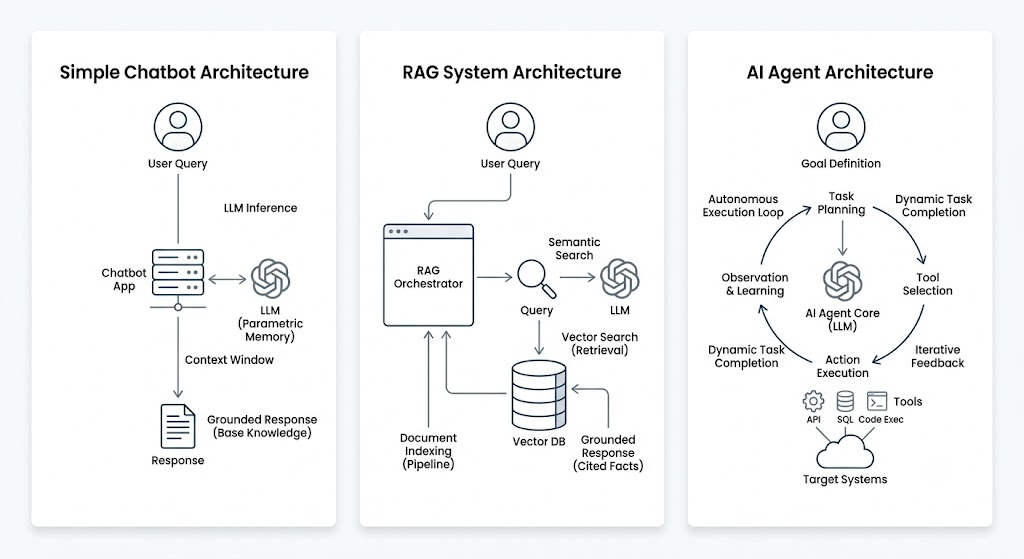
The images above clearly distinguish the operational flow of each system:
- Simple Chatbot: A linear, single-pass system that takes a query, runs it against the LLM’s parametric memory, and provides an answer. (READ ONLY: parametric memory).
- RAG System: A structured knowledge pipeline that retrieves relevant context from external indices (like a Vector DB) to augment the prompt before generation. (READ ONLY: external knowledge).
- AI Agent: An autonomous execution loop. The agent core reasons over a goal, selects tools, takes multi-step actions, observes feedback, and iterates until the goal is achieved. (READ/WRITE: dynamic systems).
Can You Combine Chatbots, RAG, and AI Agents?
Yes. Mature enterprise AI deployments layer these patterns into a unified architecture:
- Chatbot + RAG: The chatbot handles natural conversation while RAG pulls real-time corporate documents to ground responses.
- RAG + Agent: The agent uses RAG as a read tool to look up policy guidelines or account histories before calling write APIs to execute a task.
- Chatbot + RAG + Agent + Deterministic Workflow: A chat front-end passes requests to an agent core. The agent searches data via RAG, hands transaction steps to a deterministic workflow, and routes queries to human operators when encountering safety thresholds.
How Do You Choose the Right Architecture for Your Business?

Work through these decision points to identify the right AI architecture:
- Does the use case only require natural language conversation? Use a Chatbot. Add RAG if answers must pull from private corporate files.
- Does the system need fresh, secure corporate knowledge? RAG is required. Prompting alone cannot supply an LLM with private internal records.
- Is the business process predictable and rule-bound? Use a Deterministic Workflow. Avoid agentic complexity where traditional code solves the problem.
- Does the task require dynamic decisions or system actions? You need an AI Agent with API tool access.
- What is the business impact of an incorrect action? Higher system autonomy requires stronger governance, rate limits, and audit logs. Gartner research projects that over 40% of enterprise agentic AI projects face cancellation risk by 2027 due to rising compute costs, loose permission controls, and unclear business metrics.
Building an AI Architecture That Scales
The ideal AI architecture is the simplest design that reliably solves your business problem while leaving room to scale.
If your team is working through architectural choices or evaluating enterprise AI deployments, Softude’s AI Team provides technical audits, system architecture design, and production engineering services. Reach out to schedule a technical session with our team.
Frequently Asked Questions
A chatbot operates in a simple conversational exchange: it receives text, queries context memory, and generates text output. An AI agent accepts an overarching goal, plans execution steps, invokes external system APIs, evaluates intermediate outcomes, and adjusts its actions until the task is complete.
RAG is an architectural retrieval pattern designed to fetch, rank, and insert reference context into an LLM’s prompt window. An AI agent is an execution framework that uses reasoning loops and function calls to interact with external tools. An agent often uses RAG as one of its internal lookup tools.
Generative AI deployments scale costs based on inference token volume during content generation. Agentic AI deployments introduce additional cost variables, including repeated multi-step LLM reasoning calls, vector database query volumes, and external API execution overhead across connected software tools.