Softude
Most businesses making AI strategies are solving the wrong problem. They spend months building a document, frameworks, vision statements, use case lists, and almost nothing happens after that. The strategy sits in a slide deck while teams keep running pilots that never ship.
According to Deloitte’s 2026 State of AI in the Enterprise report, 42% of organizations believe their strategy is well-prepared for AI adoption, yet only 34% are actually reimagining their business with it. That gap is the real problem.
This is not a framework problem. It is an execution problem.
What an AI Strategy Actually Is (and What It Isn’t)
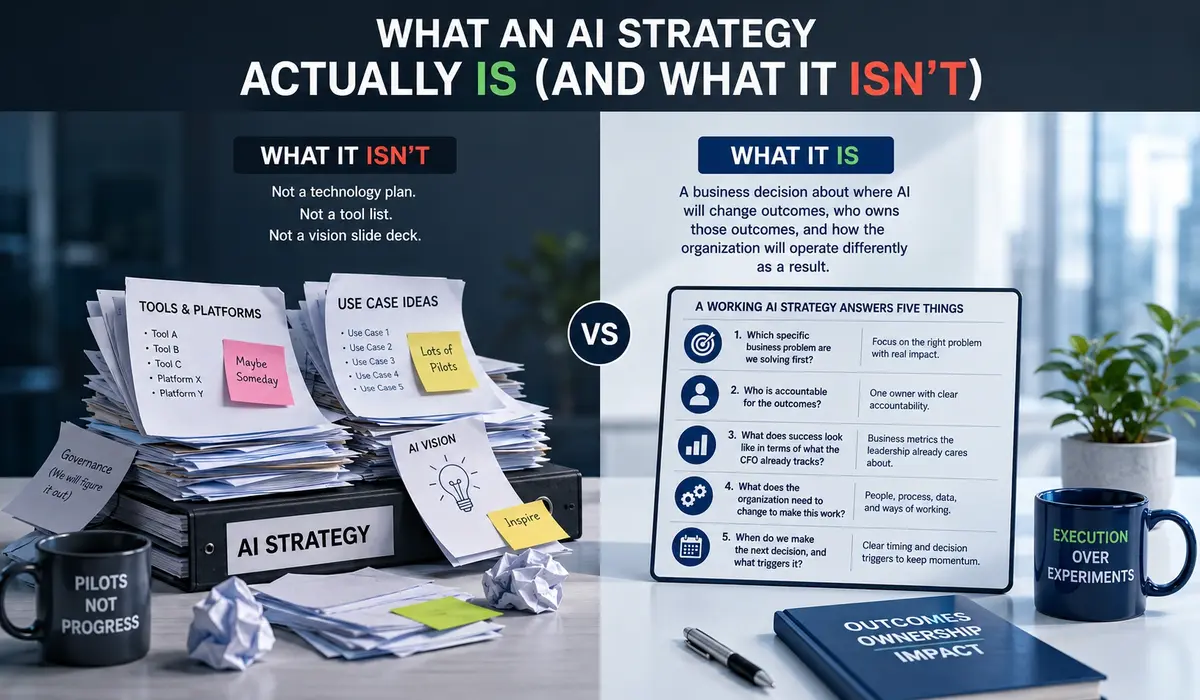
An AI strategy is not a technology plan. It is a business decision about where AI will change outcomes, who owns those outcomes, and how the organization will operate differently as a result.
Most strategies that fail are written as technology plans. They list tools, platforms, and use cases. They describe governance in the abstract. They set a vision but assign no one to execute it.
A working AI transformation strategy answers five things:
- Which specific business problem are we solving first?
- Who is accountable for the outcomes?
- What does success look like in terms of what the CFO already tracks?
- What does the organization need to change to make this work?
- When do we make the next decision, and what triggers it?
If your current strategy document cannot answer those five questions with specifics, it is a vision statement. Valuable for direction. Not sufficient for execution. Before building the strategy, conduct an AI readiness assessment for your business to understand whether to move ahead or not.
How to Build an AI Strategy for Your Business

1. Start with a Business Problem, Not an AI Use Case
The instinct is to ask: “Where can we use AI?” The better question is: “What is costing us the most in time, money, or customer satisfaction right now?”
Pick one. Dig into the actual process. Understand the data that flows through it. Then ask whether AI can change the outcome, not the activity.
This distinction matters. Automating a broken process with AI makes the problem faster. Fixing the process first, then applying AI, creates leverage.
2. Define Ownership With Budget Authority
AI strategies die in committees. They survive when one person, not a working group, not a task force, owns the outcome and controls the resources to act.
This person does not have to be a technologist. They need to understand the business deeply, have direct access to the decision-makers who control data and workflows, and be willing to make unpopular calls about prioritization.
3. Don’t Pilot Everything
Pilots are useful. Endless pilots are a waste. McKinsey’s research consistently shows that most organizations are stuck in the AI experimentation phase and cannot cross into production at scale.
The reason is usually not technical. It is political. Pilots are safe. Production means someone is accountable for results.
Set a hard rule: any AI initiative that cannot define its success metric in two sentences does not get funded. Any pilot that runs longer than 90 days without a go/no-go decision gets cut.
4. Fix the Data Before You Scale the AI
This is the step everyone knows, and almost no one does it properly. The AI transformation strategy framework is direct: data, models, and governance are the three building blocks, and data comes first for a reason.
Clean, accessible, well-governed data is not a technology problem. It is a process and ownership problem. Who is responsible for data quality in each business unit? What happens when data is wrong?
Start by auditing the two or three data sources most critical to your first AI use case. Fix those. Scale later.
5. Build the Operating Model Alongside the Strategy
The operating model is how the AI strategy for your business gets executed day to day: team structure, decision rights, how models get deployed, monitored, and retired. Most strategies define the “what” and skip the “how”.
According to SAP’s guide on AI strategy for business leaders, an effective operating model balances agility with control. Centralized AI teams move fast but create bottlenecks. Fully decentralized models move faster but fragment standards. The right model depends on business size and the maturity of AI adoption, but the decision must be made explicitly, not inherited by default.
6. Measure Business Outcomes, Not AI Outputs
Model accuracy is not a business metric. The number of AI tools deployed is not a business metric. Revenue impact, cost reduction, and customer retention are business metrics.
Set them before deployment. Measure them after. Report them to leadership the same way any other business initiative is reported. If the AI initiative cannot speak the language of business results, it will always be treated as an IT project.
The AI Transformation Strategy Execution Checklist

Before calling your AI strategy final, ask yourself these questions:
- Does each initiative have one named owner with budget authority?
- Is the first use case selected based on business pain, not technical interest?
- Is there a defined go/no-go date for each pilot?
- Are the data sources for the first use case audited and governed?
- Does the operating model define who approves, monitors, and retires models?
- Are success metrics defined in business terms, not technical terms?
If any answer is “no” or “not yet,” those are the gaps most likely to stop execution.
Quick Reference: Building Blocks of AI Strategy For Business
| Component | Common Mistake | What to Do Instead |
| Use case selection | Picking what’s technically exciting | Pick what’s causing the most business pain |
| Ownership | Assigning to a committee | Name one person with budget authority |
| Data readiness | Assuming it’s the IT team’s job | Audit and govern data for the first use case before anything else |
| Piloting | Running too many, too long | Hard 90-day limit with a go/no-go decision |
| Success metrics | Measuring AI outputs | Measure business outcomes only |
| Operating model | Letting it form by default | Define team structure and decision rights explicitly |
A Realistic Timeline: From Making to Executing AI Strategy
For organizations that are past the exploration phase and ready to move:
Weeks 1–2: Name the owner. Select the first use case based on business pain. Agree on the business metric that defines success.
Weeks 3–4: Audit the data for that specific use case, not the entire enterprise data estate. Just what this problem needs.
Month 2: Run the pilot. The definition is already written. Kill date is already set.
Day 90: Make the call. Scale, end, or re-scope.
Month 4 onward: Apply the model to the next use case. The second one moves faster because the AI infrastructure already exists.
Conclusion
An AI transformation strategy that gets executed is not about having the right framework. It is about making real decisions: picking one problem, naming one owner, setting a kill date, measuring in business terms, and redesigning work, not just deploying tools.
If you are struggling with building an AI strategy for your business, we help you cut through the tech hype and build simple, practical AI roadmaps that drive real results.
Whether you need help organizing your data, choosing the right tools, or training your team, our AI consulting services help you move past the testing phase and into the real world. Let’s work together to turn AI into a reliable engine for your business growth.
Frequently Asked Questions
What is an AI strategy for business, and why does it matter?
An AI strategy is a structured plan that defines where AI will create business value, who owns the outcomes, and how the organization will operate differently as a result. It matters because without it, AI investment fragments across disconnected pilots that never scale, generating cost without return.
How is an AI transformation strategy different from a digital transformation strategy?
Digital transformation is broader; it covers the entire shift to digital operations, culture, and business models. An AI strategy is a specific subset focused on where and how artificial intelligence creates value within that broader change. The two should be aligned, but an AI strategy can, and often should, be built and executed before a full digital transformation is complete.
How do you choose the right first use case?
Pick the problem that already has a financial cost attached to it. The best first use case sits at the intersection of three things: a clear business pain with a measurable baseline, enough quality data to work with, and a team that is motivated to change how the work gets done. Avoid use cases chosen because they are technically interesting. Choose ones where the business result, if achieved, would be immediately visible to leadership.
What is the biggest mistake businesses make when building an AI strategy?
Distributing ownership. When no single person is accountable for results, when responsibility lives in a steering committee or is shared across departments, difficult decisions do not get made. Pilots extend indefinitely. Investments do not get evaluated honestly. The most important structural decision in any AI strategy is assigning one named owner with the authority to act.
How long does it take to see ROI from an AI strategy?
For a well-scoped first use case, realistic ROI visibility is 6 to 12 months. There is a natural performance dip during implementation, where productivity may appear flat or slightly worse before improving. Setting this expectation with the board before the initiative begins prevents mid-cycle pressure that leads to premature pivots or abandonment.