Softude
As per McKinsey Global Survey, fewer than a third of organizations report successful AI adoption at scale ,and the gap between high-performing “AI leaders” and the rest keeps widening. The differentiator isn’t the technology. It’s the planning that comes before it.
An AI implementation roadmap is the bridge between AI ambition and operational reality. It translates high-level AI strategy into sequenced, measurable actions across people, processes, data, and technology, so that AI delivers actual business value, not just proof-of-concept demos.
This guide walks you through how to build one, whether you are leading an enterprise AI transformation or guiding a mid-sized organization through its first meaningful AI adoption.
Why an AI Implementation Roadmap Matters
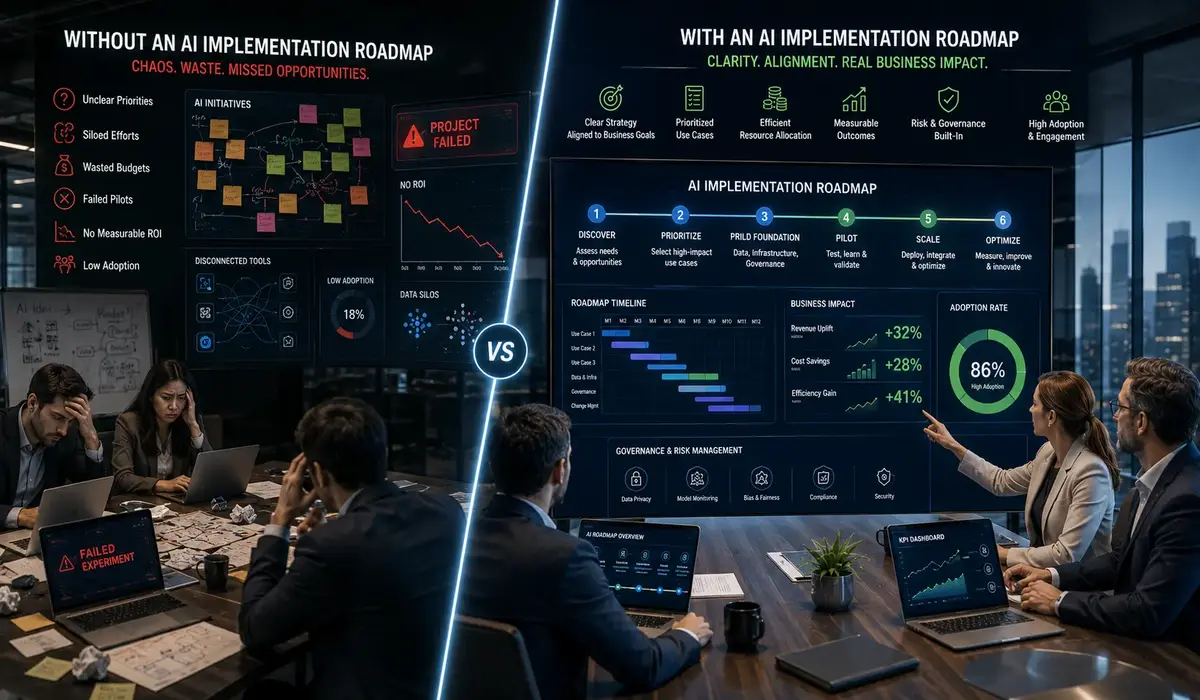
Without a roadmap, AI adoption tends to follow one of two failure patterns. Either the organization pursues every shiny new capability at once and achieves nothing meaningful, or it over-engineers a single solution in isolation and can’t scale it beyond the original team.
A well-constructed AI implementation roadmap solves both problems by:
Aligning stakeholders early. When business leaders, IT teams, and operations leaders share a common view of sequencing, priorities, and success metrics, the organization moves together rather than in competing directions.
Creating accountability. A roadmap translates abstract goals into defined milestones. It makes it clear who owns what, and when outcomes should be visible.
Managing risk systematically. AI carries real risks , including model reliability, data privacy, regulatory exposure, and workforce disruption. A roadmap builds in governance checkpoints rather than treating these as afterthoughts.
Connecting AI to ROI. Leadership teams that fund AI initiatives need to see a credible path to business impact. A structured roadmap is the artifact that builds that confidence.
AI Strategy vs. AI Adoption vs. AI Implementation
These three terms are often used interchangeably, which creates real confusion in planning conversations. They are distinct stages with different deliverables.
AI Strategy answers why and where. It defines the business objectives AI should serve, identifies the highest-value use cases, and sets the principles that will govern how the organization uses AI. Strategy is largely a leadership and executive function.
AI Adoption answers who and how willingly. It describes how broadly AI capabilities are being used across the organization ,the degree to which employees have integrated AI tools into their actual workflows, not just whether the tools have been deployed.
AI Implementation answers what, when, and how. It is the operational execution layer ,the specific projects, integrations, timelines, data requirements, and team structures needed to bring AI from strategy to practice.
You need all three in order. Organizations that jump to implementation without a clear strategy tend to build AI solutions that nobody uses. Organizations that have excellent strategy but weak implementation planning run endless pilots that never get to production.
What Does an AI Implementation Roadmap Include
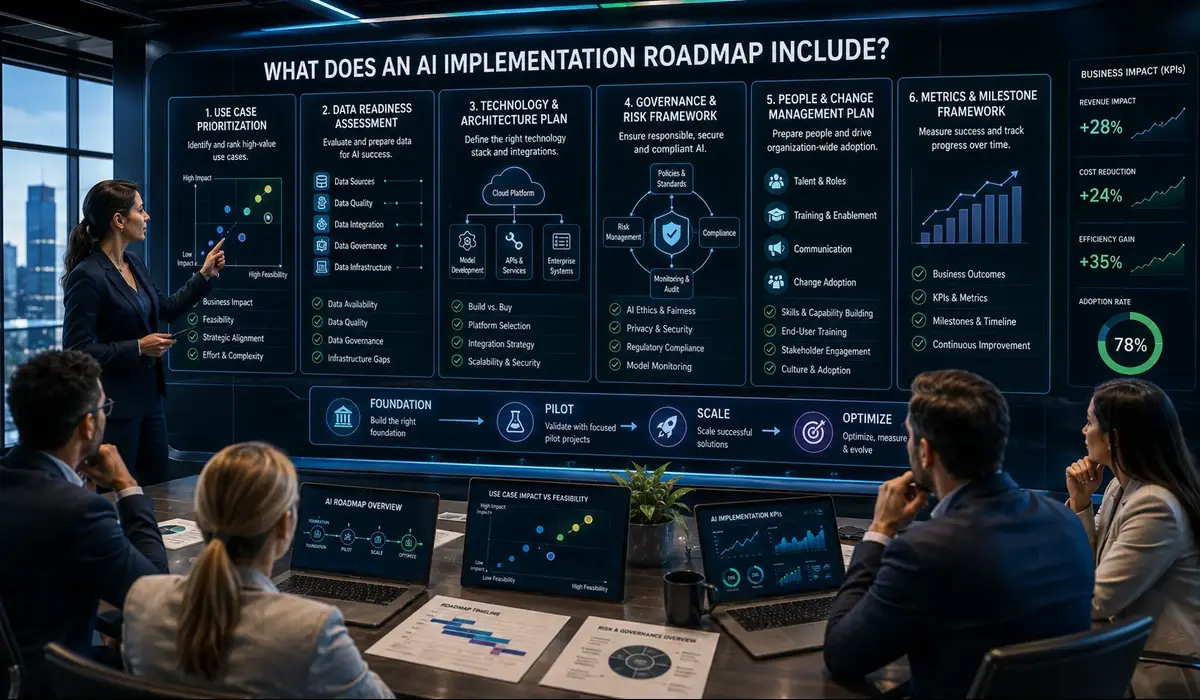
A credible enterprise AI roadmap typically includes six components working in combination:
- Use Case Prioritization: A ranked list of AI use cases evaluated against two dimensions: business impact and implementation feasibility. The highest-priority use cases typically sit in the upper-right quadrant of that grid: high value, realistic to execute.
- Data Readiness Assessment: AI is only as good as the data feeding it. This component maps what data exists, where it lives, how clean it is, and what data infrastructure work is needed before any model can be trained or deployed reliably.
- Technology and Architecture Plan: Covers build vs. buy decisions, vendor and platform selection (cloud AI services, foundation model APIs, fine-tuned models, or custom development), and how AI systems will integrate with existing ERP, CRM, and operational tools.
- Governance and Risk Framework: Defines who approves AI use cases, how models are monitored in production, how the organization handles AI errors or bias, and how it stays compliant with applicable regulations (GDPR, EU AI Act, sector-specific rules).
- People and Change Management Plan: Identifies the talent needed (internally or externally), the training required for end users, and the change management activities that drive actual adoption ,not just deployment.
- Metrics and Milestone Framework: Defines what success looks like at each stage. Metrics should be tied to business outcomes (revenue impact, cost reduction, process cycle time) rather than purely technical KPIs.
Step-by-Step AI Roadmap for Enterprises
Phase 1 Alignment and Discovery (Months 1–2)
The goal of this phase is to establish a shared baseline. That means running a structured AI readiness assessment across business, data, and technical dimensions; interviewing business unit leaders to surface the highest-priority problems AI could address; and aligning the executive team with measurable success.
A common mistake here is skipping the AI readiness assessment and moving straight to use case selection. If data infrastructure isn’t adequate, even the most compelling use case will stall in production.
Key deliverables: AI readiness report, use case longlist, stakeholder alignment workshop, executive brief.
Phase 2 Strategy and Use Case Prioritization (Month 2–3)
With alignment established, this phase defines the AI adoption strategy ,not just the tools to be deployed, but the sequencing logic. Use cases are evaluated on a structured grid (impact vs. feasibility), and a shortlist of two to four initial use cases is selected for the first implementation wave.
For generative AI implementation specifically, this is the phase to define appropriate guardrails: where generative AI is appropriate, where it isn’t, and how human review will be built into workflows.
Key deliverables: Use case prioritization matrix, generative AI adoption policy draft, phased implementation plan.
Phase 3 Foundation Building (Months 3–5)
This is often the least visible phase to senior leadership, but it is the most consequential. It covers the data infrastructure work (pipelines, governance, labeling), platform and vendor selection, security and compliance architecture, and the standing up of any internal AI competency functions.
Organizations that skip or rush this phase typically reach production deployment only to discover their data isn’t reliable enough to produce accurate outputs ,and they have to restart.
Key deliverables: Data infrastructure foundation, platform selection decision, security and compliance architecture, AI governance framework v1.
Phase 4 Pilot Execution (Months 4–7)
The first AI use cases go live in controlled environments. The focus here is not on perfection, it’s on learning quickly. Pilots should be scoped tightly enough to run in six to eight weeks, with clear success criteria defined in advance.
Change management begins in earnest during this phase. The people who will use these tools daily need to be involved, trained, and heard. Pilots that exclude end users from the design process almost always hit adoption resistance when they scale.
Key deliverables: Live pilot deployments, user feedback loops, pilot retrospective reports, and refined model performance baselines.
Phase 5 Scale and Integration (Months 7–10)
Successful pilots move to production. This phase is about hardening what works, integrating AI outputs into core business processes, building the monitoring infrastructure to catch model drift or degradation, and expanding to additional business units or user groups.
An AI agent implementation roadmap becomes particularly relevant here, as organizations often begin exploring autonomous AI workflows at this stage. Agent-based systems require additional governance attention; they take actions, not just generate outputs.
Key deliverables: Production deployments, integration with ERP/CRM/operational systems, monitoring and alerting infrastructure, and AI agent governance addendum.
Phase 6 Optimize and Expand (Months 10–12+)
The final phase of the initial roadmap cycle establishes continuous improvement processes. Performance data from production systems informs the next use case prioritization cycle. Organizational AI literacy expands through broader training. The AI governance framework is updated based on real-world operational learning.
This phase is also where organizations typically assess whether their internal AI capability is sufficient for the next phase of ambition, or whether external AI consulting services remain appropriate for specialized workstreams.
Key deliverables: Performance dashboards, updated use case backlog, expanded training programs, and AI roadmap version 2.
How Mid-Sized Organizations Can Build a Successful Roadmap
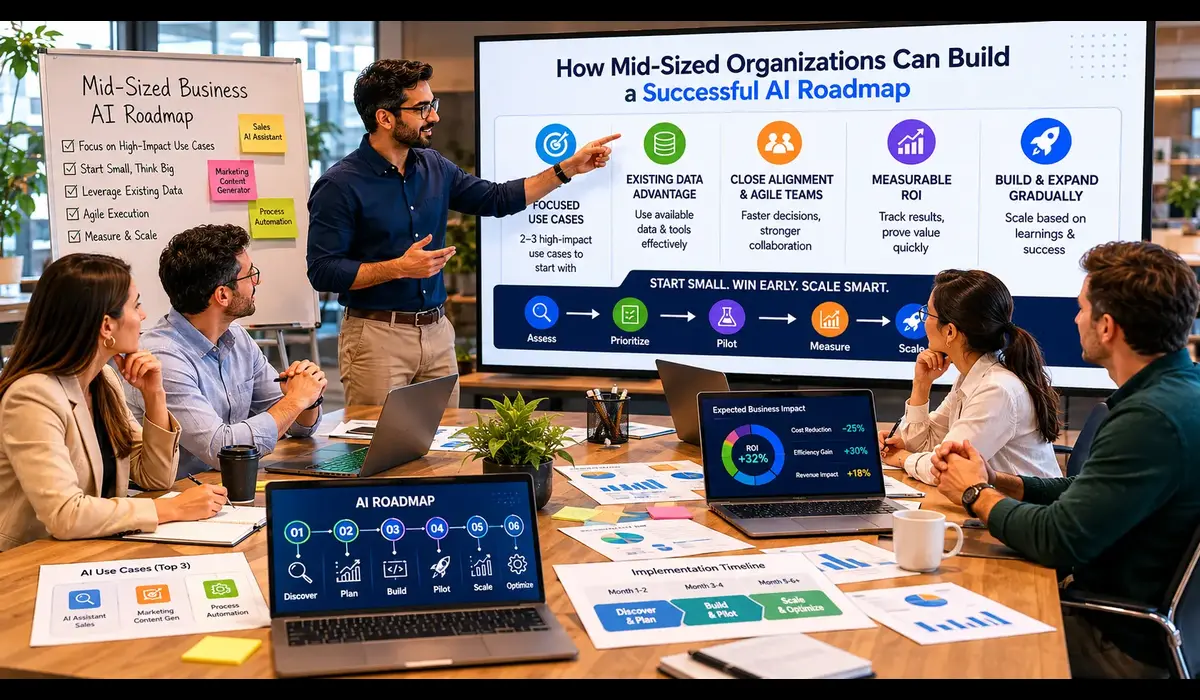
Don’t assume that a formal AI roadmap is only relevant for large enterprises with dedicated AI teams and substantial budgets. That assumption is wrong, and increasingly costly to hold onto.
The AI adoption roadmap for a mid-sized organization looks different from an enterprise version in a few important ways. Resources are more constrained, so use case selection needs to be sharper. There’s typically less legacy data infrastructure to work around, which can actually be an advantage. And leadership is closer to the operational teams, which means change management can happen faster.
The practical starting point for most mid-sized organizations is a focused two to three use case roadmap, not an enterprise-wide transformation plan. Choose use cases where the data already exists, the process is clearly defined, and the business impact is measurable. Automate a repetitive back-office workflow. Implement an AI-assisted quoting tool in sales. Use generative AI to accelerate first-draft content in marketing.
Then build from those wins. The credibility created by a visible, measurable outcome in months three to five is what unlocks the organizational appetite for the next phase.
Timeline and Milestones for Implementation of the AI Roadmap
Here’s a realistic first-year AI implementation cycle for a mid-to-large organization. Actual timing will vary based on your organization’s complexity, data readiness, and the scope of use cases selected.
| Month | Phase | Key Activities | Milestone |
| 1 | Alignment & Discovery | Readiness assessment, stakeholder interviews | AI readiness report complete |
| 2 | Alignment & Discovery | Executive alignment workshop, use case longlist | Leadership sign-off on direction |
| 3 | Strategy & Prioritization | Use case scoring, platform evaluation begins | Top 2–3 use cases selected |
| 4 | Foundation Building | Data infrastructure, vendor selection, governance v1 | Data pipelines live, platform selected |
| 5 | Foundation Building | Security architecture, compliance review | Compliance sign-off |
| 6 | Pilot Execution | First pilot deployed in a controlled environment | Pilot live, KPIs being tracked |
| 7 | Pilot Execution | User feedback, model iteration, second pilot begins | Pilot retrospective complete |
| 8 | Scale & Integration | First production deployment, integration work begins | AI live in production workflow |
| 9 | Scale & Integration | Additional user groups onboarded, monitoring live | Monitoring and alerting operational |
| 10 | Scale & Integration | Second use case in production | Two use cases fully deployed |
| 11 | Optimize & Expand | Performance review, next use case prioritization | Updated roadmap cycle launched |
| 12 | Optimize & Expand | Training expansion, governance update, v2 planning | Year 1 retrospective, roadmap v2 draft |
Common Mistakes Organizations Make During AI Implementation
- Prioritizing technology over use cases. Selecting a platform or committing to a vendor before validating that there are real, high-value problems it can solve leads to expensive solutions in search of a purpose.
- Underestimating data readiness. Most production AI failures trace back to data quality issues ,missing values, inconsistent formats, poor labeling, and incomplete coverage. A data readiness assessment isn’t optional; it’s foundational.
- Running pilots that can’t scale. Pilots scoped around favorable datasets, cooperative teams, or bypassed security requirements often produce impressive results that evaporate when moved into real operating conditions.
- Neglecting change management. An AI tool that employees don’t trust, don’t understand, or don’t see as relevant to their work will not get used. Adoption is a human problem, not a technical one.
- Diffuse governance. When nobody owns responsibility for monitoring AI system performance, errors accumulate quietly until they become organizational incidents.
- Measuring success in deployment metrics. The number of AI models deployed or users onboarded is not a business outcome. ROI metrics need to be defined before implementation begins and tracked against real operational baselines.
How AI Consulting Services Help in AI Adoption and Implementation
Building and executing an AI transformation roadmap is a significant undertaking, and most organizations don’t have the full range of expertise it requires sitting inside their walls. Our AI consulting services can fill specific gaps through:
Readiness Assessment and Benchmarking. We have worked across multiple organizations and industries and can calibrate an honest assessment of where a business actually stands ,not just technically, but in terms of data maturity, leadership alignment, and organizational change capacity.
Strategy Development. Our experienced AI strategy advisors help leadership teams move from vague ambition to a prioritized, resourced, and defensible AI adoption strategy, including the difficult conversations about what not to do.
Governance Design. Building an AI governance framework that balances speed with appropriate risk controls is genuinely hard. Organizations dealing with regulated data, cross-border operations, or high-stakes decision domains benefit from our expertise in this area.
Technical Implementation and Integration. For organizations without deep ML engineering or MLOps capacity, our teams can provide the technical execution that translates use case designs into production systems and connect those systems to existing business infrastructure.
Change Management. Structured change management programs that build internal AI literacy, address workforce concerns, and create genuine end-user advocacy drive adoption rates that standalone IT deployments almost never achieve.
Our AI consulting services help in accelerating and building your organization’s capacity ,not creating permanent dependencies on us.
Conclusion
The organizations that will lead in their industries over the next decade will not necessarily be those that deployed the most AI tools first. They will be those who built AI into the fabric of how they operate ,systematically, around real business objectives, with the people and processes ready to capture the value.
A thoughtful AI implementation roadmap is not about chasing the latest model or meeting a board-level mandate to “do something with AI.” It’s about making disciplined choices: which problems are worth solving, in what order, with what data, what infrastructure, and what organizational capability. Done well, it turns AI from a set of interesting capabilities into a compounding operational advantage.
Frequently Asked Questions
What is an AI implementation roadmap?
An AI implementation roadmap is a structured plan that translates AI strategy into sequenced, operational execution. It covers use case prioritization, data and infrastructure requirements, governance, technology decisions, people and change management, and a milestone framework tied to business outcomes. It is the bridge between an organization’s AI ambitions and the actual delivery of value from AI systems.
What is the first step in AI implementation?
The first step is evaluating where the organization currently stands across business alignment, data maturity, technology infrastructure, and organizational capability. Without this baseline, use case prioritization and planning are built on assumptions that frequently turn out to be wrong.
How long does AI implementation take?
The time required depends heavily on organizational complexity, data readiness, and the scope of use cases being pursued. For a focused initial deployment covering two to three use cases, a realistic timeline is six to twelve months from alignment to production. Enterprise-wide AI transformation programs with multiple workstreams typically unfold over two to three years in meaningful phases.
How do enterprises adopt generative AI?
Successful generative AI adoption in enterprise settings follows the same disciplined approach as broader AI adoption. Start with specific, high-value use cases rather than broad deployment; establish guardrails and a governance framework before wide rollout; involve end users in pilot design; and build in human oversight for high-stakes outputs. The organizations seeing the most durable value from generative AI are using it to augment specific workflows ,not as a general-purpose tool deployed without structure.
What are the biggest AI adoption challenges?
The most consistent barriers to successful AI adoption are data quality and readiness issues, misalignment between AI initiatives and actual business priorities, insufficient change management investment, unclear governance and accountability structures, and a tendency to measure success in deployment activity rather than business outcomes. The technology is rarely the limiting factor.
Can mid-sized organizations create an AI roadmap?
Yes, and their structure often makes focused AI adoption faster than in a large enterprise. With fewer bureaucratic layers and closer alignment between leadership and operations, mid-sized organizations can move quickly on well-chosen use cases. The key is starting narrow with two or three high-impact, well-scoped use cases, and building organizational confidence and capability from those wins before expanding scope.