Softude
Every week, another vendor promises that their AI tool will cut costs, accelerate decisions, and outpace competitors. The pressure on business leaders to act is real. But the risk of acting without preparation is equally real.
Before your organization writes a single line of AI implementation into its roadmap, they need to answer one question honestly: Are we actually ready?
Not in terms of technology and infrastructure. But overall, people, data, processes, governance, and technology. Here is a structured approach to doing an AI readiness assessment for your organization.
AI Readiness Checklist for Businesses
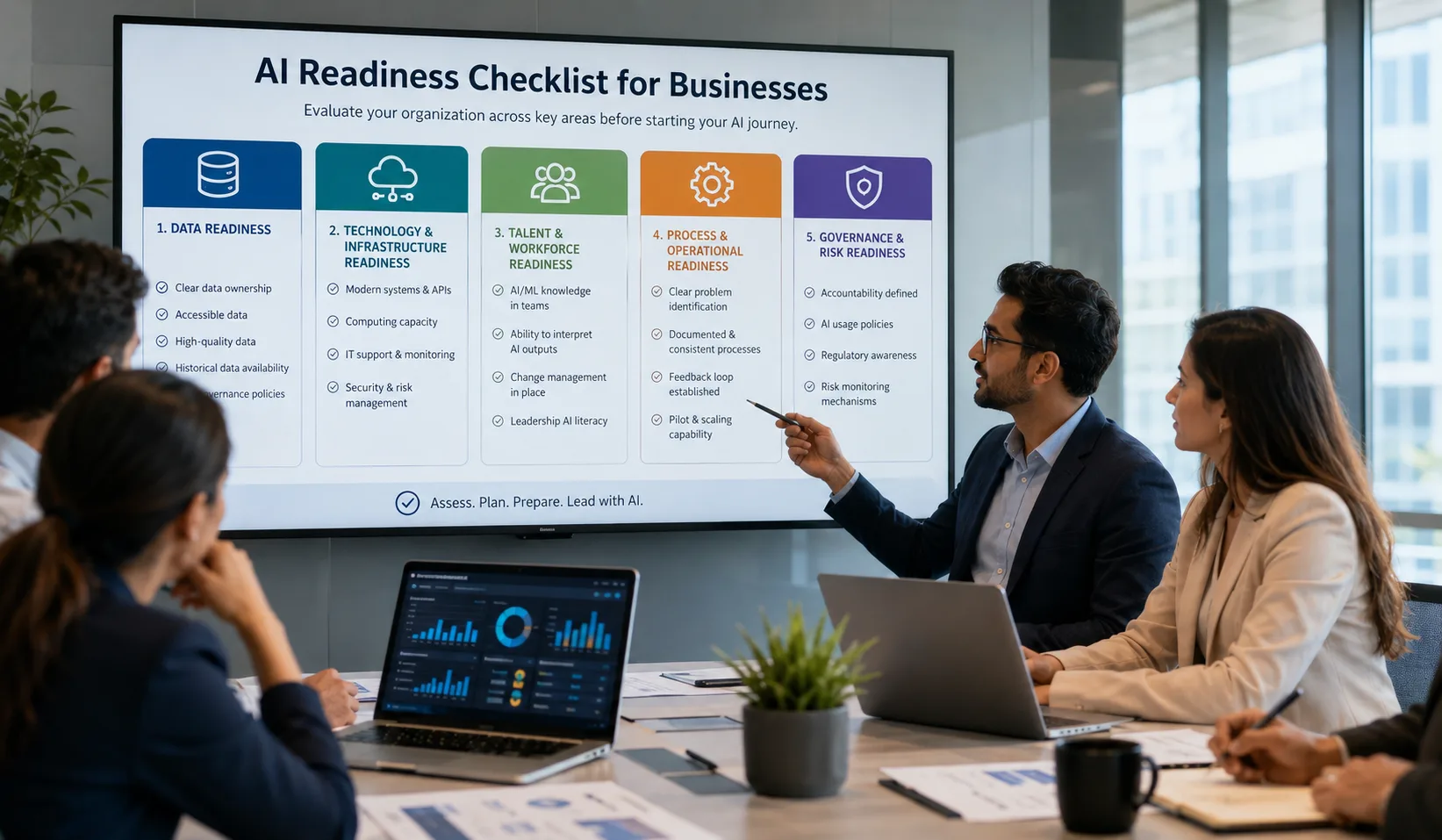
Before implementing AI, businesses should first evaluate whether their data, operations, and teams are prepared for adoption using this AI readiness checklist.
1. Data Readiness
AI runs on data. If your data is incomplete, siloed, inconsistently labeled, or stored in formats that cannot be accessed programmatically, no AI system will perform well on it. This is the most common and most underestimated gap.
Questions to ask:
- Do you have clear ownership of data across your organization?
- Can your teams access the data they need without significant manual effort?
- Is historical data available in sufficient volume and quality for the use cases you have in mind?
- Do you have data governance policies that define how data is collected, stored, and used?
If the honest answer is mostly no, data readiness is your first priority, not AI implementation.
2. Technology and Infrastructure Readiness
Look at whether your existing technology stack can support AI workloads. That includes cloud infrastructure, integration capabilities, security architecture, and the ability to deploy and monitor models in production.
Questions to ask:
- Are your core systems modern enough to connect to AI tools through APIs or data pipelines?
- Do you have the computing capacity, either in-house or through cloud providers, needed to run AI models?
- Can your IT team support ongoing maintenance, updates, and monitoring of AI systems?
- Do your security protocols cover the risks introduced by AI, such as model vulnerabilities or data leakage?
A common mistake businesses make is assessing technology readiness only at the point of adoption.
3. Talent and Workforce Readiness
AI does not replace the human workforce. It changes the nature of it. Your workforce needs to be equipped to work alongside AI tools, interpret their outputs, and identify when those outputs should not be trusted.
Questions to ask:
- Do you have employees who understand machine learning concepts at a functional level?
- Do your teams know how to interpret AI-generated recommendations critically rather than accepting them at face value?
- Is there a change management plan for roles that will be directly affected?
- Does your leadership team have enough AI literacy to make informed decisions about AI investment, risk, and strategy?
Workforce readiness is not just about hiring AI and ML engineers. It is about building baseline AI fluency across the organization, especially among the people who will use AI outputs to make decisions.
4. Process and Operational Readiness
AI works best when it is integrated into well-defined processes. If the underlying workflows are unclear, inconsistent, or overly manual, layering AI on top of them rarely improves outcomes and often makes the problems harder to diagnose.
Questions to ask:
- Have you identified specific, measurable problems that AI could address, rather than general aspirations?
- Are the processes involved in those problems documented and consistent?
- Is there a feedback loop in place so that AI outputs can be evaluated against real outcomes?
- Do you have the operational capacity to implement and monitor a pilot before scaling?
Leaders who struggle most with AI adoption are often those who try to implement it across too many areas simultaneously, with no single process fully mature enough to serve as a reference point.
5. AI Governance and Risk Readiness
Most organizations address AI governance in the last, but it should be addressed first. AI introduces specific risks, bias, regulatory exposure, reputational harm, and accountability gaps that require deliberate governance structures before deployment.
Questions to ask:
- Who in your organization is accountable for AI decisions and their consequences?
- Do you have policies for how AI is used in high-stakes contexts, such as hiring, credit, or customer communications?
- Are you aware of relevant regulations in your jurisdiction, including the EU AI Act, that apply to your intended use cases?
- Is there a mechanism for employees and customers to flag AI-related concerns?
Governance readiness is not bureaucracy. It is risk management. Organizations that skip this step often move fast, only to stall when a regulatory inquiry or public incident forces them to rebuild controls from scratch.
How to Conduct the AI Readiness Assessment

The AI readiness checklist should be a cross-functional exercise rather than a one-time review. The teams closest to your data, operations, workflows, and systems should be involved alongside senior leadership to ensure the assessment reflects operational reality rather than just strategic assumptions. Because when evaluations happen only at the executive level, critical implementation gaps are often overlooked until deployment begins.
Here is a practical AI readiness assessment framework for enterprise-level evaluation.
- Run structured interviews or workshops with department heads and functional leads across IT, operations, finance, HR, and any business unit considering AI adoption. The goal is to surface ground-level information that does not appear in dashboards or strategy documents.
- Score each dimension using a consistent rubric, for example, a simple three-level scale: not ready, partially ready, ready. Avoid the temptation to average scores across dimensions. A low score in governance or data quality cannot be offset by a high score in technology infrastructure. Each dimension represents a distinct category of risk.
- Map your findings to specific use cases. A business may be ready for AI in a narrow, low-risk context, automating internal document classification, for example, while not yet being ready for AI in customer-facing or decision-critical contexts. Readiness is not binary. It is use-case specific.
How to Interpret the Results of Readiness Assessment
Once you have completed the assessment, you will fall into one of three broad positions.
- If your scores are strong across most dimensions, with isolated gaps. You are ready to begin structured pilots in areas where your readiness is highest. Prioritize use cases with clear success metrics, a contained scope, and low risk if the AI performs poorly. Use the pilot to close the remaining gaps in a controlled environment rather than waiting for perfect conditions that will not come.
- If your scores reveal significant gaps in two or more dimensions. Your next step is not AI adoption. It is a structured readiness improvement program. This is not a failure. It is the correct strategic response. Organizations that acknowledge gaps and close them before deployment consistently outperform those that rush ahead and rebuild under pressure.
- If your organization is at an early stage across nearly all dimensions. It is worth considering whether there are lower-complexity automation tools that could deliver near-term value while the foundations for AI are built in parallel. Not every business problem requires AI. Some require better data management, clearer processes, or simply more consistent execution. Honesty about this distinction is itself a sign of strategic maturity.
A Practical Starting Point for Businesses

If you have not yet conducted a formal readiness assessment, start small. Pick one use case your leadership team has discussed seriously. Run the AI readiness framework against that specific use case with the people who know it best. Document your findings honestly. Identify the two or three gaps that would most significantly affect your probability of success. Then decide, with that information in front of you, whether to move forward, prepare, or wait.
Conclusion
Treat AI readiness assessment as an ongoing process rather than a one-time exercise. As AI technologies evolve, businesses will need to continuously reassess governance standards, workforce skills, infrastructure requirements, and operational workflows.
The organizations that gain long-term advantage from AI will not necessarily be the ones adopting the most tools. They will be the ones building systems, teams, and decision-making frameworks that allow AI to scale responsibly over time.
For businesses planning their next phase of digital transformation, readiness is what turns AI from an experimental initiative into a sustainable business capability.
FAQs
What is an AI readiness checklist?
An AI readiness checklist typically covers data quality, infrastructure, workforce capability, operational maturity, governance, and implementation planning.
Why is checking AI readiness important before implementation?
Without proper readiness, AI projects often fail due to poor data quality, unclear processes, lack of governance, or low workforce adoption. Readiness assessment helps identify these risks early.
How long does an AI readiness assessment take?
The timeline depends on business size and complexity. Smaller organizations may complete an assessment within a few weeks, while enterprise-level assessments can take several months.
Can small businesses benefit from AI readiness assessments?
Yes. Small businesses often benefit even more because readiness assessments help them avoid unnecessary AI investments and focus on practical, high-impact use cases first.
Is AI readiness only about technology?
No. Technology is only one part of readiness. Successful AI adoption also depends on data quality, leadership alignment, employee capability, operational maturity, and governance structures.
Do you help businesses with AI readiness assessments?
Yes. AI readiness assessments are often conducted as part of our broader AI strategy consulting services. We start by evaluating data infrastructure, operational processes, workforce readiness, governance risks, and identifying practical AI use cases aligned with your goals. The outcome is usually a clear roadmap that helps you understand where to start, what gaps need attention, and how to approach AI adoption strategically.