Softude
Artificial Intelligence has moved far beyond simple automation. Today, AI tools actively assist in writing, coding, research, customer service, and strategic decision-making. Among the most prominent names in this space are Claude AI and ChatGPT. These two advanced language models are often compared because they share similar goals- understanding human language and producing meaningful, context-aware responses. However, they approach these goals differently.
In this detailed guide, we explore Claude AI vs ChatGPT across performance, accuracy, architecture, use cases, strengths, limitations, and real-world suitability. If you’ve ever wondered which AI tool fits your needs better, this in-depth comparison will give you clarity.
What Is Claude AI and What Is ChatGPT?
Claude AI and ChatGPT are both large language models (LLMs), but they are developed by different organizations with different design philosophies.
ChatGPT, developed by OpenAI, is widely recognized for its conversational abilities, creative writing skills, and adaptability across a broad range of tasks. It has gained massive popularity among writers, marketers, developers, students, and businesses.
Claude AI, developed by Anthropic, is built with a strong emphasis on safety, reliability, and ethical AI behavior. Its design focuses on minimizing harmful outputs while maintaining logical consistency and contextual understanding.
While both LLMs aim to assist humans efficiently, the contrast between Claude and ChatGPT becomes clearer when examining how they think, respond, and prioritize user intent.
How Do Claude AI and ChatGPT Differ in Design Philosophy?
The design philosophy behind each AI directly affects its behavior and reliability.
ChatGPT is optimized for:
- Natural, flowing conversations
- Creative expression and idea generation
- Broad adaptability across industries
Claude AI is optimized for:
- Safety-first reasoning
- Reduced hallucinations (fabricated information)
- Predictable and controlled responses
In the Claude AI vs ChatGPT debate, this philosophical difference explains why ChatGPT feels more expressive and conversational, while Claude often feels more cautious and analytical.
How Do Claude AI and ChatGPT Perform in Real-Time Interactions?
Performance is a critical factor when comparing AI systems, especially for real-time applications.
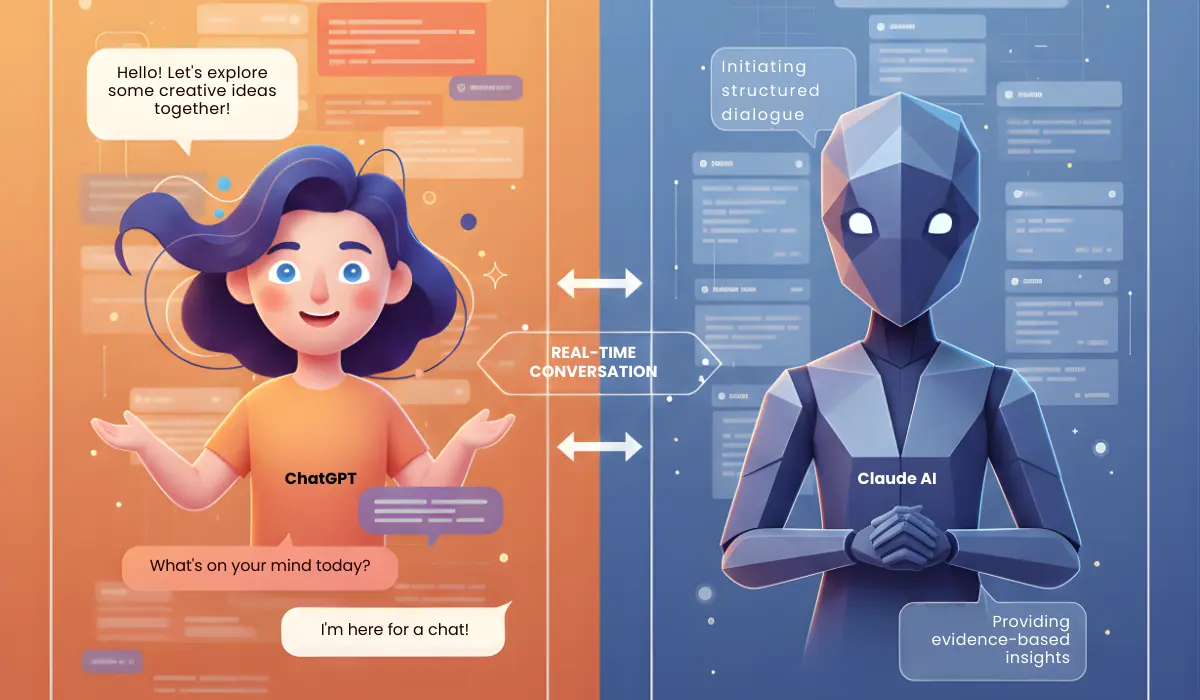
ChatGPT typically responds quickly and adapts smoothly during multi-turn conversations. It remembers context effectively within a session and can shift tone, style, and intent with minimal prompting.
Claude AI also performs efficiently but places more emphasis on structured responses. It may pause or decline to answer certain prompts if they cross safety or ambiguity thresholds.
In practical use:
- ChatGPT feels more “human-like” in casual interactions
- Claude AI feels more “professional” and controlled
Thus, when evaluating Claude vs ChatGPT for conversational performance, ChatGPT often wins in engagement, while Claude excels in consistency.
Which Is More Accurate: Claude AI or ChatGPT?
Accuracy in AI is multi-dimensional. It includes factual correctness, logical coherence, and compliance with instructions.
Claude AI is widely regarded as more conservative with facts. It avoids making confident claims when uncertainty exists and often uses neutral language to minimize misinformation.
ChatGPT, while highly knowledgeable, occasionally prioritizes fluency over caution. This can result in answers that sound convincing but require verification.
For industries like legal research, compliance, healthcare documentation, or financial analysis, Claude AI may offer better reliability. For brainstorming, content ideation, and general knowledge discussions, ChatGPT remains highly effective.
How Do Claude AI and ChatGPT Compare in Content Creation?
Content creation is one of the most popular use cases for AI tools.
ChatGPT is particularly strong at:
- Blog writing
- Storytelling
- Marketing copy
- Social media captions
- Creative narratives
Claude AI, on the other hand, excels at:
- Structured long-form writing
- Summarization of complex documents
- Professional and academic tone
- Instruction-following precision
In the Claude AI vs ChatGPT comparison for writing, ChatGPT is better suited for expressive and engaging content, while Claude AI performs well in formal and technical contexts.
How Do Claude AI and ChatGPT Handle Coding and Technical Tasks?
Developers frequently rely on AI for coding assistance, debugging, and explanation of complex concepts.
ChatGPT has a broader developer ecosystem and excels at:
- Explaining code in simple terms
- Generating sample scripts
- Offering multiple solution approaches
- Supporting various programming languages
Claude AI is more cautious but often provides:
- Clean logical explanations
- Fewer speculative answers
- Structured problem-solving steps
For experimental coding and learning, ChatGPT is often preferred. For production-level reasoning where correctness is critical, Claude AI can be a safer option.
What Are the Main Use Cases for Claude vs ChatGPT?
Both AI models serve overlapping but distinct audiences.
ChatGPT Use Cases
- Content marketing
- Creative writing
- Education and tutoring
- Product descriptions
- Chatbots and engagement tools
Claude AI Use Cases
- Enterprise documentation
- Legal and compliance analysis
- Academic research assistance
- Internal knowledge management
- Risk-sensitive environments
Understanding these use cases helps users choose between Claude and ChatGPT more effectively.
How Do Claude AI and ChatGPT Compare Side by Side?
Below is a clear comparative table highlighting the major differences:
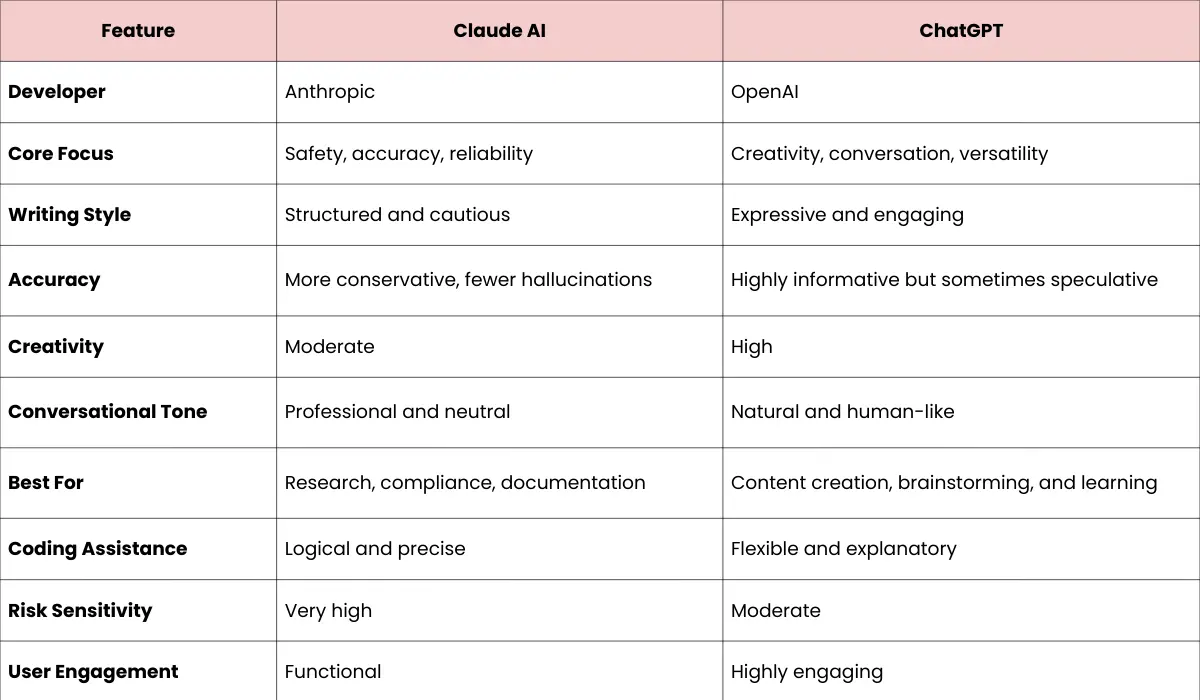
This table clearly illustrates how Claude AI vs ChatGPT differs across key performance areas.
Which AI Is Better for Businesses and Enterprises?
Businesses often prioritize reliability, data security, and consistency.
Claude AI’s safety-first design makes it appealing for enterprises that require:
- Reduced risk of misinformation
- Ethical AI compliance
- Controlled response behavior
ChatGPT, however, offers scalability and adaptability that suit:
- Marketing teams
- Customer engagement platforms
- Startup innovation environments
Thus, enterprise adoption depends heavily on the nature of the business and risk tolerance.
What Are the Limitations of Claude AI and ChatGPT?
No AI system is perfect.
Claude AI Limitations
- Less creative output
- May refuse or restrict responses more often
- Can feel overly cautious
ChatGPT Limitations
- Occasional hallucinations
- Requires careful prompting for accuracy
- Less conservative in sensitive contexts
Recognizing these limitations ensures realistic expectations when using either tool.
How to Decide Between Claude AI and ChatGPT
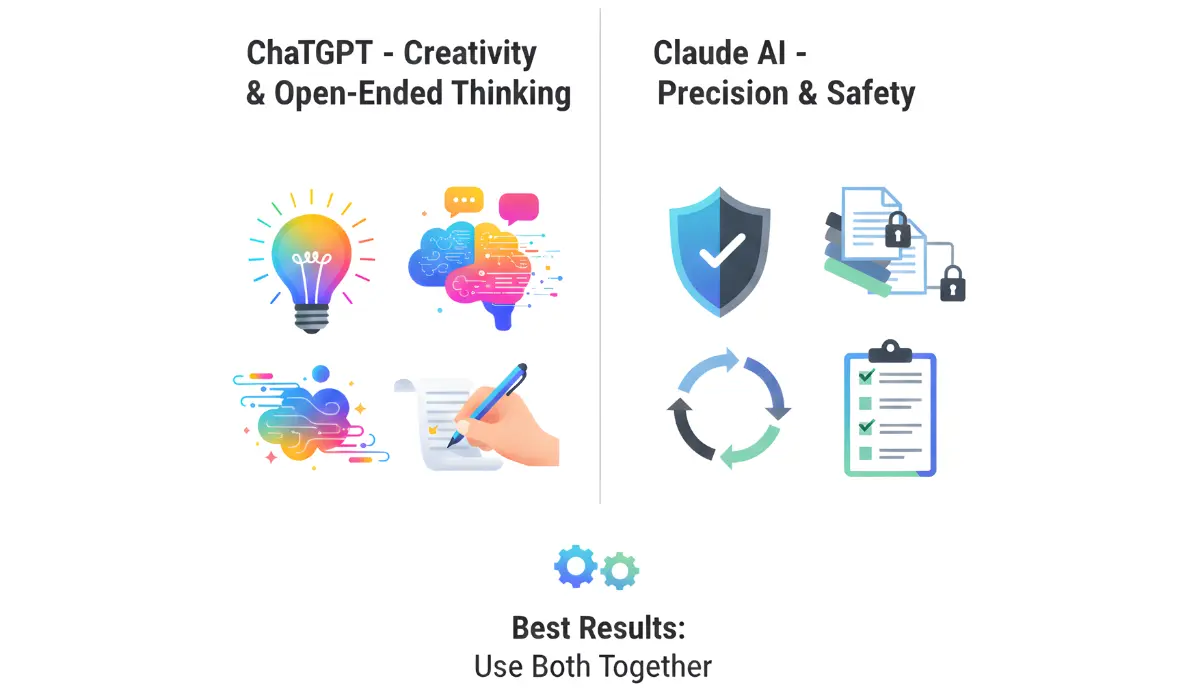
The right AI tool depends entirely on your purpose and the type of results you expect. Claude AI and ChatGPT are both powerful, but they are designed with different strengths in mind.
When ChatGPT Is the Better Choice
ChatGPT is ideal if your work benefits from creativity and open-ended thinking. It performs especially well in tasks that require imagination, fluid conversation, or idea exploration. It is commonly used for:
- Writing creative content such as stories, marketing copy, or scripts
- Maintaining natural, engaging conversations
- Brainstorming multiple concepts or variations
- Exploring flexible and unconventional ideas
If your priority is interaction, innovation, and expressive writing, ChatGPT is often the more effective option.
When Claude AI Is the Better Choice
Claude AI is well-suited for situations where precision, structure, and safety matter most. Its responses tend to be more cautious and detail-oriented, making it a strong choice for professional or technical environments. It is particularly useful for:
- Producing accuracy-focused or compliance-sensitive content
- Creating orthotics or clinical documentation
- Handling tasks that require logical consistency
- Applying a safety-first and risk-aware reasoning process
If your work demands careful analysis and reliable factual output, Claude AI may be the better fit.
Using Both Together
Rather than choosing one over the other, many users combine both tools. ChatGPT can be used to generate ideas and creative drafts, while Claude AI can refine those outputs with structure, accuracy, and risk awareness. This complementary approach often produces the best results.
Frequently Asked Questions
Is Claude AI better than ChatGPT?
Neither AI is universally better. Claude AI emphasizes safety, structured reasoning, and factual accuracy, while ChatGPT focuses on creativity and conversational engagement. The better option depends on your specific needs.
Which AI provides more accurate responses?
Claude AI generally takes a more conservative and fact-based approach, which can reduce hallucinations. ChatGPT remains accurate but sometimes prioritizes creativity or conversational flow.
Can both AI tools be used for blogging?
Yes. ChatGPT is often preferred for storytelling, opinion pieces, and engaging blog posts. Claude AI is better suited for technical, medical, or industry-specific blogs that require precision.
Which AI is better for development and coding tasks?
ChatGPT offers strong learning support, explanations, and experimentation for developers. Claude AI is commonly used for logic-heavy or risk-sensitive coding where careful reasoning is required.
There is no single “best” AI between Claude AI and ChatGPT. The ideal choice depends on whether your priority is creativity or precision. In many cases, using both together provides the most balanced and effective solution.