Softude
We are living in an age where invisible systems quietly shape some of the most important moments of our lives. An algorithm decides whether your loan is approved or denied. Another determines which résumé a recruiter sees first. Somewhere else, a self-driving car evaluates a split-second decision at a crowded intersection. These systems are fast, efficient, and often astonishingly accurate- but they carry a shadow alongside their brilliance.
That shadow is known as the Black Box problem.
As we continue to hand more authority to autonomous AI agents, we arrive at an uneasy crossroads. We have built machines that perform better than humans in many domains, yet we frequently can not explain why they make the decisions they do. The result is a strange paradox: unprecedented technological power paired with an unsettling lack of understanding.
What follows is a deep dive into the world of blackbox AI agents and the growing global effort to illuminate what happens inside them.
What Exactly Is a Blackbox AI Agent?
A blackbox AI agent is an autonomous system whose internal decision-making process is largely opaque. While we can observe what goes in (the input) and what comes out (the output), the reasoning that connects the two remains hidden, even to the engineers who designed the system.
Think of it like a locked room. You slide a question under the door. Moments later, a flawless answer slides back out. The response is correct, perhaps even impressive, but what happened inside the room is anyone’s guess.
This phenomenon is most common in modern AI systems built on deep learning and neural networks. These models are made up of millions or even billions of interconnected parameters that adjust themselves during training. Instead of following rules written in plain language, they learn by detecting statistical patterns across vast amounts of data.
The result is a decision-making process that is mathematically sound but deeply unintuitive. No single line of code explains why the AI chose option A over option B. The logic exists, but it is distributed across a web of numerical relationships far beyond human-scale reasoning.
Why Do We Rely on AI We Do not Fully Understand?

If blackbox systems are so mysterious, why do we continue to rely on them, often for critical decisions?
The answer lies in what researchers call the performance-interpretability trade-off.
In simple terms, the more interpretable a model is, the easier it is for humans to understand, but the less powerful it tends to be. Transparent models like linear regression or decision trees allow you to trace every step of their logic. However, they struggle when faced with complex, noisy, real-world data.
Blackbox models thrive in precisely those environments. They can:
- Detect subtle patterns in medical scans
- Understand spoken language across accents
- Predict market behavior from massive datasets
- Navigate dynamic, unpredictable environments
In domains where accuracy is paramount, such as healthcare, finance, and autonomous systems, the superior performance of blackbox models often outweighs concerns about transparency. We accept the mystery because the results are simply too good to ignore.
How Does a Blackbox AI Agent Actually Make Decisions?
Although the internal mechanics are difficult to interpret, the high-level process behind a blackbox AI agent generally unfolds in three stages:
1. Data Intake
The AI is trained on enormous datasets- credit histories, driving behavior, medical records, user interactions, or sensor data. The quality and scope of this data largely determine how the system behaves later.
2. Pattern Learning
During training, the model continuously adjusts its internal parameters to reduce errors. Over time, it learns complex correlations: when certain patterns appear, specific outcomes are statistically more likely to follow.
3. Autonomous Execution
Once deployed, the agent encounters new, unseen data and applies what it has learned to make decisions in real time, often without human oversight.
The “blackbox” moment occurs here. When asked why it made a particular choice, the system cannot offer a human-style explanation. It does not reason through logic or rules; it calculates probabilities and follows the strongest mathematical signal.
The Real-World Risks of Opaque AI

The lack of transparency in blackbox AI is more than a philosophical concern. It carries serious practical, ethical, and legal risks.
Hidden Bias
AI systems learn from historical data, which often reflects human prejudice. If biased data goes in, biased decisions can come out- quietly and at scale. Without visibility into the decision process, these biases may remain undetected until real harm occurs.
The Accountability Gap
When an AI system causes damage, responsibility becomes murky. Who is to blame- the developer, the organization deploying it, or the model itself? If no one can explain how the decision was made, assigning accountability becomes extraordinarily difficult.
Errors and Hallucinations
AI systems sometimes reach correct conclusions for the wrong reasons, or worse, generate confident but entirely false outputs. Without insight into the reasoning process, identifying and correcting these failures is a challenge.
In high-stakes domains- healthcare, criminal justice, finance- this opacity is not just inconvenient. It can be dangerous.
How Explainable AI (XAI) Helps Open the Box?
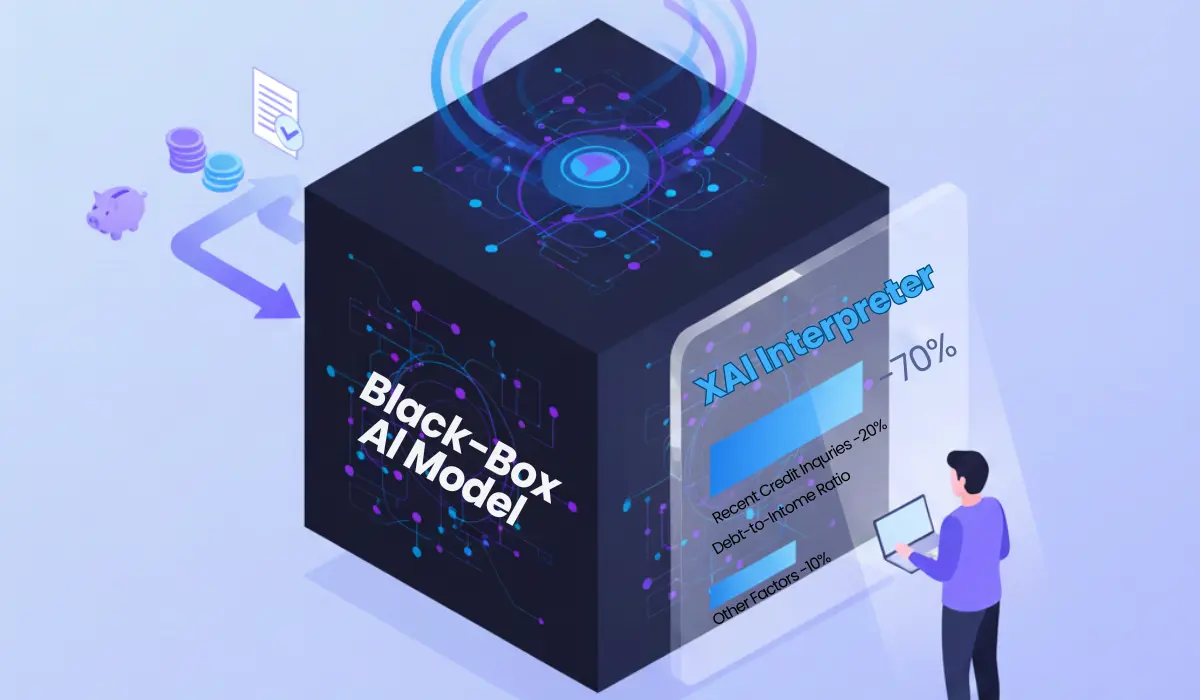
This is where Explainable AI (XAI) comes into play.
XAI is not about replacing powerful blackbox models with simpler ones. Instead, it acts as a kind of interpreter, translating complex machine behavior into explanations humans can understand.
Techniques like LIME and SHAP analyze individual decisions and identify which features contributed most strongly to the outcome. For example, instead of simply denying a loan, an AI system enhanced with XAI might explain:
“This decision was primarily influenced by recent credit inquiries (70%) and debt-to-income ratio (20%).”
These explanations do not reveal every internal detail, but they provide meaningful insight- enough to audit decisions, detect bias, and build trust.
Is the Future of AI Transparent?
As we move deeper into the decade, transparency is no longer optional. Governments and regulators are stepping in. Frameworks like the EU AI Act now require that high-risk AI systems offer a degree of explainability and accountability.
The future of autonomous AI is not about choosing between power and understanding. Instead, it points toward a hybrid approach: using high-performance blackbox models for complex tasks, while surrounding them with layers of explainability, safety checks, and ethical oversight.
In this future, AI does not just work- it can also be questioned, audited, and trusted.
Frequently Asked Questions
How does Softude ensure transparency in AI solutions?
Softude embeds Explainable AI techniques to make AI decisions clear, traceable, and trustworthy.
What is the difference between blackbox and whitebox AI?
Whitebox (or glassbox) AI is fully transparent, allowing users to trace each step of its logic. Blackbox AI delivers results without revealing its internal reasoning.
Can we ever fully understand deep learning models?
Not in a traditional sense. However, Explainable AI provides functional insight by showing which factors mattered most, even if the full internal logic remains complex.
Can Softude customize AI models for regulated or high-risk industries?
Yes. Softude builds compliant, auditable AI solutions tailored for regulated and high-impact industries.
Is blackbox AI inherently bad?
No. For low-stakes applications, such as entertainment recommendations, opacity is rarely a problem. Issues arise when blackbox systems are used in decisions that affect lives, rights, or livelihoods.
What are everyday examples of blackbox AI?
Spam filters, facial recognition systems, voice assistants, and social media algorithms are all common blackbox systems.
How does Explainable AI benefit businesses?
XAI helps organizations build trust, comply with regulations, identify errors, and improve system performance- making transparency not just ethical, but economically smart.