Softude
At some point, every growing company faces the same moment: the support queue is getting longer, customers are getting more demanding, and someone decides it’s time to “add AI to CX.” Good call. But the decision that actually determines whether that investment works isn’t whether to use AI — it’s how you set it up.
That’s where the single bot vs multi-agent question comes in. And it’s more important than it sounds.
Get the architecture right, and your CX scales smoothly as your business grows. Get it wrong, and you’ll be stuck patching a system that was never built for the complexity you’re throwing at it. In 2026, with AI agents for customer experience becoming table stakes across industries, this is a decision worth thinking through carefully.
First, Let’s Talk About What “Scale” Actually Means in CX

When most people say they want to scale customer experience, that means they want to handle more tickets. That’s fair. But it’s only half the picture.
The harder part of scaling isn’t how many calls the bot will handle, but the complexity of queries. As your product grows, your customers’ problems become more complex. Someone calls in about a billing issue that turns into a technical question that turns into “can you just help me figure out what plan I should be on?”
That’s three different problems in one conversation. And customers expect the bot to remember their problem every time and suggest practical resolutions, without making them repeat themselves.
So when we talk about scaling CX, we are really talking about handling more complex situations, not just volume of simple queries. That’s exactly where choosing between a single bot and a multi-agent system matters.
What Is a Single AI System and How Does It Help?

A single bot is exactly what it sounds like: one AI customer chatbot handling everything. Every question, every workflow, every customer, all routed through the same system.
For many businesses, especially early on, choosing a single AI bot can feel affordable and worthwhile. If your customers mostly ask the same kinds of questions, order tracking, basic FAQs, and appointment scheduling, then the decision is right. It’s faster to set up, cheaper to run, and easier to manage. For a small team or a focused product, you don’t need anything more complicated than this.
What Happens When You Scale a Single AI System for Customer Support?
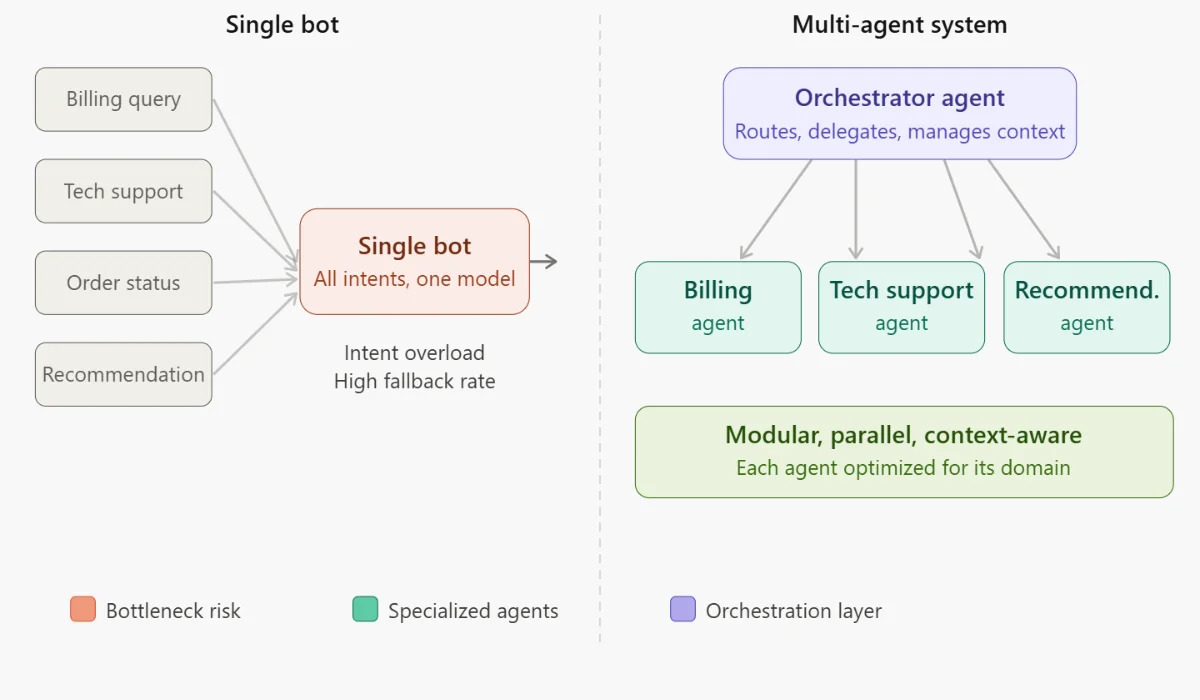
- It Become Less Accurate: The more intents you pile onto one AI model, the more it starts to lose accuracy. It works great on your top ten query types. By the time you are at fifty or a hundred, it’s hedging more, misreading more, and sending more conversations to a human because it doesn’t know what to do.
- It Gets Confused: When a single AI agent system is tasked with knowing everything, the mathematical “distance” between different topics shrinks. The agent makes a wrong assumption. It might see a billing complaint as a technical bug, leading to high frustration and human escalation.
- It Becomes Hard to Change: Changing one rule in a monolithic system can have unforeseen consequences elsewhere. This makes the system hard to change. The more you add to it, the easier it is to break.
- It Forgets The Context: Keeping track of what a customer said three messages ago, especially across sessions, is genuinely hard when a single model tries to juggle everything at once. And every time you update a policy or launch something new, you’re touching the whole system. Change how you handle refunds, and you might accidentally affect how the bot responds to something completely unrelated.
The warning signs are usually the same: more conversations falling back to humans, inconsistent answers, and customers having to repeat themselves. However, there is nothing wrong with your AI agent, but these warning signs aren’t bugs you can patch. It’s just that it was built for simplicity, not complexity.
What Is a Multi-Agent AI System?

A multi-agent system works differently. Instead of one AI trying to do everything, you have a team of specialized agents, each one focused on a specific job, coordinated by an orchestrator that figures out who should handle what.
Think of it like a well-run support team. You wouldn’t have your billing specialist also handle your technical troubleshooting. You’d have the right person for the right problem, with someone making sure conversations get routed correctly and nothing falls through the cracks. Multi-agent systems work the same way, but with AI.
Here’s what that actually buys you.
- Specialists do their job better. A billing agent only needs to be really good at billing. Tighter focus means sharper answers. When every agent in the system is optimized for its specific domain, the overall quality of responses goes up.
- Things can happen in parallel. Multiple agents can work at the same time on different parts of a complex query. This keeps response times fast even when the problem is complicated, which matters a lot when you’re handling high volumes.
- Context actually sticks. The orchestrator( the agent managing the overall conversation) keeps track of what’s been said and passes the right information to whichever specialist picks up next. A customer who starts with a billing question and ends up needing tech support doesn’t have to re-explain their whole situation. The conversation feels continuous because it is.
- Adding something new doesn’t break everything else. Launching a new product? Add an agent for it. One agent underperforming? Fix just that one. You’re not touching the whole system every time something changes. That’s a big deal when your business is moving fast.
Which Is Better: Single or Multi-Agent AI Systems
Multi-agent systems are more powerful, but they’re not easier. That’s worth saying clearly.
Building a multi-agent AI system takes more upfront work. Getting the routing logic right, making sure context passes cleanly between agents, and keeping response times from stacking up are some of the real engineering challenges your team can face.
A poorly designed multi-agent setup doesn’t fail in obvious ways. It fails when one agent contradicts another, a conversation is too long and complex, resulting in a frustrating experience for the customers.
The cost is also higher. More models, more infrastructure, more to monitor. For a business that doesn’t need this level of sophistication, you’d just be paying for complexity you don’t use.
The honest way to think about it: multi-agent systems don’t make complexity disappear. They just organize it in a way that holds up better over time. That’s valuable but only if you actually have the complexity to justify it.
Comparing the ROI of Both Approaches
So Which One Should You Choose?
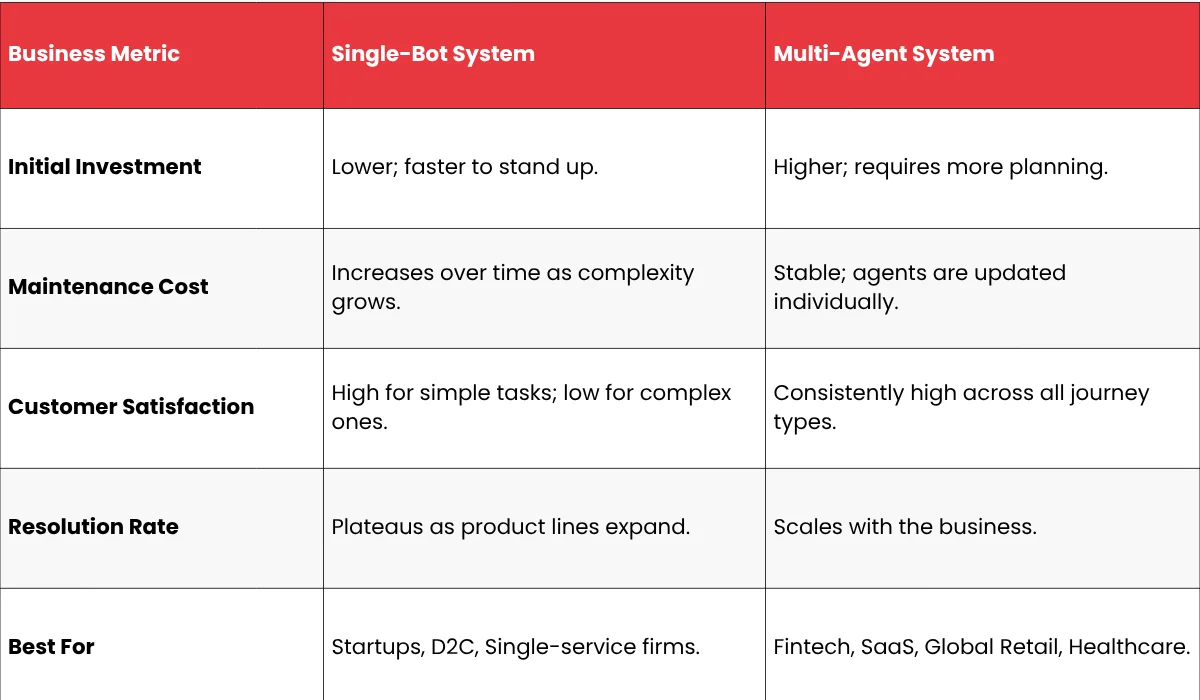
Go with a single bot if: You are still figuring out your CX automation. Your customers mostly ask the same kinds of questions. Your volume is manageable. You need to move fast and don’t want to over-engineer something before you know what you actually need. D2C brands, small support teams, and single-product companies often fall here, and a well-built single bot will serve them well.
Seriously consider multi-agent systems if: You are handling high volumes across multiple channels. Your customers’ problems are complicated and multi-step. You need the system to actually remember what’s going on across a conversation. If the customer journey involves high-stakes data (such as financial or medical records) or complex troubleshooting, a multi-agent architecture is the only way to scale without sacrificing the brand’s reputation.
The Question Worth Asking Yourself Now
If your CX roadmap includes more products, more channels, more personalization, or a tighter link between support quality and customer retention, the architecture you choose now will either grow with you or get in your way.
Single bots scale well up to a point, then plateau. Multi-agent systems are built to grow modularly, which means adding complexity doesn’t automatically mean adding chaos.
This isn’t really a debate about which AI agent architecture is theoretically better. It’s a practical question: what does your CX operation look like in two years, and does your current setup get you there?
For businesses where customer experience is a real competitive advantage, the single bot vs multi-agent question tends to answer itself pretty quickly. The only real decision is when to make the move, and for fast-growing businesses, it’s usually sooner than they expect.
The system you build today is the foundation for everything else. Build it for where you are. But make sure it can handle where you’re going.
How Softude Can Help You Make the Right Decision

Softude specializes in bridge-building: connecting complex enterprise needs with high-performance AI solutions. Here is how our AI consultants can help.
1. AI Readiness Assessment & Strategy
We don’t start with building an AI agent system without knowing what to build, who we are building for, what it needs to do, and how ready your organization is. Our consultants evaluate your current data infrastructure, ticket volume, and workflow complexity to determine if your business is better served by a robust single-bot system or a sophisticated multi-agent ecosystem. This ensures you are getting what helps your business.
2. Tailored AI Agent Architecture Design
Every enterprise has a unique “logic footprint.” Softude designs a custom AI agent architecture that fits into your existing tech stack (CRM, ERP, and legacy databases). Whether it’s building specialized AI agents for billing, technical support, or lead qualification, the focus is on creating a modular system that grows alongside your product lines.
3. Seamless Multi-Agent Orchestration
The primary challenge of multi-agent AI systems is coordination. We implement advanced orchestration layers that manage “agent-to-agent” communication, ensuring context is never lost during a handoff. This prevents the “fragmented experience” where a customer has to repeat their problem to different parts of the AI.
4. Human-in-the-Loop (HITL) & Governance
Scaling CX at an enterprise level requires trust. Our strict governance frameworks and “Human-in-the-Loop” checkpoints are integrated from the start to build that trust. This ensures that high-stakes decisions like major financial adjustments or sensitive data handling are always reviewed by a human expert, maintaining the perfect balance between automation and accountability.
5. Continuous Optimization & Scaling
Deployment is just the beginning. We monitor and refine AI agents to improve the customer experience. By analyzing performance data, the team helps identify when a single-bot setup has reached its limit and supports a modular transition to a multi-agent framework without disrupting your live operations.
If your roadmap includes cross-functional support, deep personalization, and global omnichannel scale, the right AI agent architecture is a must.
Ready to scale your customer experience? Contact Softude today to discover which AI architecture will drive your next era of growth.
Frequently Asked Questions
1. Is a multi-agent system more expensive than a single bot?
Initially, yes. A multi-agent systems approach involves higher upfront costs for orchestration design and a more complex AI agent architecture. However, for large enterprises, it is often more cost-effective at scale. While a single bot becomes more expensive to maintain, specialized agents are easier to update independently, reducing long-term engineering overhead.
2. Will moving to a multi-agent setup increase response latency for customers?
If designed poorly, yes. However, a well-optimized system actually reduces perceived latency. While the “Orchestrator” adds a split-second layer of thought, multi-agent setups allow for parallel processing. For instance, while one agent is retrieving billing data, another can be analyzing a technical log simultaneously, often resulting in a faster total resolution time than a single bot’s sequential processing.
3. Can we transition from a single bot to a multi-agent system later?
Absolutely. Most enterprises start with a single AI agent. The key is to build with an API-first mindset. As your support volume grows, you can turn specific intents, like Technical Support or Refunds, into specialized agents that report back to your original bot, which then evolves into the Orchestrator.
6. Are AI agents for customer experience secure for regulated industries?
Yes, provided they are built with the right guardrails. Multi-agent systems are preferred in regulated sectors such as Fintech and Healthcare. You can isolate sensitive data by creating a “Compliance Agent” that sits between the customer and the database, ensuring that no unauthorized data (such as PII) is ever processed or stored by the broader agent network.