Softude
Old systems run the world’s most critical operations, from major bank platforms to huge logistics networks, but they are notoriously slow, expensive, and risky to change. Traditional modernization often involves a high-stakes gamble. Fortunately, AI modernization offers a groundbreaking path to transform your critical systems without ever stopping the business. Here is your definitive guide to choosing the right path for modernizing legacy systems with AI and accelerating your return on investment.
Why Modernizing Legacy Systems is Crucial Now

What do we mean by “legacy system”? These are essential programs, often built decades ago on mainframes (such as COBOL), that must run but are outdated in structure. They are the engine for many global industries, but they are slowing down over time.
The main reasons for urgent legacy system modernization are tied to three major business problems:
- Stop the Risk: Old technology is fragile and prone to breaking. It’s hard to find experts who can maintain this code, and a sudden crash can instantly stop massive operations. Modernizing is the only way to make your infrastructure secure and avoid catastrophic downtime.
- Be More Agile: In today’s market, demands change fast. Legacy systems are built with rigid, all-in-one code structures. They can take months or years just to connect to new services, stopping your company from launching new products or keeping up with competitors.
- Cut the Costs: While they might seem “free” because they were paid for long ago, maintaining legacy systems is incredibly costly. The price of specialized talent, constant patches, and old hardware often uses up far more budget than building a modern, cloud-based platform.
Also Read: 8 Signs It’s Time for Legacy App Modernization
How AI Makes Legacy System Modernization Faster and Safer
Artificial intelligence is the most powerful tool for enterprise transformation. AI injects smart capabilities into the change process, bringing clarity, speed, and safety to every step.
Here are five key ways AI fundamentally helps with legacy app modernization:
- Smart Automation (RPA + AI for Routine Tasks): AI-enhanced Robotic Process Automation (RPA) does much more than just capture data from a screen. By using machine learning to understand the context of a process, AI can automate complex, multi-step jobs that cross between the old system and modern tools. This provides immediate efficiency and frees up human staff.
- Data Cleanup & Transfer (NLP on Documents and Logs): Old business information is often locked up in unstructured files, hard-to-read logs, or physical paperwork. Natural Language Processing (NLP) can read, sort, and pull out organized data from these sources, like customer records or system event logs, turning it into a clean, modern format ready for a new database.
- Predictive Maintenance (Forecast Failures, Find Issues Early): By studying years of operational data and system logs from the legacy environment, AI models can predict when hardware or software might fail. This shifts your organization from fixing problems after they occur to preventing them, ensuring high stability during and after the legacy system modernization project.
- Intelligent Advice (Recommendations from Past Data): Many legacy systems hold decades of valuable business knowledge, often hidden deep within old programming rules. AI can analyze past transaction patterns and customer actions to automatically suggest better decisions, such as optimizing inventory or offering personalized product ideas, long before the original business rules are moved or rewritten.
- Code Review & Understanding (AI-Assisted Rewriting): One of the biggest obstacles is figuring out millions of lines of old, undocumented code. AI-powered code analysis tools can map connections between code blocks, find unnecessary code, assess complexity, and even suggest modern code snippets (like Python or Java) based on the logic found in the original COBOL or Fortran. This drastically speeds up the entire rewriting process.
What Are the Key Strategies for Modernizing Legacy Systems with AI
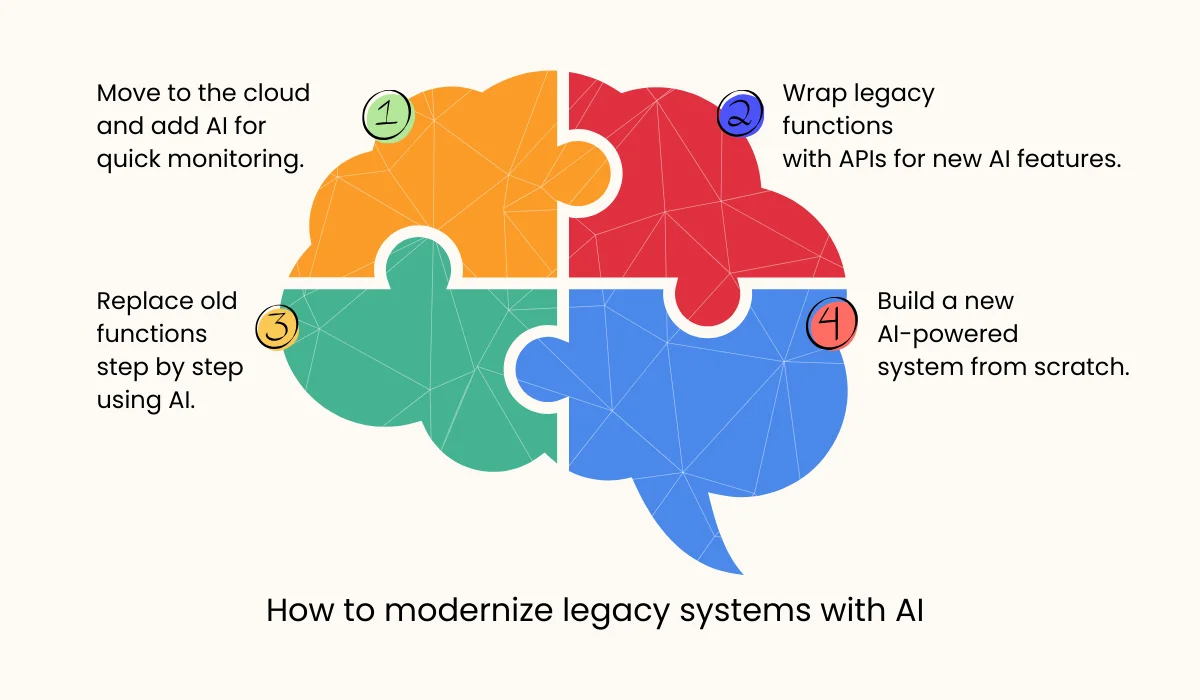
Choosing the right strategy for legacy app modernization is the most important decision. AI doesn’t force a single path but makes all four major approaches more efficient and safe. Your choice should balance how much risk you can handle, your budget, and how quickly you need the transformation to happen.
1. Lift & Shift + AI Overlay (The Fastest Win)
This strategy involves moving the old application (often a mainframe copy) directly onto a cloud server (Re-hosting). The original code stays mostly the same, but the hardware and operating system underneath are modern.
How AI Helps: AI is placed on top of the newly cloud-hosted system. This layer gives immediate benefits like:
- Anomaly Detection: Real-time AI monitoring for unusual transaction spikes or strange system behaviors.
- Smart Logging: AI analyzes cloud logs to simplify finding and fixing problems and identifying slow parts of the system.
Pros
- Fastest time to see results
- Lowest initial risk
- Immediate savings on old hardware costs
Cons
- No improvement in core architecture
- The problem in the code still exists
- Can’t easily add new features
2. API Wrapping + Microservices (The Secure Bridge)
This very effective method leaves the main legacy system alone but wraps its essential functions inside modern APIs (application programming interfaces). New services, built as small, modern microservices in the cloud, can access data and business logic through these APIs.
How AI Helps: To get immediate functional improvement, this is the perfect strategy for modernizing legacy apps with AI. AI models can be deployed as new, external microservices (such as an AI fraud detection system) that easily interact with the wrapped legacy data.
Pros
- Keeps the core system safe and stable
- Allows for fast creation of new, modern features
- Great setup for future, gradual migration
Cons
- Performance speed is still dependent on the old system
- Maintaining the wrapper layer adds some complexity
3. Incremental Refactoring (The Step-by-Step Replacement)
Incremental refactoring involves slowly replacing small, self-contained parts of the old system with modern, cloud-native services. A typical starting point might be the customer login area, a specific billing service, or a system of business rules.
How AI Helps: Use AI code analysis tools. They map the connections of the part being replaced to ensure no business rule or logic is lost. For example, an old rule engine might be replaced by a modern AI-powered system that uses machine learning to handle customer requests instead of fixed rules.
- Pros: Allows the business to see returns on investment in phases; a proven way to handle large, complex transformations; minimal disruption to daily work.
- Cons: Needs a strong, long-term commitment to the plan; connections between old parts can be tricky to figure out without AI help.
4. Full Rebuild (AI-Native) (The Complete Overhaul)
Shutting down the old system entirely and replacing it with a brand-new, cloud-native application is the most complete and highest-risk strategy for legacy system modernization. This is usually done when it is impossible to fix the old system or app, or the entire business model is changing.
How AI Helps: AI’s role here is crucial. The new system is built from the ground up to be AI-native, meaning machine learning models are built directly into core processes (e.g., an insurance system that uses AI to instantly calculate risk). Additionally, AI data migration tools are essential for the final, massive transfer of historical information.
Pros
- Highest potential for long-term profit and competitive edge
- No old code to worry about
- Unlimited flexibility and growth potential
Cons
- Highest initial cost and complexity
- Longest project time
- The most challenging organizational change for employees
Key Considerations for a Successful AI Modernization Journey
Simply purchasing AI modernization tools doesn’t guarantee success. Pay equal attention to the challenges that are not purely technical.
-
Data Quality and Accuracy
AI models rely completely on the data they use. Since old systems often have messy or inconsistent data, a key task in any AI legacy modernization project is data cleaning. You must set strict rules for data handling before you train any models. This ensures data privacy, accuracy, and legal compliance throughout the migration. Bad data quality will lead to poor AI models, wasting the whole effort.
-
Risk Management and Running Systems Side-by-Side
The core rule of using AI for IT modernization is always to keep a safety net. For mission-critical functions, use a method in which the old system and the new AI-enhanced system run in parallel for a while. This allows your team to check the new system’s accuracy against the old one, gradually directing more work to the new system only when you are 100% confident.
-
Organizational Change Management
Technology is the easy part; dealing with people is the challenge. A successful AI modernization requires thorough training and cultural adaptation. Employees must understand how their jobs will change, from doing manual tasks to managing smart automation tools.
-
Legal and Compliance Adherence
Industries like banking, healthcare, and government must follow strict legal rules. Any legacy modernization with an AI project must adhere to these regulations. Using AI for sensitive processes like fraud detection or loan approval needs clear explanations (Explainable AI or XAI) to satisfy auditors, ensuring the AI-driven decisions are transparent and fair.
Essential Tools and Techniques for AI-Powered Modernization
The AI landscape offers a growing set of tools specifically designed to speed up legacy transformation.
- RPA and Intelligent Automation: Moving beyond simple bots, modern RPA platforms include AI features (like computer vision) to handle variations in screen layouts and forms, allowing for automation of more complex processes that touch old user interfaces.
- NLP for Documentation and Logs: Specialized NLP tools can read massive archives of undocumented old code and system logs to create clear, human-readable instructions and system maps. This drastically cuts the time engineers spend trying to figure out how the existing system works.
- AI-Powered Data Migration Tools: These tools use machine learning to intelligently match data fields between different old and modern database structures. They find hidden patterns and differences that manual matching would miss, ensuring data remains accurate during the switch.
- AI Code Analysis and Transformation: Tools that analyze the structure, syntax, and logic of very old programming languages (like COBOL, PL/I, or Assembly) and automatically suggest or help translate the code into modern languages (like Java, C#, or Python). This is a vital feature for large-scale code rewriting, making it a cornerstone of efficient AI modernization.
Ready to Modernize Your IT Legacy Apps?
The struggle with old technology is real, but the days of slow, risky, manual transformation are over. AI modernization provides the intelligence, speed, and security needed to protect your most valuable business assets while giving you incredible new flexibility.
Don’t let your core systems hold your business back. Take the first step toward legacy system modernization today.
If you need expert help, Softude offers end-to-end modernization services. We’ll help you plan, implement, and optimize AI-driven solutions so you can modernize your systems confidently, achieve the best results, and minimize risk.
FAQs
- What is a legacy system?
A legacy system is an older software or platform that is still in use but built on outdated technology, making it hard to maintain, upgrade, or integrate with modern tools. - Why are legacy systems a problem?
They increase maintenance costs, limit innovation, pose security risks, and often fail to meet current business needs. - Can legacy systems be modernized without replacing them completely?
Yes. AI enables incremental modernization through approaches like API wrapping, cloud migration, and module refactoring. - How does AI help in modernizing legacy systems?
AI automates code analysis, speeds up data migration, predicts system failures, and enables intelligent integration with modern platforms. - Is AI modernization risky?
AI reduces risk by automating repetitive tasks, improving data quality, and enabling gradual migration rather than a full rip-and-replace. - What AI tools are commonly used for modernization?
Tools include RPA (Robotic Process Automation), NLP for document analysis, AI-powered data migration platforms, and AI-based code refactoring tools. - What are the benefits of AI-driven modernization?
Lower costs, faster timelines, improved security, better compliance, and the ability to add new features without major disruptions. - Do I need AI experts to modernize legacy systems? Not necessarily. Many AI-powered tools are designed for IT teams and come with vendor support, so you don’t always need deep AI expertise.