Softude
Enterprise AI agents are rapidly becoming a core component of modern digital operations. These systems combine large language models, reasoning capabilities, and tool-driven execution to handle context‑aware, multi‑step tasks across business workflows. Unlike traditional automation, which depends on static rules, AI agents interpret unstructured inputs, adapt to changing conditions, and interact directly with enterprise systems through APIs. This shift expands what organizations can automate, from isolated tasks to full end‑to‑end processes.
For CTOs, the relevance is both strategic and operational. Companies piloting AI agents report meaningful reductions in manual effort, improved cycle times, and greater process consistency across functions such as IT operations, finance, HR, procurement, and customer support. These gains translate into measurable ROI, typically through 20–40% efficiency improvements in workflows that rely on repetitive, knowledge-heavy tasks.
Yet the real transformation occurs at the architectural level. Deploying AI agents requires thoughtful integration with existing systems, robust governance mechanisms, and new approaches to monitoring, security, and model risk management.
This guide provides the architectural foundations, decision frameworks, and deployment considerations needed to operationalize AI agents with confidence.
What Are Enterprise AI Agents?

Enterprise AI agents are autonomous software entities designed to perceive context, reason about tasks, and execute actions across enterprise workflows. They combine the capabilities of large language models, orchestration engines, and system integrations to perform multi‑step, goal‑oriented tasks with minimal human intervention. Unlike static automation tools, AI agents can interpret unstructured data, make decisions in ambiguous scenarios, and dynamically select the appropriate tools or APIs needed to complete a workflow.
At their core, enterprise AI agents operate through an iterative loop of understanding → planning → executing → evaluating, allowing them to adapt and improve over time. They can integrate with ERP, CRM, ITSM, data warehouses, communication platforms, and custom services, functioning as digital operators embedded within the enterprise ecosystem. Their scope covers a wide range of use cases, from automating tier‑1 support and financial reconciliations to orchestrating procurement cycles, generating reports, monitoring IT systems, and facilitating employee onboarding.
At their core, enterprise AI agents operate through an iterative loop of understanding → planning → executing → evaluating, allowing them to adapt and improve over time. They can integrate with ERP, CRM, ITSM, data warehouses, communication platforms, and custom services, functioning as digital operators embedded within the enterprise ecosystem. Their scope covers a wide range of use cases, from automating tier‑1 support and financial reconciliations to orchestrating procurement cycles, generating reports, monitoring IT systems, and facilitating employee onboarding.
Difference Between an AI Agent and a Chatbot
AI chatbot responds to predefined prompts or scripts, primarily serving as an interface for information retrieval or simple transactions. It lacks autonomy, decision‑making, and workflow-execution capabilities.
An AI agent, by contrast:
- Executes tasks end‑to‑end, not just conversations
- Calls APIs, triggers microservices, and updates enterprise systems
- Understands context beyond a single query
- Takes actions aligned with a defined goal
Single‑Purpose Agents vs Multi‑Agent Systems
A single‑purpose agent focuses on one function, e.g., invoice validation, ticket routing, or data extraction. These are easier to deploy but limited in scope.
A multi‑agent system comprises many specialized agents collaborating to achieve larger objectives. For instance, a procurement workflow may involve:
- a document‑processing agent,
- a validation agent,
- an approval orchestration agent,
- and a compliance agent.
Multi‑agent systems enable scalable, modular automation that evolves with enterprise needs.
Also Read: Single AI Agent vs. Multi-Agent AI Systems
Strategic Value of AI Agents for Enterprises

Enterprise AI agents create value at the intersection of automation, decision intelligence, and process optimization. Their impact extends far beyond task execution; agents reshape how organizations operate, allocate resources, and scale capabilities. For CTOs, understanding this strategic value is essential to prioritizing investments and framing enterprise‑wide adoption.
1 ROI and Cost Efficiency
AI agents help enterprises realize measurable ROI by reducing manual work, lowering operational costs, and improving throughput across functions. Traditional automation (such as RPA) typically delivers linear efficiency gains. AI agents introduce non‑linear returns because they handle both structured and unstructured workflows, allowing automation of processes previously considered too variable or complex.
Examples of ROI drivers include:
- Reduction in manual workload across ticketing, reporting, reconciliation, approvals, and data validation.
- Decreased cycle time for ITSM, procurement, onboarding, and finance operations.
- Lower operational overhead, especially in areas where teams handle high-volume repetitive tasks.
Enterprises piloting AI agents commonly observe productivity improvements of 20–40% in targeted workflows. These savings compound when agents are deployed across interconnected processes, for example, an agent that triages tickets, another that retrieves diagnostics, and a third that drafts resolutions can collectively reduce service desk backlogs and MTTR.
2 Operational Efficiency and Workflow Acceleration
AI agents deliver operational efficiency by orchestrating end-to-end workflows rather than just isolated tasks. Their ability to interpret context, retrieve data, make decisions, and interact with systems creates a step-change in process velocity.
Key efficiency benefits include:
- Rapid task execution through automated tools and API calls.
- Consistency and standardization, replacing human variability with predictable execution.
- Always‑on operations, enabling 24/7 processing without additional staffing.
In functions like finance or procurement, AI agents accelerate processes by automatically gathering documents, validating data, escalating edge cases, and triggering approvals. In IT operations, they enrich incidents, run diagnostics, update CMDB entries, or execute remediation steps, reducing human intervention and improving service levels.
This shift allows teams to spend more time on strategy, innovation, and exception handling, rather than repetitive administrative work.
3 Decision Support and Knowledge Intelligence
While dashboards provide visibility, AI agents deliver actionable intelligence by combining retrieval, reasoning, and execution. They analyze data, synthesize insights, and trigger actions, all within policy and governance constraints.
Decision-support value emerges through:
- Contextual recommendations based on historical patterns and enterprise data.
- Automated summaries, reports, and forecasts using multi-source inputs.
- Scenario evaluation, where agents propose next steps and execute chosen options.
For example, in IT operations, agents can analyze system logs, predict incidents, and initiate preventive workflows. In finance, they reconcile transactions, identify anomalies, and highlight discrepancies for human review. This creates a hybrid operating model in which humans oversee strategy and exceptions, while agents handle the analytical and operational workloads.
4. Competitive Advantage and Strategic Differentiation
Enterprises that adopt AI agents early gain a structural advantage. They deliver faster customer response times, reduce operational friction, and improve decision cycles, enabling them to move quicker than competitors.
Strategic advantages include:
- Higher organizational agility, with workflows that adapt to changing business conditions.
- Enhanced customer experience, especially in support, onboarding, and service delivery.
- Accelerated digital transformation, as agents unlock automation across previously inaccessible processes.
Over time, agent-driven enterprises build a compounding capability moat: every automated workflow frees capacity, every agent improves over iterations, and every integrated system expands the automation surface area.
In a landscape where speed, efficiency, and precision define competitiveness, AI agents become not just operational tools but a strategic lever for modernization and long-term resilience.
Core Capabilities of Enterprise AI Agents

Enterprise AI agents derive their value from advanced cognitive, analytical, and operational capabilities that enable them to operate autonomously as digital operators. These capabilities go far beyond conversational interfaces, allowing agents to perceive context, reason about tasks, and take actions across enterprise systems. For CTOs, understanding these capabilities is essential to evaluating feasibility, integration depth, and governance requirements.
1. Natural Language Understanding & Reasoning (NLP/NLU)
AI agents leverage large language models to interpret complex inputs and make nuanced decisions.
Key capabilities include:
- Contextual comprehension: Understands domain‑specific terminology across IT, finance, HR, procurement, and operations.
- Intent recognition: Accurately identifies user goals, constraints, and workflow requirements.
- Semantic parsing: Converts natural language into structured actions (e.g., SQL queries, API calls, workflow steps).
- Multi-turn reasoning: Maintains context across long sequences, enabling coherent decision-making.
- Policy-aware interpretation: Uses retrieval augmentation to align responses with enterprise rules and compliance mandates.
This cognitive foundation drives all higher-level automation and decision execution.
2 Task Automation & Workflow Orchestration
AI agents automate both simple and complex workflows by dynamically orchestrating system interactions and tool executions.
Core automation features:
- Autonomous task execution: Executes multi-step processes without human supervision.
- API and tool calling: Integrates with ERP, CRM, ITSM, and custom microservices.
- Cross-system orchestration: Coordinates data retrieval, validation, posting, and updates across enterprise platforms.
- Adaptive workflows: Adjust steps based on real-time conditions or data anomalies.
- Exception handling: Identifies edge cases and escalates to humans when necessary.
This enables end-to-end automation of repetitive, rules-driven, and knowledge-heavy tasks.
3 Predictive Analytics & Decision Intelligence
AI agents incorporate analytical capabilities that allow them to anticipate needs, detect anomalies, and support decision-making.
Key capabilities:
- Forecasting: Predicts demand, incidents, delays, or cost fluctuations using historical patterns.
- Anomaly detection: Flags deviations in transactions, system performance, or operational metrics.
- Root-cause analysis: Synthesizes logs, signals, and documents to isolate underlying issues.
- Scenario simulation: Evaluates multiple options and recommends optimal actions.
- Real-time insights: Summarizes data across heterogeneous systems for faster decision cycles.
By integrating reasoning with analytics, agents act as decision engines rather than passive assistants.
4 Continuous Learning & Optimization
Agents improve over time through structured learning mechanisms.
Learning capabilities include:
- Reinforcement loops: Refines task strategies based on outcomes and feedback.
- Memory updates: Stores relevant context, past actions, and organizational knowledge.
- Self-evaluation: Validates results and identifies success criteria.
- Playbooks refinement: Improves workflows based on observed patterns and exception cases.
- User preference modeling: Adjusts recommendations and actions based on team behavior.
This enables agents to become more accurate, reliable, and aligned with business processes as they operate.
Enterprise AI Agent Architecture
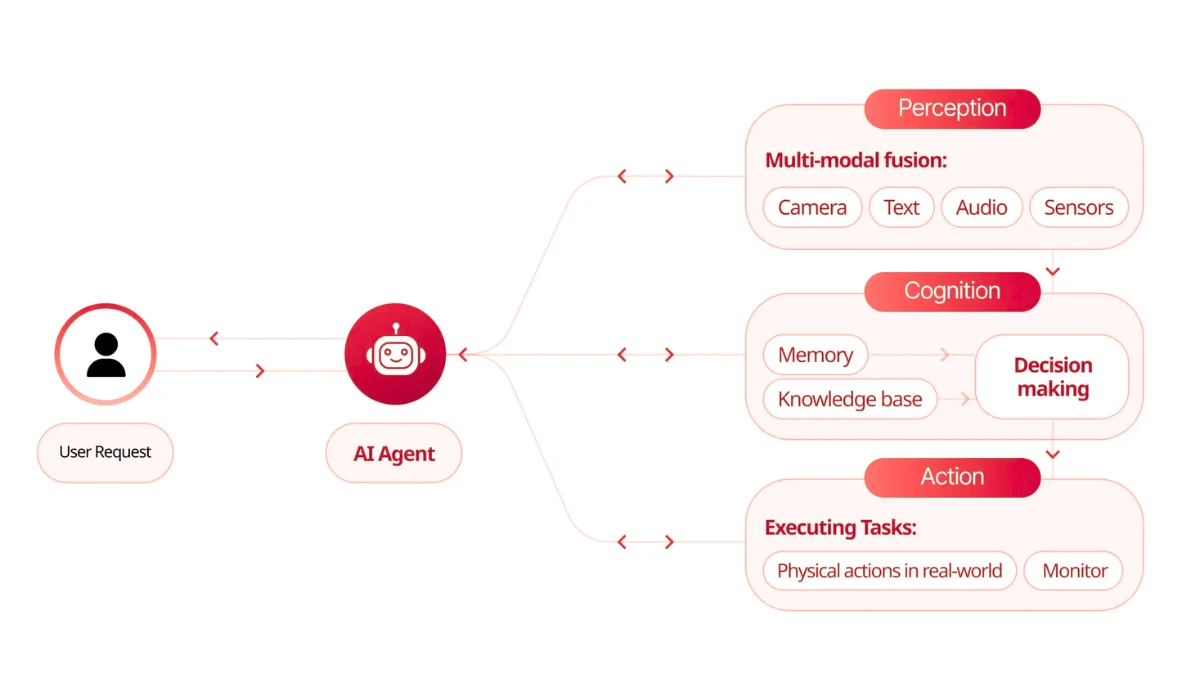
Traditional LLM implementations are stateless and reactive, a simple “input-output” loop. In contrast, an Enterprise AI Agent is a “Cognitive Architecture.” It is a persistent system that maintains a “state,” understands its environment, and utilizes tools to change that environment to reach a specific goal.
A. The Reasoning Engine (The Brain)
At the core is the Frontier Model (e.g., GPT-4o, Claude 3.5 Sonnet, or Gemini 1.5 Pro). However, for enterprise-grade agents, the engine must support Inference-Time Scaling. Unlike standard chat, where the model provides the first statistically probable token, agentic reasoning requires “System 2” thinking.
This allows the agent to allocate more “compute” during the reasoning phase, often via Chain-of-Thought (CoT) or Tree-of-Thoughts (ToT) processing, to verify logic, anticipate edge cases, and self-correct before committing to an action in a production system.
For CTOs, this means evaluating models not just on benchmarks (MMLU), but on Agentic Reasoning Benchmarks like GAIA or SWE-bench, which test the model’s ability to use tools and resolve multi-step tasks.
B. The Memory Layer (Contextual Continuity)
A robust agent requires three distinct types of memory to function reliably within a corporate ecosystem:
- Short-term (Working) Memory: Manages the immediate session state, current task progress, and the “Plan-Act-Observe” loop. This is typically stored in memory or in a fast-access cache, such as Redis, to ensure the agent doesn’t “forget” what it just did in the previous step of a long-running process.
- Long-term (Semantic) Memory: Utilizes Vector Databases (Pinecone, Milvus, or Weaviate) or Knowledge Graphs. Unlike basic RAG, an agent’s long-term memory is often read-write. This allows the agent to update its own “learnings”, saving successful workflow patterns or noting that a specific API endpoint often returns 404s on Tuesdays.
- Procedural Memory: This involves storing the “How-To” of the enterprise, standard operating procedures (SOPs), and code snippets. This ensures the agent follows company-specific logic rather than generic internet-trained logic.
C. The Perception Layer (Multimodal Ingestion)
Enterprise agents must process “Dark Data”, unstructured PDF invoices, complex SQL schemas, real-time telemetry from IoT devices, and screen recordings of legacy software workflows. This layer utilizes specialized encoders to convert raw environmental signals into structured tokens. For example, a “Browser Agent” uses visual perception to identify DOM elements in a legacy web app that lacks a modern API, allowing it to perform data entry just as a human operator would.
D. The Tool/Action Layer (The Hands)
This is the interface between the model and the enterprise stack (SAP, Salesforce, Jira, Snowflake). In a governed architecture, this is enabled by Function Calling (JSON schema-based) and secure API gateways. The agent does not “hack” the system; it calls predefined, audited functions with scoped permissions.
Key architectural requirements here include:
- Sandboxed Execution: Running agent-generated code (Python/Bash) in isolated containers (e.g., E2B or Modal).
- Idempotency: Ensuring that if an agent retries a “Charge Credit Card” tool call due to a timeout, the customer isn’t billed twice.
E. The Control Plane (Governance & Safety)
The Control Plane is the most critical component for enterprise reliability. It manages:
- PII/PHI Masking: Using a proxy layer (like Helicone or LiteLLM) to scrub sensitive data before it reaches external providers.
- Rate Limiting & Recursive Loop Protection: Detecting if an agent has entered an infinite loop (Step A → Step B → Step A) and terminating the process before it exhausts the token budget.
- Financial Thresholds: Hard-coding “Human-in-the-Loop” (HITL) triggers for any action exceeding a specific risk or dollar value.
How to Deploy AI Agents in Enterprises: Best Strategy & Practices

Deploying enterprise AI agents requires more than selecting a model and connecting APIs. It demands a structured strategy that balances innovation with governance, ensures architectural readiness, and supports long‑term scalability. This section provides a step‑by‑step approach to implementing AI agents in real enterprise environments, along with practical recommendations and common pitfalls to avoid.
Step 1: Define Outcomes and Prioritize Use Cases
Start with business value, not technology.
Key actions:
- Identify high-volume, repetitive, rules-based, or knowledge-heavy workflows.
- Select use cases with clear success metrics (e.g., reduced cycle time, fewer errors, faster resolution).
- Validate feasibility across systems, data quality, and process ownership.
- Prioritize use cases that don’t require complex autonomy or sensitive decision-making initially.
Best practice: Begin with “contained autonomy” use cases such as ticket triage, document extraction, or reporting, then scale to cross-functional workflows.
Pitfall to avoid: Deploying agents across mission-critical workflows before validating reliability and compliance constraints.
Step 2: Establish an Agent Governance Model
Governance must be embedded early to prevent operational and compliance risks.
Key governance components:
- Role-based action permissions: Define what actions an agent is allowed to take.
- Human-in-the-loop gates: Require approval for high-risk tasks (e.g., financial postings, access management).
- Auditability: Track every action, API call, and decision.
- Ethical and compliance controls: Enforce data minimization, privacy requirements, and policy adherence.
Best practice: Use a layered control model: preventive (policies), detective (monitoring), and corrective (rollback mechanisms).
Pitfall to avoid: Allowing agents unrestricted system access without guardrails.
Step 3: Build the Technical Foundation
AI agents require a stable, modular architecture.
Core components to implement:
-
- LLM Orchestration Layer: Handles planning, tool selection, and workflow decomposition.
- Tooling and API Connectors: Standardize how agents call enterprise systems.
- Vector Database: Supports retrieval-augmented grounding and reduces hallucinations.
- Observability Stack: Provides logs, traces, metrics, and behavioral analytics.
- Security and IAM Integration: Enforces authentication, authorization, and permissions.
Best practice: Standardize agent-to-system interactions through reusable connectors and abstraction layers.
Pitfall to avoid: Hard‑coding workflows within the agent, which leads to brittle implementations and versioning issues.
Step 4: Pilot With Controlled Autonomy
Incrementally deploy AI agents in your enterprise, starting with low‑risk workflows and well-defined boundaries.
Pilot guidelines:
- Operate in a sandbox or non‑production environment first.
- Monitor agent behavior across multiple runs to identify edge cases.
- Validate performance metrics: accuracy, latency, tool-call success, and exception rates.
- Conduct security and compliance reviews before moving to production.
Best practice: Run pilots in parallel with existing workflows to compare output quality and reliability.
Pitfall to avoid: Relying solely on one-time testing. Agent behavior must be evaluated under real operational load.
Step 5: Scale to Enterprise Workflows
Once validated, expand agent roles across interconnected systems.
Scaling considerations:
- Multi-agent orchestration: Assign specialized agents to specific tasks and coordinate via a controller or event bus.
- Horizontal scaling: Use container orchestration (e.g., Kubernetes) to support concurrent tasks.
- Cost optimization: Route to smaller LLMs when possible and enable caching of tool outputs.
- Model improvements: Continuously optimize prompts, workflows, and retrieval pipelines.
Best practice: Adopt a “capability reuse” model, and new agents leverage existing connectors, memory stores, and governance controls.
Pitfall to avoid: Creating isolated agents leads to duplicated logic and inconsistent governance.
Risk Management and Safety Considerations
AI agents introduce new classes of operational and model risks that must be proactively mitigated.
Operational Risks
- Unintended actions: Prevented through action whitelists and approval workflows.
- Integration failures: Use retry logic, circuit breakers, and fallback flows.
- Escalation gaps: Ensure agents detect ambiguity and route tasks to human experts.
Model Risks
- Hallucination-driven errors: Mitigated via retrieval grounding and output validation.
- Context drift: Regularly refresh memory, embeddings, and knowledge bases.
- Bias and fairness: Audit outputs, especially in HR or financial workflows.
Security Risks
- Privilege escalation: Enforce strict IAM controls for each agent.
- Data exposure: Apply encryption, tokenization, and data‑minimization strategies.
- Model prompt injection attacks: Use input sanitization and allowlisting.
Best practice:
Introduce a “Safety Gateway” layer, policy filters, security checks, and anomaly detectors, before any agent action reaches production systems.
Best Tools and Platforms for Enterprise AI Agents

Enterprise AI agents rely on a layered ecosystem of AI/ML platforms, orchestration engines, RPA systems, and analytics tools that together enable perception, reasoning, execution, and monitoring. For CTOs, selecting the right combination of platforms is critical to ensure scalability, governance, interoperability, and long‑term maintainability.
1 AI/ML Platforms
AI agents typically use a combination of foundation models, fine‑tuning frameworks, and retrieval systems:
- LLM Platforms: Azure OpenAI, OpenAI API, Google Gemini, Anthropic Claude, used for cognitive reasoning and language interpretation.
- Model Ops / LLMOps Tools: Databricks, AWS SageMaker, Azure Machine Learning, manage model deployment, monitoring, and versioning.
- Vector Databases: Pinecone, Weaviate, Chroma, and Milvu enable retrieval augmentation, memory, and contextual grounding.
These platforms form the cognitive substrate of the agent architecture.
2 Orchestration & Workflow Platforms
Agents require orchestration to translate decisions into actionable workflows:
- Agent Orchestration: LangChain, Semantic Kernel, AutoGen, Haystack—support planning, tool routing, and memory management.
- Workflow Engines: Temporal, Airflow, AWS Step Functions—coordinate complex multi-step processes across distributed systems.
- Integration Platforms: MuleSoft, Workato, Zapier for Enterprise—provide prebuilt connectors to ERP, CRM, HRIS, and ITSM platforms.
Orchestration is crucial for reliability, error handling, and transaction-level guarantees.
3 RPA and Task Automation
While AI agents extend beyond RPA, RPA remains valuable for interacting with legacy systems that lack APIs:
- RPA Platforms: UiPath, Automation Anywhere, Blue Prism, to automate UI-driven workflows.
- Asynchronous Task Runners: Celery, Kubernetes Jobs to enable scalable background execution.
RPA bots and AI agents often work together: the agent determines what should happen, and the RPA executes UI actions when APIs are unavailable.
4 Analytics & Monitoring
To ensure safe and reliable agent behavior, enterprises require strong observability:
- Analytics Tools: Power BI, Tableau, and Looker to visualize agent performance metrics.
- Observability Platforms: Datadog, Grafana, Elastic to track latency, API failures, and resource consumption.
- LLM-Specific Monitoring: Arize AI, Weights & Biases, LangSmith to monitor prompt quality, drift, hallucination rates, and model behaviors.
Robust analytics enable continuous improvement and governance.
Key Comparison of AI Platforms
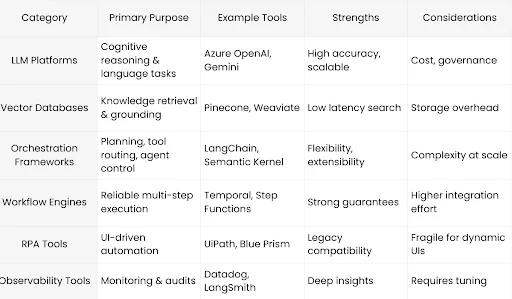
The effectiveness of enterprise AI agents depends on selecting a cohesive stack of AI, orchestration, RPA, and analytics platforms that complement one another. CTOs should prioritize modularity, robust governance, and ecosystem interoperability to ensure long‑term scalability and maintainability.
Security, Compliance, and Governance for Enterprise AI Agents
Enterprise AI agents must operate within strict security and compliance boundaries to prevent unauthorized actions, data exposure, or regulatory violations. At the foundation is robust access control, with each agent assigned least‑privilege permissions via IAM, RBAC, and scoped API keys. Sensitive actions, such as financial postings, identity changes, and data exports, should require human approval or policy-based gating.
Compliance requirements such as GDPR and CCPA mandate data minimization, purpose limitation, and clear audit trails. Agents should never store or process personal data outside approved boundaries, and all interactions must be logged for traceability. Encryption in transit and at rest, tokenization of PII, and strict retention controls are essential.
A comprehensive governance AI framework for regulated industries should include model‑risk controls, bias monitoring, hallucination mitigation through retrieval grounding, and periodic behavioral audits. Additionally, observability tools must track agent decisions, tool calls, failures, and policy deviations.
Together, these controls ensure agents remain safe, compliant, and predictable, while giving enterprises the confidence to scale autonomous workflows responsibly.
Measuring ROI of Enterprise AI Automation Agents
Measuring the impact of enterprise AI agents requires a disciplined, metrics-driven framework that captures both operational gains and strategic outcomes. For CTOs, tracking the right indicators ensures transparency, optimizes scaling decisions, and validates long‑term value.
1 Automation Rate & Workflow Coverage
The automation rate quantifies how much of a workflow an agent can independently complete.
Key metrics include:
- Task automation rate (%): Portion of tasks executed without human intervention.
- Workflow coverage: Number of processes fully or partially automated.
- Human‑handoff frequency: Measures where agents still require escalation.
A rising automation rate reflects maturity in both agent capability and integration depth.
2 Efficiency Gains & Cycle‑Time Reduction
One of the clearest indicators of ROI is operational speed and reduced manual effort.
Track improvements in:
- Cycle time (before vs after): Time to complete tickets, approvals, reconciliations, or onboarding steps.
- Agent throughput: Number of tasks executed per hour/day.
- Manual effort reduction: Hours saved through automation, mapped to cost savings.
Organizations often see 20–40% reductions in processing time when agents orchestrate multi‑step workflows end‑to‑end.
3 Decision Accuracy & Quality
For agents performing reasoning or decision-support tasks, quality matters as much as speed.
Monitor:
- Decision accuracy: Alignment with ground truth, policies, or human benchmarks.
- Error rate: Frequency of incorrect actions, misclassifications, or hallucination-driven outputs.
- Validation success rate: How often the agent’s outputs pass quality checks.
This ensures autonomous decisions remain reliable and compliant.
4 Reliability, Uptime & System Performance
Since agents execute operational tasks, stability directly impacts business continuity.
Track:
- Agent uptime: Availability of the orchestration and inference systems.
- Tool-call success rate: Percentage of successful API interactions across ERP/CRM/ITSM platforms.
- Latency: Response time for LLM reasoning and action execution.
High uptime and stable latency ensure predictable performance under enterprise load.
5 ROI Dashboarding & Continuous Optimization
A comprehensive ROI dashboard should visualize:
- Cost savings (labor hours saved, SLA improvements)
- Quality improvements (higher accuracy, fewer errors)
- Reliability (uptime, failure patterns)
- Adoption metrics (active agents, workflows automated)
Together, these metrics offer a full view of the economic and operational impact of AI agents, guiding future scaling decisions and investment priorities.
Emerging Trends and Future Directions
The next wave of enterprise AI will be defined by multi-agent collaboration, where specialized agents coordinate across functions to execute complex, end‑to‑end workflows. Instead of a single agent handling all tasks, ecosystems of agents, procurement agents, compliance agents, and diagnostic agents will work together through shared orchestration layers. This model increases scalability, modularity, and fault tolerance.
Advances in generative AI will deepen agent capabilities, enabling richer reasoning, more accurate document understanding, and dynamic synthesis of insights across large, unstructured datasets. These improvements will unlock new use cases such as autonomous reporting, contract analysis, and scenario modeling.
Another major trend is the rise of self-optimizing workflows. Agents will continuously observe their own performance, identify inefficiencies, refine playbooks, and modify workflows in real time, without requiring manual rule updates. Combined with real‑time telemetry, this enables systems that improve continuously as operational conditions evolve.
Together, these trends point to a future where AI agents behave not just as digital workers but as adaptive operational ecosystems deeply woven into enterprise architecture.
Conclusion & Next Steps
Enterprise AI agents are rapidly evolving from experimental tools into core operational assets that reshape how organizations automate, analyze, and execute work. By combining advanced reasoning, workflow orchestration, and deep system integration, agents deliver measurable improvements in efficiency, accuracy, and decision-making quality. For CTOs, the strategic value is clear: AI agents reduce operational load, unlock new automation opportunities, and enable teams to focus on higher‑impact initiatives.
However, sustainable adoption requires a structured, well-governed approach. Robust architecture, clear security boundaries, strong observability, and disciplined model‑risk controls ensure agents behave predictably and safely at scale. With these foundations in place, enterprises can confidently expand from isolated pilots to multi-agent ecosystems that drive continuous operational improvement.
Recommended next steps:
- Identify 2–3 pilot workflows with high volume, clear metrics, and manageable risk—such as ticket triage, reporting, procurement validation, or knowledge retrieval.
- Establish an agent governance framework covering IAM, audit logging, and human‑in‑the‑loop checkpoints.
- Build foundational integrations (APIs, connectors, vector retrieval) to ensure agents operate with accurate and compliant data.
- Enable continuous improvement mechanisms to refine prompts, update knowledge bases, and optimize performance.
By following a deliberate, value-first strategy, CTOs can unlock the full potential of enterprise AI agents and lay the groundwork for scalable, future-ready automation.
FAQs
How are AI agents different from traditional automation?
They can reason, adapt, and handle unstructured data—far beyond rule-based RPA.
Do agents replace humans?
No. They automate repetitive tasks while humans handle strategy and exceptions.
What systems can AI agents integrate with?
ERP, CRM, ITSM, HRIS, data warehouses, APIs, and legacy systems via RPA.
How do I measure agent performance?
Track automation rate, cycle-time reduction, accuracy, uptime, and tool-call success.
Are AI agents secure for regulated industries?
Yes—if implemented with strong IAM, audit logs, encryption, and compliance controls.
What is the biggest risk?
Unbounded autonomy. Use action whitelists, guardrails, and human‑in‑the‑loop steps.
How long does deployment take?
Initial pilots take 6–12 weeks; enterprise scaling depends on integration complexity.