Softude
High operational costs and low margins are the reality for many mid-size enterprises; you might be facing them too. Your legacy systems, those “reliable” tools you’ve used for a decade, are now preventing you from quick digital transformation. Meanwhile, smaller, digital-native competitors are entering your space and moving twice as fast because they aren’t carrying your technical debt.
Why does it happen? Most leaders make the mistake of treating digital transformation as an IT project, a line item for software and faster servers. That’s a trap. Real transformation is a business strategy. It’s about fixing how you create value, how you talk to customers, and how you handle risk before it handles you.
If your departments can’t share data without manual exports, or if your security plan is just “hope we don’t get hit,” you are at risk. You need a realistic, phased digital transformation roadmap to balance the long-term goal with the need for a return on your investment today.
Here is the practical business transformation guide that you need to follow over the next 12 to 24 months.
Why Digital Transformation is Still Harder for Mid-Size Enterprises

Fortune 500 companies have the budget to fail. They have innovation labs and massive IT teams. You might have that too, but not on that big scale, resulting in the following hurdles:
- The Resource Gap: You have enterprise-level problems but mid-market staff levels. Your IT team is likely buried under day-to-day maintenance, leaving zero room for strategic growth.
- Legacy “Brains”: Your business probably runs on an old ERP or a custom database that holds all your history. Replacing it is like doing a heart transplant while the patient is running a marathon.
- The “Way We Do Things” Mentality: In a mid-size business, culture is strong. Middle managers may see automation as a threat to their jobs rather than a tool to help them.
- Cash Flow Constraints: Every dollar spent has to work. You don’t have the luxury of “experimental” spending; you need to see efficiency gains within months, not years.
Your Practical Guide for Business Transformation
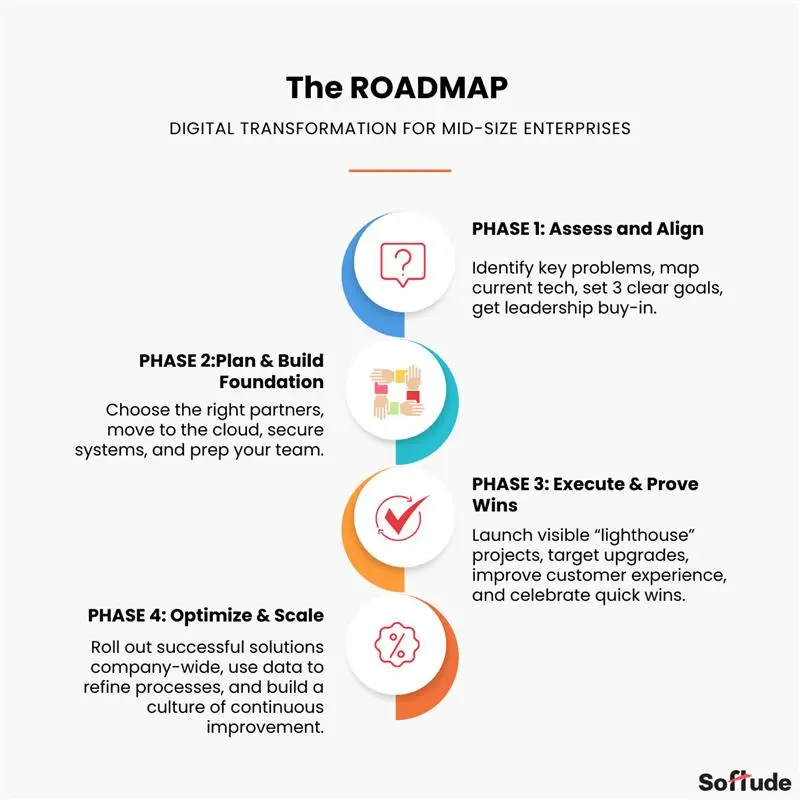
Transformation shouldn’t happen all at once. If you try a “Big Bang” approach, you’ll break the business. Instead, go phase-wise.
Phase 1: Assessment & Strategic Alignment
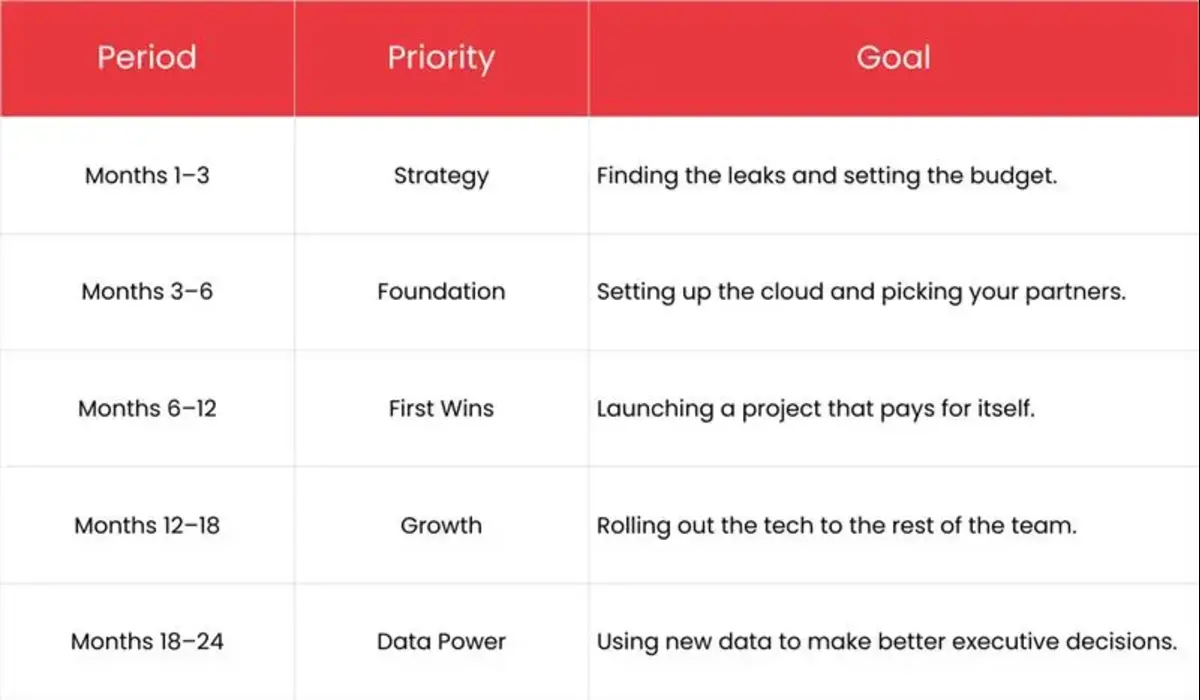
Timeline: 1-3 Months
Ask Yourself: Are we actually fixing the right problems?
Don’t sign a single contract until you know exactly what business outcome you’re chasing.
- Audit the Mess: Map out your current tech. Find out where people are using Excel because the main system isn’t working. Find where data is getting stuck.
- Spot the Bottlenecks: Talk to your operations and sales leads. Where is the friction? Is the sales team spending more time on data entry than on selling?
- Set 3 Simple Goals: Don’t try to fix everything. Pick three targets, maybe reducing shipping errors by 20%, or cutting the time it takes to close the monthly books in half.
- Get the “C-Suite” on Board: If your CFO thinks this is just “buying computers,” they will pull the plug when things get difficult. They need to own the business outcomes.
Deliverable: A blueprint that shows exactly what you’re building, why it’s worth the money, and where the funding is coming from.
Phase 1 Checklist:
- [ ] List of every software tool currently in use.
- [ ] Top 5 business pain points ranked by cost.
- [ ] A small, dedicated team to lead the change.
Phase 2: Planning & Foundation
Timeline: 3-6 Months
Ask Yourself: Is our foundation solid enough to grow?
This phase of the enterprise modernization plan is critical.
- Choose Partners, Not Just Vendors: You need a digital transformation partner who understands mid-market constraints. Avoid the “giant” vendors who will treat you like a small fish unless you have a dedicated account manager who actually answers the phone.
- The Cloud Move: Move away from on-premise servers where possible. The cloud lets you scale up (or down) without buying more hardware.
- Security from the Start: Cybersecurity isn’t an add-on. Build it into every new process. It’s much cheaper to secure a new system than to fix a breached one.
- Talk to Your People: Start the internal PR campaign. Tell your staff what’s coming, why it helps them, and how you’ll train them.
Phase 3: Execution & “Lighthouse” Wins
Timeline: 6-18 Months
Ask Yourself: Where can we show people this actually works?
To keep morale high and the board happy, you need a “Lighthouse Project”- a visible win that proves the digital adoption strategy is working.
- Targeted Upgrades: Instead of a total ERP overhaul, maybe you start by modernizing the CRM or automating the invoicing process.
- Fix the Customer Experience: Build a portal or an app that makes it easier for customers to order from you. When customers are happy, everyone sees the value.
- Why Speed Matters: Quick wins provide the “political capital” you need to keep going. A 15% gain in one department is the best argument for continuing the project.
Phase 4: Optimization & Scaling
Timeline: 18-24 Months
Ask Yourself: How do we keep this momentum without making things too complex?
Now that the foundation is set and you have some wins, it’s time to make it the new standard.
- Roll It Out: Take what worked in one department and apply it to the rest of the company.
- Use Your Data: You’re finally collecting clean data. Use it. Move from “I think we’re doing well” to “the data shows we need to adjust our inventory here.”
- Culture of Change: Digital transformation doesn’t really have an end date. You are building a company that is now capable of constant, incremental improvement.
Also Read: Enterprise AI Adoption Roadmap 2026
What This Costs

Budgeting for transforming your business is usually the hardest part. So, don’t agree on the fixed numbers; look at these benchmarks:
- Investment Range: Most successful mid-market firms spend 2% to 5% of their annual revenue on transformation over two years.
- The “Lighthouse” Spend: Expect to put 20% of your total budget into those first high-impact projects.
- OpEx vs. CapEx: You’re moving from buying assets (servers) to paying for services (SaaS). This is better for your cash flow but requires a shift in the finance team’s approach to the books.
- The “Soft” Costs: Budget an extra 20% for things you’ll forget: training, integration help, and the temporary dip in productivity while people learn new systems.
5 Things the Mid-Size Enterprises Must Do
Technology fails because of leadership, not code. Focus here:
- Lead by Example: If you keep asking for paper reports while the team is using a dashboard, the project is doomed.
- Strategy First: Don’t buy a tool because you saw it in a LinkedIn ad. Buy it because your audit showed it solves a $100k-a-year problem.
- Think of the Customer: If a digital “improvement” makes it harder for a customer to talk to a human when they have a problem, you’ve failed.
- Over-Invest in Training: Software is only as good as the person using it.
- Secure It: One ransomware attack can put a mid-size firm out of business. Don’t cut corners on security.
Mistakes to Avoid When Applying Digital Adoption Strategy
- The “Big Bang”: If you try to do everything at once. You will fail.
- Ignoring the Users: If your team feels incompatible with the new technology, they will find ways to work around it.
- Data Messes: Moving bad data from an old system to a new system just gives you a faster way to make mistakes. Clean your data first.
- Long Contracts: Avoid 5-year lock-ins. Technology changes too fast.
At a Glance: Quick Digital Adoption Strategy
Bottom Line
Digital transformation isn’t a tech problem; it’s a leadership choice. You have to be the one to tell the organization that the “old way” is no longer an option.
For a mid-size enterprise, this isn’t about investing in a new technology. It’s about building a business that can handle a supply chain crisis, a labor shortage, or a new competitor without breaking.
The next two years are going to pass anyway. You can spend them fighting your old systems, or you can spend them building a business that’s ready for the next decade.
So, start today, and if you need help with digital adoption strategy or implementation, we are just one click away. Contact us to build and implement your enterprise modernization plan.
FAQs
Q: How do I handle employees who are afraid of being replaced by AI or automation?
Be transparent early. Explain that automation handles the “robotic” parts of their jobs, like data entry, so they can focus on higher-value work. Re-skilling should be part of your budget. If they see the tools making their lives easier, the fear drops significantly.
Q: We already have an IT Director. Why do I need to be involved?
Because an IT Director can buy software, but they can’t change your business model or force cross-departmental collaboration. If the CEO isn’t the one saying, “This is how we do business now,” the project will eventually get sidelined by other departments’ priorities.
Q: What if we start the 24-month roadmap and the market changes?
That is exactly why you use a phased approach. By moving to the cloud and partnering with agile providers, you’re building a system that is easier to pivot than your legacy hardware. Enterprise transformation is about building flexibility, not just a static set of new tools.
Q: How do I pick between two vendors that seem identical?
Look at their mid-market track record. Ask for references from companies of your size, not their Fortune 500 clients. Also, check their support model. Do you get a dedicated human or a ticket number? For a mid-size firm, access to support is more important than a long list of niche features.
Q: Is it better to build custom software or buy off-the-shelf?
In 90% of cases, buy off-the-shelf and configure it. Building custom software is expensive to maintain and creates a new type of “legacy” problem for the future CEO. Only build custom if that specific software actually” makes you better than every competitor.