Softude
If your enterprise is getting ready to scale IoT solutions, you’ve likely realized that it’s more than just adding more devices. IoT can improve efficiency, provide insights, and give your business a competitive edge, but expanding without careful planning can create technical, financial, and organizational roadblocks that slow progress and hurt ROI.
Before rolling out more devices or systems, it’s important to understand the challenges ahead and how to tackle them. Here’s a look at the main hurdles of scaling enterprise IoT solutions, and practical ways to overcome them.
The Immediate Challenge of Scaling Enterprise IoT Solutions
Scaling IoT today means managing a growing network of devices, sensors, and connected systems that generate large volumes of data. At the same time, enterprises must handle rising connectivity demands, security risks, complex integrations, and the need to turn data into actionable insights.
Without a solid plan, even well-designed IoT projects can hit bottlenecks. Recognizing these challenges early helps you plan smarter and expand your IoT ecosystem with fewer disruptions.
What Are the Challenges of Scaling Enterprise IoT Solutions
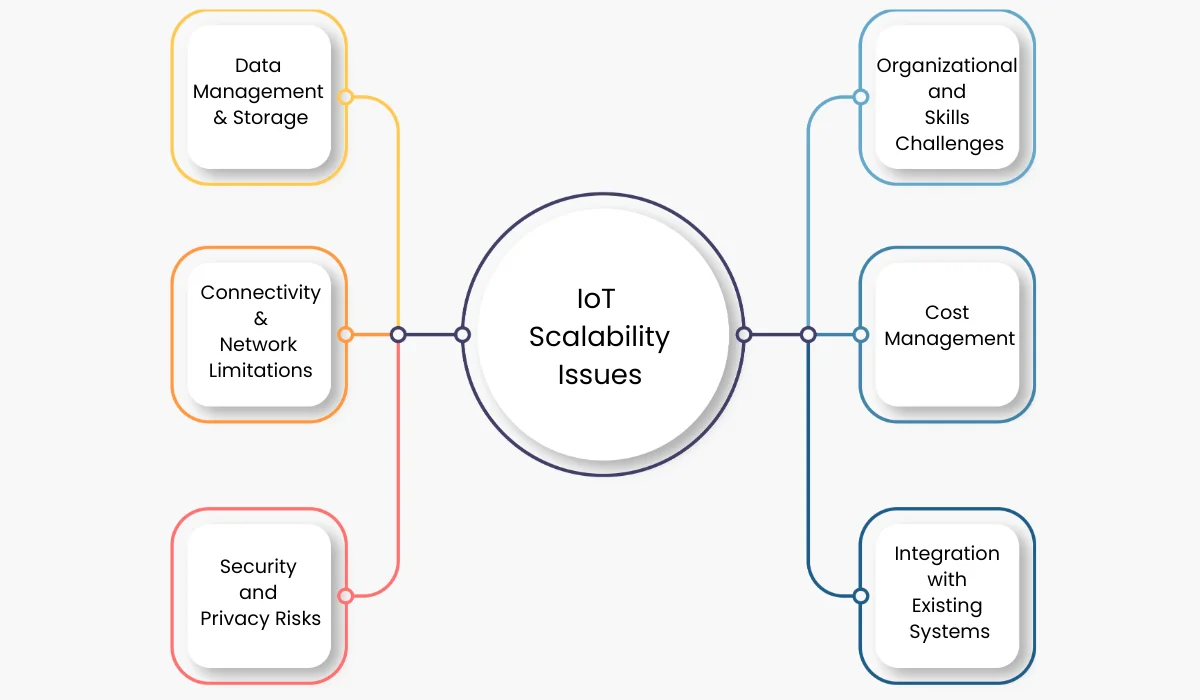
1. Data Management and Storage
As the number of IoT devices grows, so does the data they produce. Sensors, cameras, and machines generate constant streams of structured and unstructured data that need to be stored, processed, and analyzed.
If your infrastructure can’t handle high volumes and speed, you risk slow processing, storage bottlenecks, or lost insights.
Solution: Use scalable cloud storage or hybrid setups with edge computing to process critical data locally. This reduces latency and ensures only the data that matters gets sent to central servers.
2. Connectivity and Network Limitations
Adding more IoT devices puts a heavy load on your network. Bandwidth limits, inconsistent connectivity, and latency issues can disrupt operations.
For businesses that rely on real-time decisions, such as manufacturing or logistics, even small delays can cause productivity losses. Deployments in remote locations add further challenges due to unreliable coverage.
Solution: Use technologies like 5G, LPWAN, and Wi-Fi 6 to improve connectivity. Edge computing also helps by processing data closer to devices, reducing reliance on constant network connectivity.
3. Security and Privacy Risks
Every new IoT device adds potential security risks. Many devices have limited built-in security, making them vulnerable to attacks. At the same time, enterprises must protect sensitive operational data and customer information. Failure to meet regulatory requirements can result in fines and damage your reputation.
Solution: Implement security measures like device authentication, encryption, and secure firmware updates. Pick IoT platforms that comply with GDPR, CCPA, and other regulations.
Also Read: 5 Tips to Secure IoT Devices
4. Integration with Existing Systems
IoT devices need to work with the systems you already use. But many legacy IT systems, ERP, CRM, or asset management, weren’t built for real-time IoT data, which can create friction between old and new systems.
Multiple vendors in an IoT ecosystem make integration more complex. Without careful planning, you could end up with data silos or incompatible systems.
Solution: Use middleware or select enterprise IoT platforms that bridge the gap between legacy and modern systems. Standardized APIs help keep everything communicating smoothly.
5. Analytics and Actionable Insights
Collecting data is only useful if you can turn it into insights. Enterprises often struggle to process large volumes of IoT data in real time, generate predictive analytics, or create dashboards that decision-makers can use.
Solution: Invest in analytics platforms that handle real-time IoT data and integrate AI or machine learning to generate predictive insights. User-friendly dashboards help teams act quickly when issues arise.
6. Cost Management
Running IoT often costs more than just buying the devices. Monthly data fees, software updates, and sending technicians to fix broken devices can add up quickly. As costs rise, it becomes harder to show that the project is delivering value.
Solution: Focus on small wins. Look for immediate ways to save money, like using sensors to cut energy use by 5%, and reinvest those savings into the next phase of your IoT rollout. Using edge computing and energy-efficient devices can also help control costs.
7. Organizational and Skills Challenges
Even with the right technology, scaling IoT requires skilled people. Many enterprises struggle to find staff with experience in IoT hardware, software, and data analytics.
Scaling also requires organizational change. Processes need to adapt, and employees must be trained to use new systems effectively.
Solution: Train existing teams, hire IoT specialists, and foster a culture open to digital transformation. Partnering with experienced vendors can make the process smoother and reduce operational strain.
How to Overcome IoT Scalability Issues

Successfully scaling IoT requires a strategic approach. Focus on these areas:
- Hybrid Architectures: Combine edge and cloud computing for a balance of performance, storage, and cost.
- IoT Platform Selection: Choose platforms with strong device management, security, and analytics capabilities.
- Security by Design: Build security into your strategy from the start, rather than as an afterthought.
- Cost Optimization: Track expenses, phase deployments, and invest in energy-efficient solutions.
- Training and Change Management: Make sure teams are prepared to operate and maintain the IoT ecosystem.
- Vendor Management: Standardize protocols and maintain strong relationships with key vendors to avoid integration issues.
Addressing these areas proactively allows your enterprise to scale IoT efficiently while minimizing risks and maximizing ROI.
Conclusion
Scaling enterprise IoT solutions is complex, but entirely manageable. The key challenges,data overload, network constraints, security risks, integration issues, analytics bottlenecks, cost pressures, and skills gaps, can all be addressed with the right strategy.
Focus on flexible architectures, strong security, actionable analytics, cost control, and skilled teams. With planning and execution, IoT can transform operations, deliver insights, and drive real business value.
For a professional audit of your IoT setup or guidance on moving to an Edge-First system, feel free to reach out to our team.