Softude
Every sales manager knows the real cost of inefficiency. Your team spends precious hours on initial data enrichment, following up with leads that went cold weeks ago, and manually qualifying prospects who were never a fit. Every minute spent chasing a cold contact is a minute stolen from closing a qualified deal. This isn’t just wasted time; it’s a measurable drag on your pipeline velocity.
Imagine a genuine prospect, ready to take your services, lands on your website at 11 PM on Sunday. They have a specific, urgent pre-sales question. Since your team is offline, they submit a generic form, and by the time your rep follows up, they’ve already started the demo process with a competitor.
This is a structural weakness that compromises your Service Level Agreement (SLA) with marketing. The solution isn’t hiring another expensive full-time BDR for 24/7 coverage. It’s implementing an AI chatbot for lead generation.
What is an AI Lead Generation Chatbot?

At its core, a lead generation bot is an automated conversational program designed to proactively engage website visitors, gather their information, and qualify them as potential sales leads. Unlike a standard customer service chatbot that primarily answers FAQs, a lead generation chatbot has a singular, strategic mission: to identify and capture new sales opportunities.
Think of it as your tireless, 24/7 sales assistant, always ready to greet visitors, understand their needs, and guide them through the initial stages of the sales funnel. It’s programmed to ask targeted questions, collect contact details, and even provide basic product information, all while maintaining a natural, engaging conversation.
The key differentiator lies in its purpose. A regular chatbot might help a user find a specific article or reset a password. AI-powered lead generation chatbot, however, is engineered with sales goals in mind, focusing on converting anonymous visitors into identifiable prospects ready for human interaction.
How Does a Lead Generation Chatbot Work?
They work almost like a real salesperson. Here’s how
- Engaging Visitors
As soon as a visitor lands on your website, a chatbot can initiate a friendly greeting. This might be a subtle pop-up or a proactive message like, “Hi there! Looking for something specific, or just browsing? I can help you find what you need.”
The chatbot can be triggered based on user behavior, such as time spent on a page, pages viewed, or exit intent.
- Asking Qualifying Questions
Once engaged, the chatbot guides the conversation. Instead of a generic form, it asks a series of intelligent, qualifying questions tailored to your sales process.
For example, it might ask about the visitor’s company size, their role, their specific challenges, or their budget. This helps determine if they fit your ideal customer profile and whether they are ready to talk to sales.
- Collecting Contact Details
Once a visitor is qualified and shows interest, the chatbot seamlessly requests essential contact information like name, email, and phone number.
This is often framed as an offer for more personalized assistance, a demo, a valuable resource (e.g., an e-book), or a direct connection with a sales representative.
- CRM Integration
A crucial feature of any effective lead-generation chatbot is its ability to integrate with your existing Customer Relationship Management (CRM) system.
As soon as lead information is captured, it’s automatically pushed into your CRM, creating a new lead record. This eliminates manual data entry, reduces errors, and ensures your sales team has immediate access to new prospects.
- Role of AI and Automation
Bots leverage artificial intelligence to understand natural language, interpret user intent, and provide relevant responses. This makes conversations feel less robotic and more human-like.
Automation drives the entire process, from initiating conversations to qualifying leads and passing them to the sales team. This ensures consistency, efficiency, and round-the-clock operation.
Many advanced chatbots use AI predictive lead scoring to prioritize leads based on their engagement and responses, helping sales teams focus on the real prospects.
Key Benefits of Using AI Lead Generation Chatbots
For sales managers, the benefits of implementing AI chatbot lead generation are tangible and directly impact the bottom line.

- 24/7 Availability: Your website is always open, and so is your chatbot. It can engage prospects, answer questions, and capture leads even outside of business hours, on weekends, or during holidays. This means never missing a potential lead due to time zone differences or limited staff.
- Instant Engagement: In today’s on-demand world, customers expect immediate responses. Chatbots provide instant engagement, answering queries and initiating conversations without any delay. This significantly improves the user experience and reduces bounce rates.
- Personalization at Scale: While automated, chatbots can be programmed to deliver highly personalized experiences. They can greet visitors by name (if returning), tailor questions based on previous interactions or visited pages, and offer relevant content or solutions. This level of personalization makes prospects feel valued and understood.
- Higher Conversion Rates: By proactively engaging visitors, quickly qualifying them, and guiding them toward the next step, chatbots significantly boost conversion rates. They remove friction from the lead capture process and ensure that interested prospects are identified before they leave your site.
- Cost-Effectiveness: Automating the initial stages of lead generation with a chatbot can drastically reduce operational costs. It lessens the burden on your sales development representatives (SDRs) for initial qualification, allowing them to focus on closing deals rather than chasing cold leads.
- Data-Driven Insights: Chatbots collect valuable data on user interactions, common questions, and conversion paths. This data provides actionable insights into customer behavior, content effectiveness, and areas for sales process improvement. These chatbot performance metrics are invaluable for optimizing your strategy.
Also Read: Why AI Chatbots Are Valuable for Enterprise
What Are the Features of AI Lead Generation Bots
Modern AI lead generation chatbots come equipped with a suite of features designed to maximize their effectiveness:
- Templates for Lead Capture: Pre-built conversation flows and templates specifically designed for capturing lead information, making setup quick and easy.
- CRM and Marketing Integrations: Seamless connectivity with popular CRM systems (like Salesforce, HubSpot, Zoho) and marketing automation platforms. This is crucial for chatbot CRM integration.
- Automated Follow-ups: Ability to trigger automated email sequences or notifications to sales teams once a lead is qualified, ensuring timely follow-up.
- Multi-channel Support: Deployment across various platforms, including websites, social media (Facebook Messenger, Instagram), and messaging apps, offering a consistent experience wherever your prospects are.
- Analytics and Reporting: Dashboards and reports that provide insights into chatbot performance, conversion rates, conversation paths, and popular queries.
- Bot-to-Human Handoff: A critical feature that allows the chatbot to smoothly transfer a conversation to a live human agent when queries become too complex or a prospect is ready for a direct sales discussion.
- Multilingual Capabilities: Support for multiple languages, enabling businesses to engage a global audience effectively. These multilingual chatbots expand your reach significantly.
- Customization Options: The ability to tailor the chatbot’s appearance, tone, and conversation flow to align with your brand’s identity.
AI Chatbot vs. Human for Lead Generation: Which is Better
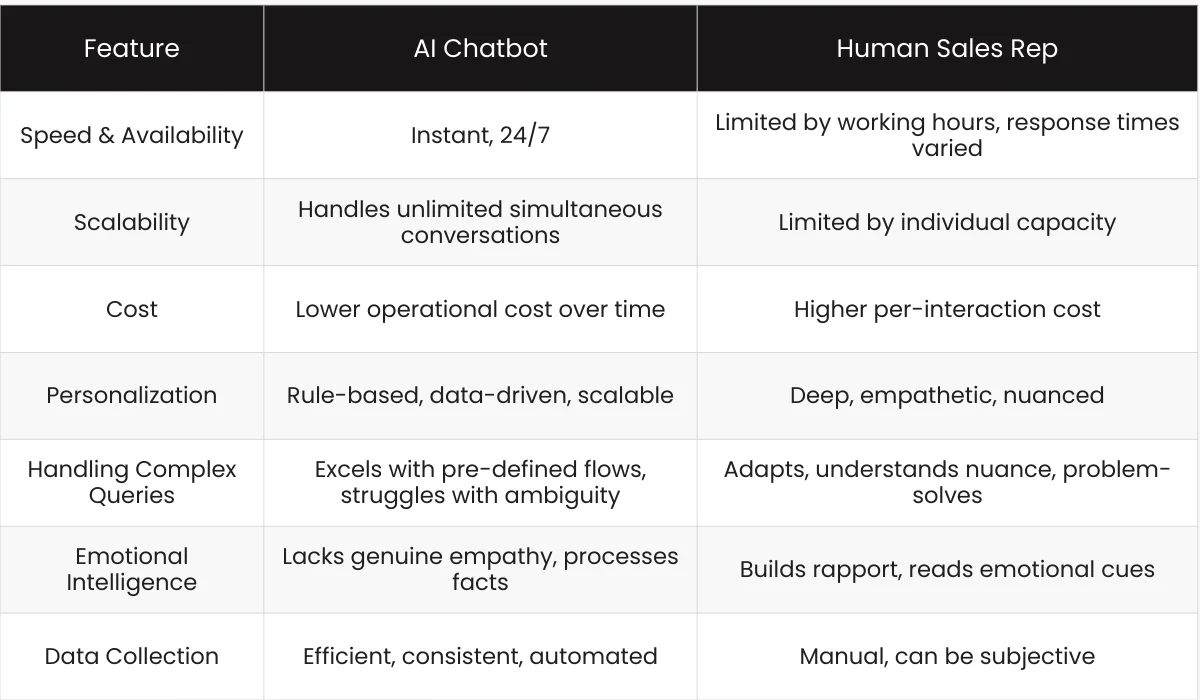
The debate isn’t about replacing humans but augmenting their capabilities. Here’s a comparison to illustrate where each excels:
Where AI Excels:
- Instant Responses: Providing immediate answers and engagement.
- Scalability: Handling hundreds or thousands of concurrent conversations without fatigue.
- Data-Driven Insights: Consistently collecting and analyzing data to improve lead qualification.
- Repetitive Tasks: Efficiently asking qualifying questions and gathering basic information.
Where Humans Excel:
- Building Trust and Rapport: Establishing genuine connections and empathy.
- Handling Nuanced Conversations: Understanding complex emotional cues and ambiguous requests.
- Creative Problem Solving: Deviating from scripts to find unique solutions.
- Closing High-Value Deals: Leveraging persuasion and negotiation skills.
What Are the Best AI Tools for Lead Generation
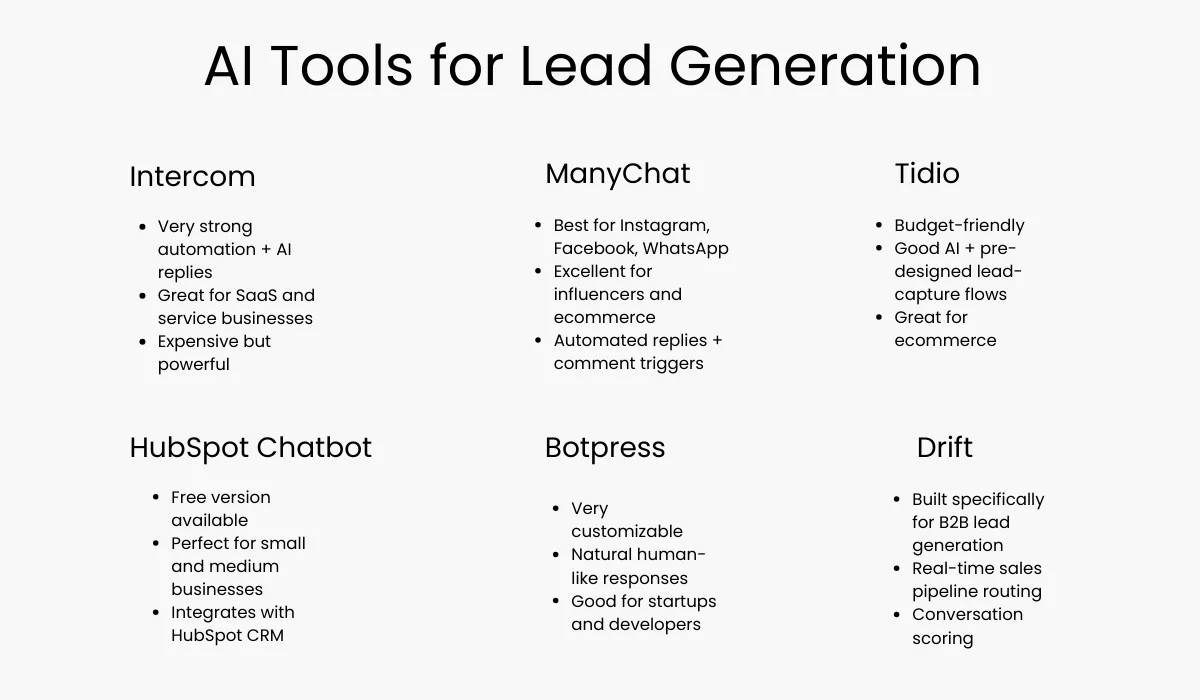
The market offers a range of powerful lead generation chatbot tools with AI features and unique strengths:
- Drift: Known for its conversational marketing platform, Drift offers robust lead qualification, meeting scheduling, and seamless integrations. It’s excellent for businesses focused on sales and customer experience.
- Intercom: A comprehensive platform that combines live chat, email, and bots. Intercom is strong in customer messaging and lead engagement, offering personalized journeys.
- HubSpot Chatbot: Integrated within the HubSpot CRM, this chatbot allows businesses to capture leads, book meetings, and provide customer support, all within a unified platform. It’s ideal for existing HubSpot users.
- Tidio: A user-friendly live chat and chatbot platform that helps businesses generate leads, provide customer service, and automate repetitive tasks. It’s affordable and easy to use.
- ManyChat: Primarily focused on Facebook Messenger and Instagram, ManyChat is powerful for businesses leveraging social media for lead generation and marketing campaigns.
These tools often provide templates and drag-and-drop builders, making it easier for sales managers to build lead generation chatbots without extensive coding knowledge.
When to Build a Custom AI Chatbot for Lead Generation
Why consider a custom solution? A custom AI chatbot is built from the ground up to meet your precise business needs and integrate perfectly with your unique tech stack.
Advantages:
- Full Control Over Features: Design every aspect of the chatbot’s functionality, from the deepest integrations to specific AI logic.
- Brand-Specific Experience: Ensure the chatbot’s personality, tone, and visual design perfectly align with your brand identity, offering a truly unique customer experience.
- Complex Integrations: Handle highly complex integrations with proprietary systems or specialized software that off-the-shelf solutions might not support.
- Scalability for Unique Demands: Build a solution that can scale precisely according to your future growth and specific operational demands.
How to Build a Custom Chatbot for Lead Generation
- Clearly outline what you want the chatbot to achieve (e.g., qualify leads for specific product lines) and understand your target audience’s common questions and pain points.
- Select the right platform or framework. Options include:
- Dialogflow (Google): Great for natural language understanding (NLU) and integration with Google services.
- Botpress: An open-source platform offering flexibility and control.
- Rasa: Another open-source framework, powerful for custom NLU and dialogue management, often preferred for complex conversational AI.
- Cloud-based AI Services: Azure Bot Service, Amazon Lex.
- Map out every possible user journey and chatbot response. This requires careful planning to ensure a smooth and logical conversation.
- Develop custom integrations to ensure data flows seamlessly between your chatbot and existing business tools.
- Program the chatbot’s NLU to understand various user inputs and train its AI models with relevant data to improve accuracy.
You can either hire a team of AI developers specializing in conversational AI or use advanced platforms such as Dialogflow, Botpress, or Rasa, which provide frameworks and tools for building sophisticated custom bots.
Embracing AI chatbot lead generation doesn’t mean you are giving away control over the quality of leads and sales, but it is about achieving those goals smartly, strategically, and easily. You can either opt for the best AI tool or build a custom AI chatbot.
FAQs
Q: What is the main difference between a regular chatbot and a lead generation chatbot?
A: A regular chatbot focuses on providing information and support, while a lead generation chatbot is specifically designed to proactively engage visitors, qualify their interest, and collect their contact information to create new sales leads.
Q: How does a lead generation chatbot integrate with my existing sales tools?
A: Most lead generation AI bots offer direct integrations with popular CRM systems (e.g., Salesforce, HubSpot) and marketing automation platforms. This chatbot CRM integration ensures that lead data is automatically transferred, streamlining your sales process.
Q: Can an AI chatbot replace my sales team for lead generation?
A: Not entirely. Chatbots excel at the initial engagement, qualification, and data collection. However, for nuanced conversations, building deep trust, and closing high-value deals, human sales representatives are indispensable. The best approach is a hybrid model that leverages the strengths of both.
Q: What are the key benefits of using AI for lead generation?
A: AI enables chatbots to understand natural language, interpret user intent more accurately, and provide more personalized and relevant responses. This leads to more engaging conversations, better qualification, and ultimately, higher conversion rates.
Q: Are there different types of chatbots for lead generation?
A: Yes, while the core purpose is lead generation, chatbots can vary. Some are rule-based, following pre-defined paths, while others are AI-powered, using natural language processing to understand and respond more flexibly. There are also voice-based chatbots (or voicebots) that engage users through spoken commands and can be used for lead generation in certain contexts, though text-based bots are more common for website lead capture.