Softude
If you are trying to get a clear answer on AI model vs algorithm, you have likely run into a lot of confusing explanations. In many tech circles, people use these words interchangeably, but they represent two different stages of technology.
Understanding the difference between the two is important to understand where human control ends and the machine’s “intelligence” begins. If you are managing a project, hiring developers, or trying to implement automation, you need to know whether you are looking for a set of rules or a system that learns from data.
This post breaks down the difference between these two machine learning basics.
What is an Algorithm

An algorithm is a procedure. It is a sequence of instructions designed to perform a specific calculation or data processing task. In traditional software engineering, the algorithm is the product.
Characteristics of Pure Algorithms:
- Procedural Logic: It follows a “Path A to Path B” structure. For example, a Binary Search algorithm finds an item in a sorted list by repeatedly dividing the search interval in half.
- Human-Authored: The logic is explicitly defined by a programmer. Every edge case must be anticipated and coded. If the programmer doesn’t write a rule for a specific scenario, the algorithm will fail or produce an error.
- Input/Output Consistency: In a traditional algorithm, the “intelligence” is static. If you input “X,” the algorithm executes “Step 1, Step 2, Step 3” and outputs “Y.” It does not matter if you run it once or a million times; the steps never change.
Examples:
- Dijkstra’s Algorithm: Used for finding the shortest path between nodes in a graph (used in GPS).
- SHA-256: A cryptographic hash algorithm that transforms input data into a fixed-size string of characters.
What is an AI Model

An AI model is not a sequence of instructions. It is a mathematical function (or a complex network of functions) that has been “fit” to a specific set of data.
When we talk about a model, we are talking about a file that contains parameters (weights and biases). These parameters represent the “knowledge” the system has acquired.
Characteristics of an AI Model:
- Parameterization: A model consists of an architecture (like a Neural Network) and the specific weights assigned to connections within that architecture.
- Inference-Based: Unlike an algorithm, which executes steps, a model performs inference. It takes input data, passes it through its mathematical layers, and calculates an output based on the patterns it was forced to recognize during training.
- Non-Explicit Logic: You cannot “read” a model’s logic in the way you read an algorithm’s code. If you open a Large Language Model file, you won’t see “If word = ‘Hello’, then reply ‘Hi’.” You will see billions of floating-point numbers.
Examples:
- ResNet-50: A model trained to recognize objects in images.
- GPT-4: A model consisting of hundreds of billions of parameters trained to predict the next token in a sequence.
What is the Difference Between AI Models and Algorithms
The confusion often stems from the fact that we use learning algorithms to create models. This is the core of the distinction.
The Training Phase (The Algorithm at Work)
During the training of an AI system, you use a Machine Learning Algorithm (such as Stochastic Gradient Descent or Backpropagation). This algorithm’s only job is to look at data, calculate the error in the model’s current prediction, and update the model’s weights to reduce that error.
The algorithm here is the “optimizer.”
The Deployment Phase (The Model at Work)
Once training is complete, the learning algorithm is discarded. What you are left with is the model. When you use an app that recognizes your face, the learning algorithm isn’t running; the model is simply processing your image through its established weights to give you a result.
Comparing AI Model Vs Algorithm
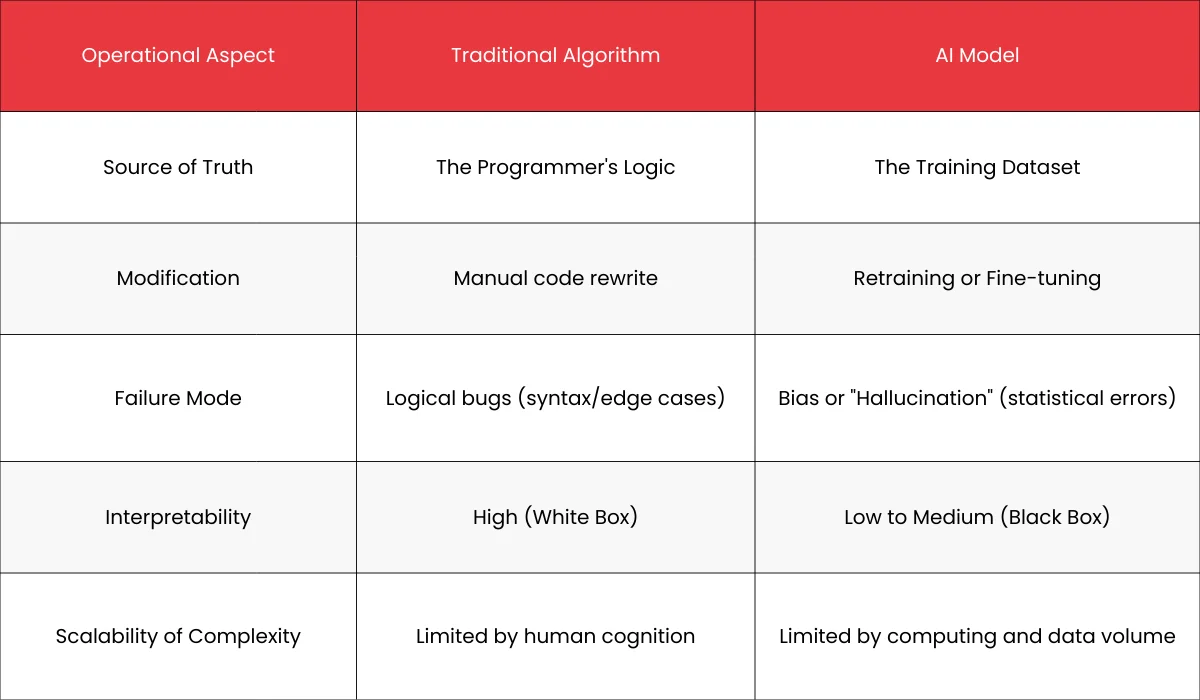
Also Read: The Fine Line Between AI Agents and AI Models
When to Deploy Which?
Choosing between a hard-coded algorithm and a trained model is a matter of complexity vs. certainty.
Use an Algorithm When:
- The outcome is binary and regulated. (e.g., calculating interest rates, validating a syntax, or sorting a database).
- Compute resources are extremely limited. Algorithms are computationally “cheap” compared to models.
- You need a guarantee. An algorithm guarantees that a specific input will always result in a specific output.
Use a Model When:
- The input data is “unstructured.” Humans cannot write algorithms to understand the pixels in a video or the nuances of human sarcasm.
- The rules are “fuzzy.” In fraud detection, the “rules” of what constitutes a scam change every hour. A model can adapt to these shifts by being retrained on the latest data, whereas an algorithm would require a human to manually update the code every time a new scam appears.
Common Misconceptions Around Model and Algorithm
-
“The Algorithm is Biased”
Technically, it is usually the model that is biased. The learning algorithm (like Gradient Descent) is just a mathematical formula for optimization. The bias enters the system via the data used to train the model, which the model then encodes into its weights.
-
“We need to update our algorithm”
When tech companies say this, they usually mean they need to retrain their model. Updating a recommendation “algorithm” usually involves feeding a newer model more recent user data so the weights shift to reflect current trends.
The Future: Algorithm-Model Hybrids
The most advanced AI systems today are moving toward Heuristic-Model Hybrids. For example, in self-driving cars:
- AI Models are used for perception (identifying “That is a pedestrian”).
- Traditional Algorithms are used for the “safety layer” (executing “If distance < 2 meters, then Hard Brake”).
This combination ensures that the system benefits from the pattern recognition of a model while maintaining the rigid, safe logic of an algorithm.
Summary
Understanding the boundary between these machine learning basics changes how you look at technology. You can now see that an algorithm is the “how”: the fixed, logical steps that guide a process, while the AI model is the “what”: the flexible system that makes predictions based on patterns it has learned.
When a system fails, you are now equipped to ask the right questions: Is the logic of the algorithm broken, or was the model trained on the wrong data? This distinction is the foundation of technical literacy in a world increasingly driven by automated decisions.
Frequently Asked Questions
- Are AI algorithms and AI models identical?
No. An AI algorithm is a defined procedure or method that specifies how a system processes data or learns from it. An AI model is the outcome of applying that algorithm to a dataset; it contains the learned parameters and represents the knowledge the system has acquired. In short, the algorithm governs how learning occurs, while the model holds what has been learned.
- Does an AI system execute the algorithm during inference?
No. Once a model has been trained, inference relies solely on the model. The learning algorithm’s role is limited to the training phase, where it adjusts the model’s parameters. After training, the algorithm is not needed for prediction.
- Can the model be updated without changing the algorithm?
Yes. The model can be refined or retrained with new data to improve performance or adapt to changes, while the underlying learning algorithm remains unchanged.
- Can the algorithm change without modifying the model?
Yes. Altering the algorithm, such as switching the optimizer, adjusting the loss function, or changing learning rules, requires retraining the system. This produces a new model, even if the original dataset is used.