Softude
Global manufacturers are transforming the way they plan production and forecast demand by using AI agents. These companies are not experimenting; they are getting measurable results: forecast accuracy improvements of up to 95%, faster schedule updates, reduced inventory costs, and a more agile, resilient supply chain.
For manufacturers facing volatile demand, supply chain disruptions, and shrinking planning windows, the message is clear: traditional methods no longer keep pace. Spreadsheets, static forecasting models, and ERP planning modules simply cannot respond fast enough. Manufacturers that fail to adopt AI-driven production planning risk falling behind competitors who can dynamically sense demand shifts, optimize schedules in real time, and prevent costly stockouts.
Why Traditional Planning Tools Fail in Production Planning

-
Spreadsheets: Fragile and Manual
Spreadsheets remain popular in manufacturing, but they’re error-prone, slow, and brittle. Manual entry, version conflicts, and complex formula chains mean one small mistake can cascade into major planning errors. Multi-variable production plan optimization or line balancing AI is nearly impossible in a spreadsheet environment without risking costly delays.
-
ERP Systems: Recording vs. Predicting
ERP platforms are excellent at capturing what happened, but they struggle with “what should happen next?” Most ERP planning modules rely on static historical data and averages, producing schedules that are obsolete almost as soon as they are generated.
-
Legacy Forecasting Tools: Slow and Non-Adaptive
Traditional demand forecasting tools depend on historical sales, seasonal indices, and long cycles. They can handle stable demand, but they don’t react well to sudden changes in customer orders, online sales surges, or supply-side disruptions. For AI demand forecasting, real-time adjustment is essential, and legacy tools just can’t deliver.
The Core Gap: No Continuous Feedback
None of these tools continuously monitors the system, senses changes autonomously, or triggers dynamic replanning without human intervention. In modern manufacturing, where a single disruption can ripple across multiple plants, that gap isn’t minor; it’s a competitive disadvantage.
What Are AI Agents in Production Planning?
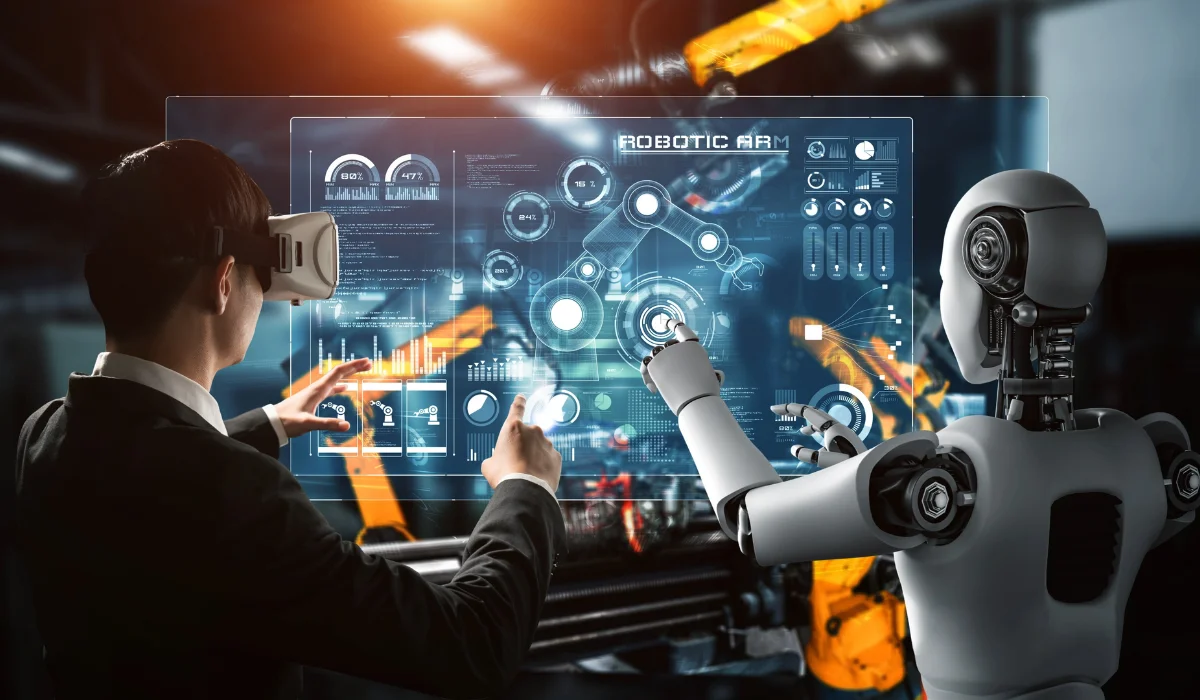
An AI agent in manufacturing is a system that continuously perceives its environment (data from sensors, ERPs, and demand signals), reasons over that data, and autonomously takes or recommends actions. Unlike rules-based automation, AI agents learn from patterns, adapt to new information, and handle ambiguity and trade-offs. They don’t just execute a static plan; they continuously evaluate whether the plan is optimal and adjust it as conditions change.
How AI Agents Help
- Faster replanning: Reduces planning cycles from days to minutes
- Improved forecast accuracy: Detects demand shifts before they impact production
- Constraint-aware decisions: Balances machine capacity, labor, and material supply simultaneously
- Reduced planner burden: Automates routine decisions so planners can focus on exceptions and strategy
- Scalability: Handles complexity across multiple plants, lines, and SKUs that a human team cannot
Where AI Agents Make the Biggest Impact
1. Demand Forecasting and Demand Sensing
Forecasting errors often start at the demand planning stage, causing downstream issues in scheduling, inventory, and service levels. AI agents improve this by:
- Real-time demand prediction: Pulls live data from POS, e-commerce orders, distributors, weather, and events, continuously updating forecasts
- Demand sensing: Detects short-term demand shifts before traditional models can
- Anomaly detection: Flags unusual spikes, drops, or deviations automatically
- Seasonal and volatile demand handling: Learns patterns across SKUs, geographies, and channels without manual adjustments
Outcome: Manufacturers report 20–40% improvement in forecast accuracy, directly reducing excess inventory and stockouts.
2. Production Scheduling Optimization
Scheduling is one of the most complex planning tasks. AI agents handle:
- Constraint-aware scheduling: Models operational constraints and generates optimized schedules
- Capacity optimization across plants and lines: Maximizes throughput and minimizes idle time
- Line balancing and workload distribution: Reduces bottlenecks and overtime
- Dynamic replanning: Adjusts schedules in minutes when disruptions occur
- Disruption-aware scheduling: Incorporates real-time signals like machine health or supplier delays
Unlike traditional APS tools, AI agents automatically adapt schedules to changing conditions, keeping shop-floor plans realistic and actionable.
3. Inventory and Supply Planning
AI agents prevent costly inventory mistakes:
- Inventory optimization AI: Dynamically calculates safety stock based on demand variability and lead times
- Reorder planning automation: Triggers procurement based on real-time inventory and predicted consumption
- Procurement forecasting: Aligns supplier orders with production plans, reducing rush orders and premium freight
Outcomes: Stockouts drop 30–50%, excess inventory decreases 15–25%, and material availability improves, freeing working capital.
How Industry Leaders Are Using AI Agents
By embedding AI in demand sensing and forecasting, Unilever continuously analyzes real-time POS data, weather, social media trends, and events. Forecast errors have dropped by over 50% in Europe and Asia, some categories achieving over 95% accuracy. Safety stock fell by up to 15%, reducing waste and manual planning effort.
BMW uses digital twins of its factories in NVIDIA Omniverse to simulate production processes, layouts, and logistics flows before physical changes. Combining simulation with AI reduced the time to validate new vehicle models from 4 weeks to 3 days.
Intel applies AI and machine learning across forecasting, inventory planning, and supply-demand coordination. Using AI-optimized hardware and software, Intel automated key planning decisions, improved forecast accuracy, and boosted gross profits by over $1.3 billion from 2014 to 2017.
Choosing the Right AI Planning Solution
With a growing number of vendors claiming AI capabilities in production planning, evaluation rigor matters more than ever. Here is what to focus on:
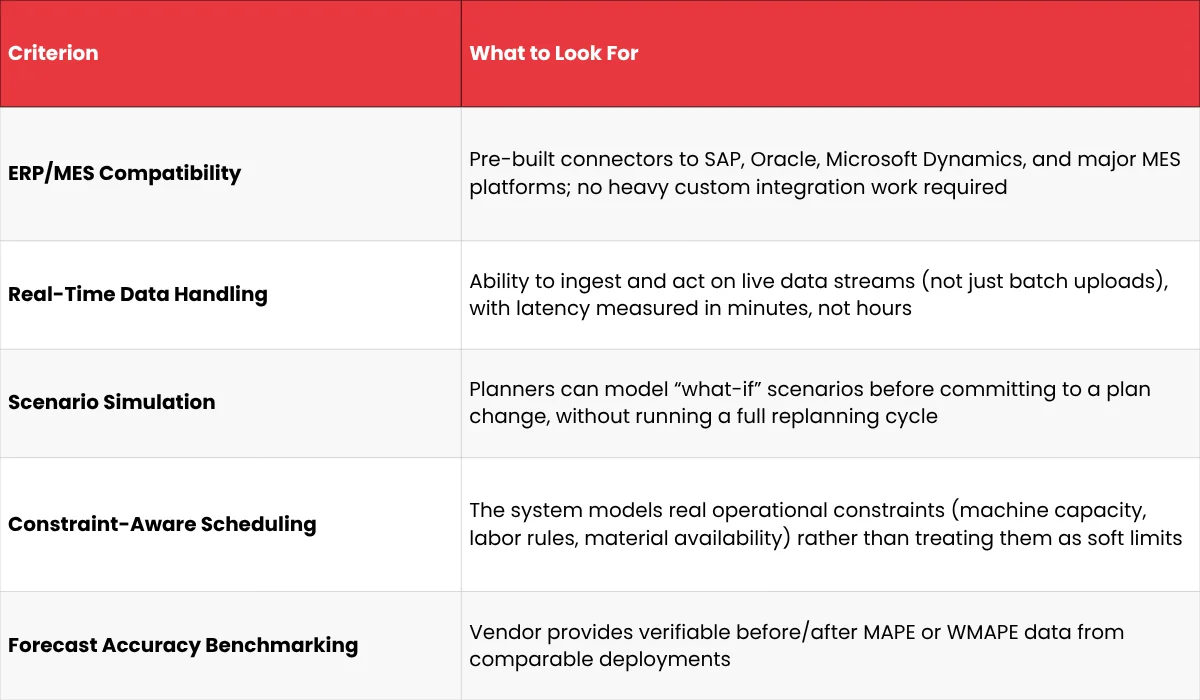
Questions to ask vendors:
- Can you provide MAPE benchmarks from real deployments?
- How fast does the system replan after a disruption?
- What’s the timeline to first value and go-live?
- How does it handle inconsistent or missing data?
- Can planners override recommendations, and does the AI learn from these actions?
Also check:
- End-to-end multi-agent systems for planning covering demand, supply, and scheduling.
- Scalable enterprise AI for manufacturing that grows with your operations.
- Explainable AI recommendations for planner trust.
- Verified ROI from real customers.
Implementation Challenges
AI agents deliver value, but implementation requires preparation:
- Data quality and integration: Poor master data, missing signals, or disconnected systems hurt accuracy. Conduct a data readiness assessment first.
- Planner adoption and trust: Without trust, planners override AI decisions, reducing effectiveness. Early wins and change management are essential.
- Model transparency: Black-box outputs undermine confidence. Ensure recommendations are explainable.
- Workflow redesign: AI often requires rethinking planning processes rather than just adding a new tool.
- Security and governance: Production planning data is sensitive; ensure compliance with data residency, access, and audit standards.
Wrapping Up
Manufacturers leveraging agentic AI in manufacturing are already seeing measurable gains like higher forecast accuracy, optimized schedules, smarter inventory, and more productive planners, often in just a few months.
The key is to start small. Pilot AI demand sensing, production scheduling optimization, or supply planning automation with clear KPIs. Early wins build trust, improve models, and create momentum for scaling across the enterprise.
The competitive window for AI-driven production planning is open but narrowing. Those who act now are not only improving efficiency, they’re transforming planning into a strategic advantage.
FAQs
How can AI improve production planning in manufacturing?
AI continuously analyzes demand, operational constraints, and supply conditions to generate optimized plans in real time. It detects disruptions, replans automatically, and reduces the time from insight to action from days to minutes.
Can AI handle real-time replanning in factories?
Yes. AI agents can instantly adjust schedules when a machine breaks down, a supplier is delayed, or a rush order arrives.
How does AI work with ERP systems?
AI agents connect via APIs or data connectors, read production orders, inventory, and master data, and update plans and procurement recommendations.
What are examples of AI in supply chain forecasting?
AI-powered demand sensing, autonomous reorder point calculation, procurement forecasting, and shortage detection systems are all real-world applications of AI in supply chain.
How do I implement AI in production planning?
Start with a data readiness assessment, select a focused pilot with clear KPIs, run it alongside current processes, and expand based on early wins. Change management is as crucial as the technology itself.