Softude
The first wave of generative AI focused on tools that write emails or summarise notes. However, the current frontier for the modern enterprise is “AI that works.” In other words, AI agents are becoming the new normal in enterprise. Unlike basic chatbots, these agents are autonomous because they don’t just process words; they execute tasks. They can understand business workflows, interact with existing software, and make real-time decisions without constant guidance from us.
For leadership teams, AI agents are the missing piece in digital transformation. They act as the “connective tissue” across a company, handling end-to-end tasks like autonomous purchasing or security monitoring. By letting agents take over routine cognitive work, leaders can decouple business growth from hiring needs. This builds the foundation for an “Autonomous Enterprise,” where your team focuses on strategy while your AI handles the execution.
The Shift From Rule-Based Automation to AI Agents
In the past, business automation relied on rigid “rule-based” systems. These tools followed a strict set of instructions: “If A happens, do B.” While effective for simple, repetitive tasks, these systems were brittle. If a single detail changed, like a slightly different invoice format, the entire process would break because the software couldn’t “think” its way through the problem.
Intelligent AI agents represent a major leap forward. Instead of following fixed rules, they use reasoning. Because they are powered by LLMs, they can understand context and handle messy, unstructured information. We have evolved from software that needs to be told how to do every step to agents that only need to be told the final goal.
Why Enterprises are Adopting This New Shift
Companies are moving toward AI-driven automation because traditional methods can no longer keep up with the volume and complexity of modern data. Leaders are adopting agents for three main reasons:
- Handling Complexity: Agents can manage tasks that involve multiple steps and different software platforms, such as processing a complex insurance claim.
- Scalability: Unlike human teams, AI agents can handle thousands of tasks simultaneously, 24/7, without losing accuracy or getting tired.
- Cost Efficiency: By automating “cognitive” chores—the small decisions that usually eat up a human’s day, enterprises can significantly lower operational costs while speeding up their response times.
The Enterprise Definition of AI Agent Systems
At its core, an AI agent system is a software entity that leverages a Large Language Model (LLM) as its “brain” to accomplish a specific goal. While a standard AI model is reactive, providing an answer only when prompted, an agent is proactive. It understands its environment, figures out what needs to be done, and uses tools to take action.
In the context of enterprise AI, an intelligent agent is defined by its degree of agency. Unlike a simple script that follows a “if-this-then-that” path, an intelligent agent can change its plan if it encounters an error. For example, if an agent tries to access a database and finds the server is down, it doesn’t simply crash; it can reason that it should notify an admin or try an alternative data source. This capacity for self-correction and tool use is what differentiates an AI agent from basic automation.
Role of AI Agents in Enterprise Digital Transformation
In the broader journey of digital transformation, AI agents act as the “connective tissue” for a company. Most large organisations struggle with “silos”—different departments using different software that doesn’t talk to each other.
AI agents bridge these gaps. They can log into one system, extract data, reason about it, and then execute an action in another system. This transforms AI from a simple “help bot” into a functional workforce. By integrating these agents, enterprises aren’t just making old processes faster; they are creating a new, autonomous way of doing business where software manages the routine so people can focus on strategy.
Benefits of AI Agents in Business
The adoption of agentic systems translates into significant strategic advantages. Understanding the benefits of AI agents in business allows leaders to view this technology not just as a tool, but as a driver of long-term organisational health and market competitiveness.
-
Cost Efficiency and Operational Scalability
One of the most immediate benefits is radical cost efficiency. By automating cognitive-intensive administrative tasks, businesses reduce their reliance on manual intervention, significantly lowering overhead. Furthermore, AI agents provide infinite operational scalability; they can handle a 10x surge in task volume without additional hiring or infrastructure expansion, allowing companies to grow without a linear increase in costs.
-
Faster Decision-Making and Reduced Error
In a data-driven world, speed is a competitive advantage. AI agents process vast datasets in seconds, leading to much faster decision-making across departments. Because agents follow precise logic and reasoning models, they virtually eliminate human error in repetitive data entry or complex calculations, ensuring that the business operates with high-fidelity information at all times.
-
Continuous Optimization
Unlike static software, AI agents are designed for continuous optimisation. They use feedback loops to learn from every interaction, identifying more efficient ways to complete tasks over time. This creates a self-improving operational engine that ensures the enterprise remains agile and optimised for current market conditions.
How Do AI Agents Work?
Understanding how AI agents work requires looking at them as a continuous loop of activity rather than a one-time calculation. An agent follows a circular workflow that enables it to interact dynamically with its environment.
The Core Workflow
To function autonomously within an enterprise, an AI agent relies on several interconnected components. Think of these as the biological systems of the software.
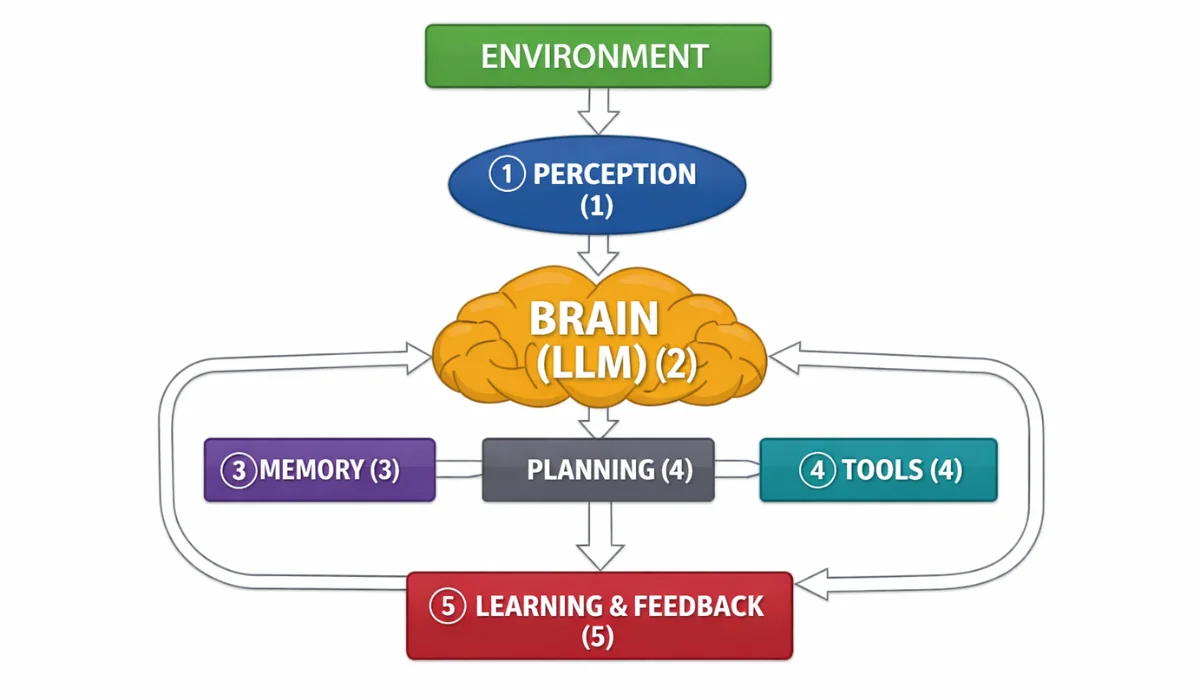
- The Brain (Reasoning Engine)
The core Large Language Model (LLM) serves as the engine for logic and language. It processes instructions, analyses context, and decides how to move toward the goal.
- Planning System
This component breaks down complex goals into smaller, manageable sub-tasks. It allows the agent to create a roadmap and adjust it in real time as conditions change.
- Memory Modules
Short-term Memory: Tracks the current conversation or immediate task context.
Long-term Memory: Uses vector databases to store historical results, ensuring the agent “remembers” successful strategies or specific user preferences.
- Toolset (Actionable Skills)
Agents use APIs, code interpreters, or search engines to interact with the world. Without this, the agent is just a thinker; with it, it becomes a doer.
- Feedback Mechanism
This component evaluates the outcome of actions. It allows the agent to self-correct and refine its decision-making model over time, ensuring continuous improvement in accuracy and efficiency.
5 Different Types of AI Agents
Not all agents are built the same. Depending on the task and environment, different types of AI agents are used. Understanding these categories helps businesses choose the right level of sophistication for their needs.
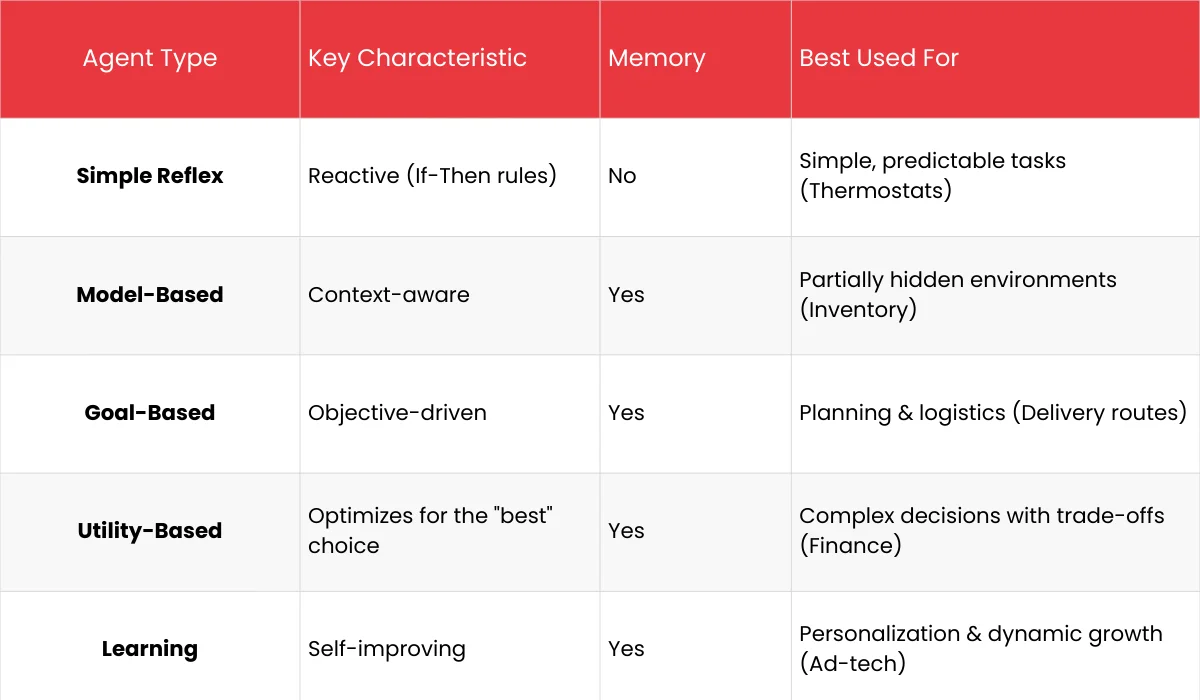
- Simple Reflex Agents
These are the most basic agents. They function using straightforward “if–then” rules. They do not have memory and only react to the current situation.
Example: A basic email filter that automatically moves any message containing the word “Winner” to the spam folder.
- Model-Based Agents
Model-based agents are one step ahead because they maintain an internal “model” or memory of the world. This allows them to handle situations where they can’t see everything at once by remembering past information.
Example: A warehouse robot that keeps a mental map of the floor so it doesn’t bump into a shelf it passed a minute ago.
- Goal-Based Agents
These agents are proactive. Instead of just reacting to rules, they have a specific objective (a goal) and plan a series of actions to reach it. They are flexible and can change course if an obstacle arises.
Example: A navigation app that calculates the fastest route to your office and automatically redirects you if it detects a new traffic jam.
- Utility-Based Agents
When there are multiple ways to reach a goal, utility-based agents choose the “best” one. They use a “utility function” to measure how happy or efficient an outcome will be, balancing trade-offs like speed versus cost.
Example: A flight booking agent that doesn’t just find a flight to London, but finds the one that offers the best balance of low price, short layovers, and high airline ratings.
- Learning Agents
These are the most advanced. They don’t just follow a set plan; they improve over time. By receiving feedback on their performance, they learn from their mistakes and successes to become more efficient.
Example: A personalised recommendation engine (like Netflix) that gets better at suggesting movies the more you interact with its choices.
The Core AI Agent Architecture
While “types” describe what an agent does, AI agent architecture describes how it is built to think. The architecture is the blueprint that defines how an agent processes information and interacts with its environment. Choosing the right architecture is critical for ensuring an agent can make intelligent, reliable decisions in a business setting.
Reactive vs. Deliberative Architecture
There are two fundamental ways an agent can “think”:
- Reactive Architecture: This design prioritises speed. The agent reacts to inputs instantly in accordance with predefined conditions. It is excellent for real-time tasks that do not allow for deep reflection, such as automated cybersecurity blocks.
- Deliberative Architecture: This design prioritises logic. The agent maintains an internal model of its world and “thinks” before it acts. It considers multiple future scenarios and carefully plans its steps. This is the preferred choice for complex project management or financial forecasting.
Hybrid AI Models
Most modern enterprise agents use a Hybrid Architecture. This combines the speed of reactive systems with the planning power of deliberative ones. A hybrid agent can handle routine tasks instantly but “escalates” to a deliberative mode when it encounters a complex problem that requires deeper reasoning.
Memory-Augmented Agents
Modern agents are increasingly “memory-augmented.” This means they are connected to external databases (often called Vector Databases) that act as a massive long-term memory. Instead of relying solely on information from a single prompt, these agents can pull in relevant data from months ago to inform their current decisions, creating a much more personalised and context-aware experience.
Tool-Using Agents Integrated with LLMs
The most powerful architectural shift involves integrating LLMs with specialised tools. In this setup, the LLM acts as the “dispatcher.” When a user asks a question, the architecture allows the agent to decide: “I don’t know the answer, so I will use the ‘Web Search’ tool”, or “I need to calculate this, so I will execute ‘Python Code’.” This integration moves the agent from a simple text generator to a functional problem-solver that can interact with the entire enterprise software stack.
Multi-Agent Systems: Collaborative AI Intelligence
While a single agent is powerful, enterprise AI reaches its full potential with multi-agent systems (MAS). In this architecture, multiple specialised agents work together as a digital workforce to solve problems that are too large or complex for any individual agent to handle alone.
Distributed Intelligence and Communication
Instead of one “all-knowing” model, multi-agent systems rely on distributed intelligence. Each agent is an expert in a specific domain (e.g., a “Security Agent,” a “Data Agent,” and a “Compliance Agent”). These agents use standardised protocols for agent-to-agent communication, allowing them to share findings, request assistance, and hand off tasks seamlessly.
Cooperative vs. Competitive Models
Most enterprise multi-agent systems use a cooperative model, where agents share a common goal and pool their resources to achieve it. However, some advanced systems use competitive models (or “adversarial” setups). In these cases, one agent might propose a solution, while another serves as a “critic” to identify flaws, ensuring the final output is highly refined and accurate.
How Multi-Agent Systems Work
A classic example of multi-agent collaboration is in automated software engineering where:
- The Product Agent defines the requirements based on user feedback.
- The Architect Agent creates the system design and selects the tech stack.
- The Coder Agent writes the actual code based on the design.
- The QA Agent runs tests and sends bugs back to the Coder Agent for fixing.
By orchestrating these agents together, enterprises can accelerate complex projects with a level of precision and speed that far exceeds traditional automation.
Are AI Agents Same as Chatbots?
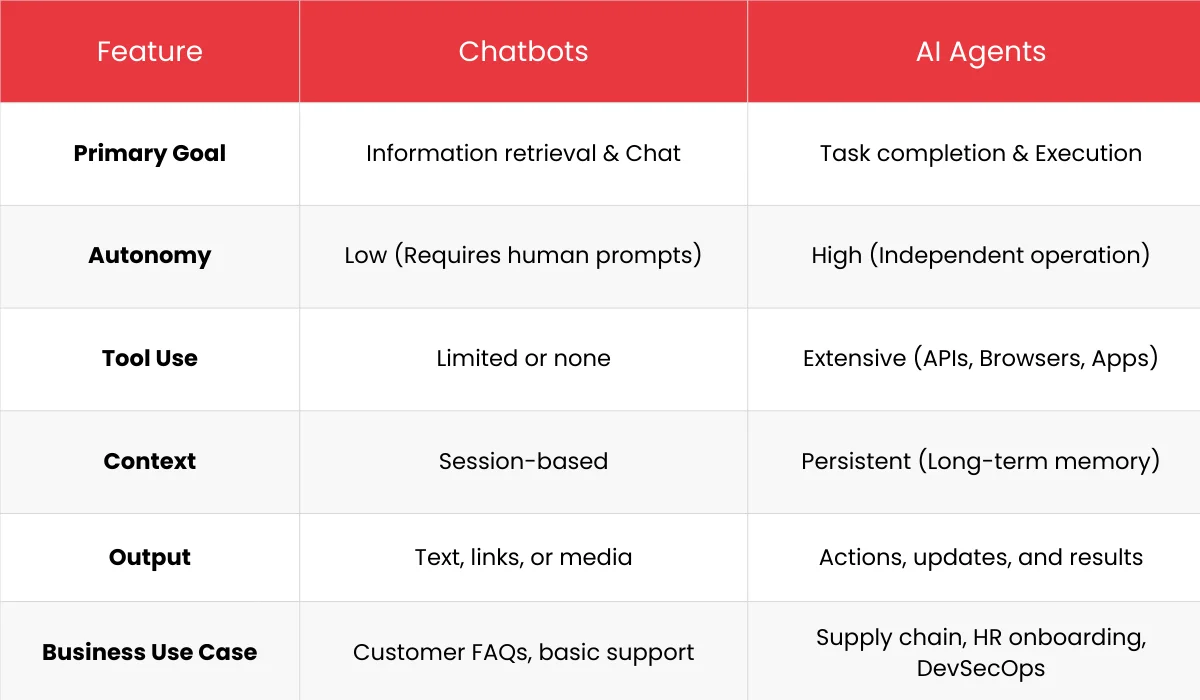
While many people use the terms interchangeably, the debate between AI agents and chatbots highlights a significant functional gap. Chatbots are designed to communicate, whereas AI agents are designed to execute. Understanding these differences is vital for any enterprise looking to move beyond simple customer support to true operational automation.
Conversational Interaction vs. Autonomous Execution
A chatbot’s primary goal is to provide information or answer questions within a conversation. It relies on a human to take the next step. An AI agent, however, is built for autonomous execution. If a chatbot tells you that your flight is delayed, its job is done. An AI agent would see the delay, find a new flight, check your calendar for conflicts, and book the new ticket for you.
Decision-Making and Integration
Chatbots typically operate in a “closed” system, answering based on the data they were trained on. AI agents possess advanced decision-making capabilities and are integrated with the broader enterprise environment. They can use tools, access real-time databases, and interact with third-party APIs to solve problems dynamically.
Comparison Table: AI Agents vs. Chatbots
Real-World Examples of AI Agents
To understand the transformative impact of this technology, look at real-world examples of AI agents currently driving efficiency in the enterprise. These examples move past simple text generation and show how agents function as active participants in business workflows.
-
Customer Service Automation Agents
Unlike basic chatbots, these agents handle end-to-end resolutions. For instance, an agent in a retail setting can process a return by verifying the receipt in a database, generating a shipping label via a logistics API, and issuing a refund in the payment gateway, all without a human agent touching the ticket.
-
Financial Decision Agents
In the fintech sector, agents monitor market data and internal portfolios. They can autonomously flag compliance risks or execute rebalancing trades based on predefined utility functions, ensuring the company’s investment strategy stays within risk tolerances during periods of high volatility.
-
Supply Chain Optimisation Agents
In manufacturing, agents monitor inventory levels across global warehouses. If a shortage is detected due to a shipping delay, the agent can automatically source alternative suppliers, negotiate pricing within set boundaries, and update production schedules in the ERP system to minimise downtime.
-
IT Operations Automation (AIOps)
IT agents manage infrastructure by proactively identifying server bottlenecks. When an error log is detected, the agent analyses the root cause, executes a script to restart the affected service, and documents the incident in a Jira ticket, closing the loop on technical issues before they impact end-users.
-
AI Copilots and Assistants
Enterprise “Copilots” serve as specialised internal assistants. A legal agent, for example, can scan thousands of contracts to find conflicting clauses, summarise the risks, and draft a memo for the legal team, effectively acting as an autonomous first-pass researcher.
Business Use Cases of AI Agents

Deploying technology is only valuable if it solves core operational challenges. Exploring business use cases of AI agents reveals how companies are fundamentally restructuring their work to achieve higher productivity and massive cost reductions.
-
Sales Workflow Automation
AI agents can act as autonomous sales development representatives. They research prospects, personalise outreach emails based on LinkedIn profiles or recent news, and handle the initial back-and-forth to book meetings. This allows human sales teams to focus solely on high-value closing conversations, increasing lead-to-opportunity conversion rates by up to 40%.
-
HR Recruitment and Onboarding
In HR, agents can screen resumes against technical requirements, schedule interviews, and even conduct initial screening chats. Once a hire is made, an onboarding agent can autonomously provision software access, send out policy documents, and answer “first-week” questions, reducing the administrative burden on HR teams and accelerating time-to-productivity for new employees.
-
Compliance and Risk Monitoring
Agents can continuously audit internal communications and financial transactions against regulatory frameworks (like GDPR or HIPAA). By identifying potential compliance breaches in real-time and automatically flagging them for review, enterprises significantly reduce the risk of costly legal fines and reputational damage.
-
Manufacturing Intelligence
On the factory floor, agents analyse sensor data from machinery to predict failures before they occur. By autonomously ordering spare parts and scheduling maintenance during off-peak hours, these agents ensure maximum equipment uptime and lower operational costs.
-
SaaS Operations Automation
For software-heavy businesses, agents can manage SaaS subscriptions. They monitor seat usage, identify underutilised licenses, and autonomously downgrade or cancel plans, resulting in immediate, measurable reductions in software spend.
How Enterprises Can Achieve AI Automation with AI Agents

Achieving AI-driven automation is not just a technology upgrade; it is a strategic shift in how work gets done. AI agents enable enterprises to move from fragmented automation to end-to-end autonomous execution. To realise this value, organisations must approach adoption as a transformation initiative rather than a series of isolated deployments.
1. Align AI Agents with Business Priorities
The starting point is not technology, but business impact. Enterprises should identify high-value workflows where automation can directly influence revenue growth, cost efficiency, or customer experience.
Instead of automating individual tasks, the focus should be on end-to-end processes such as sales conversion, supply chain operations, or customer lifecycle management. This ensures that AI agents drive measurable business outcomes rather than incremental efficiency gains.
2. Shift from Task Automation to Workflow Ownership
Traditional automation tools assist humans; AI agents take ownership of workflows. Enterprises must rethink how work is structured by allowing agents to manage multi-step processes independently.
This shift enables organisations to move from “human-led with AI support” to “AI-led with human oversight,” unlocking greater scalability and operational speed.
3. Build an Integrated AI Ecosystem
The true value of AI agents emerges when they are embedded within the enterprise technology stack. By integrating agents across systems such as CRM, ERP, and internal data platforms, organisations create a unified operational layer where decisions and actions flow seamlessly.
This integration transforms disconnected systems into a coordinated, intelligent network capable of executing complex business functions autonomously.
4. Establish Governance as a Strategic Enabler
As autonomy increases, governance becomes critical—not as a constraint, but as an enabler of scale. Enterprises must define clear boundaries for agent behaviour through policies, access controls, and audit mechanisms.
A well-designed governance framework builds trust, ensures compliance, and enables organisations to expand the scope of automation confidently without increasing risk.
5. Drive Continuous Optimisation and Competitive Advantage
AI agents are not static systems; they continuously learn and improve. Enterprises should treat them as evolving assets that refine decision-making and execution over time.
By leveraging feedback loops and performance insights, organisations can create a self-optimising operational model, one that becomes more efficient, accurate, and competitive with every interaction.
Conclusion and Next Steps
In summary, AI agent systems represent the pinnacle of modern enterprise automation. By combining LLM-based reasoning, persistent memory, and autonomous tool use, agents transcend the limitations of traditional chatbots and rule-based scripts. Whether through goal-based planning or collaborative multi-agent architectures, these systems offer a path toward radical scalability and cost efficiency.
For businesses, the importance of AI agents cannot be overstated; they provide the strategic opportunity to move from manual data processing to autonomous business execution. To remain competitive, organisations must evaluate their current workflows and identify where agentic intelligence can drive the most value. Now is the time to move beyond experimentation and explore AI agent solutions today to future-proof your enterprise and lead the next wave of digital transformation.
Frequently Asked Questions
What are AI agent systems?
AI agent systems are autonomous software entities that use Large Language Models as a reasoning engine. Unlike reactive AI, agents proactively plan, use external tools, and execute multi-step tasks to achieve specific goals with minimal human intervention.
How do AI agents operate in real-world environments?
AI agents follow a continuous loop: perceiving a trigger (like an email), reasoning through a plan, selecting appropriate tools (like an API), taking action, and learning from the outcome to self-correct and improve future performance.
How many categories of AI agents exist?
There are five main types of AI agents: simple reflex agents (rule-based), model-based agents (context-aware), goal-based agents (objective-driven), utility-based agents (optimisation-focused), and learning agents (self-improving through feedback). Each offers different levels of complexity and autonomy.
What is AI agent architecture, and why is it important?
Architecture defines how an agent processes data, manages memory, and interacts with tools. It is important because it determines the agent’s reliability, its ability to reason through complex problems, and its integration with enterprise systems.
What are multi-agent systems in AI?
Multi-agent systems consist of multiple specialised agents working together. This collaborative approach allows agents to solve complex problems by sharing information and handing off tasks, functioning like a coordinated digital workforce.
How are AI agents different from chatbots?
Chatbots are primarily conversational and require human prompts for each step. AI agents are execution-oriented; they possess the autonomy to use tools and complete entire workflows independently after receiving a single high-level objective.
What are the most common ways businesses use AI agents?
Businesses use AI agents for various tasks such as sales outreach, hiring and onboarding, compliance monitoring, predictive maintenance, and managing software tools. These are usually repetitive, data-intensive processes.
How do AI agents benefit enterprises?
The primary benefits include significant cost efficiency, infinite operational scalability, faster decision-making, and a massive reduction in human error. Agents also continuously optimise business processes through their inherent learning capabilities.
Are autonomous AI agents safe for enterprise environments?
Yes, provided they are deployed with proper governance. Safety is ensured through constrained action spaces, deterministic guardrails, and human-in-the-loop triggers that prevent agents from taking unauthorised or high-risk actions without approval.
Should businesses build or buy AI agent systems?
This depends on the use case. Choosing ready-made platforms enables quicker deployment, whereas building in-house allows for tailored functionality and a competitive edge.