Softude
AI predictive maintenance reduces machine downtime by reading sensor data from your equipment in real time and catching the early signs of failure, often weeks before anything actually breaks. Instead of waiting for a machine to fail or servicing it on a fixed calendar, you repair it when the data says it’s about to fail. Businesses using it typically cut unplanned downtime by 30-50% and see an 8-12x return on what they spend building it.
- According to Aberdeen Research, unplanned downtime costs manufacturers an average of approximately $260,000 per hour.
- Machine learning predicts failure by learning what normal sensor behavior looks like for a specific machine, then flagging deviations that match patterns seen before past breakdowns.
- Preventive maintenance and predictive maintenance are two different terms. One runs on a calendar and later runs on actual machine condition, which is why it catches failures preventive schedules miss and skips servicing that isn’t needed yet.
- To implement AI-driven predictive maintenance, manufacturers should start with 5-10 of the highest-cost-of-failure machines, rather than a plant-wide rollout.
Ask any plant manager what keeps them up at night, and unplanned downtime is usually near the top of the list. It’s not just the repair bill. It’s the missed shipment, the overtime pay, the customer who starts calling competitors. And most of it is preventable because machines don’t fail without warning. They fail with a warning. Nobody’s watching closely enough to catch it in time.
That’s the gap AI predictive maintenance closes.
What Is AI Predictive Maintenance?
AI predictive maintenance is a maintenance strategy that uses machine learning to analyze equipment sensor data and predict when a machine may fail, so repairs happen before a breakdown instead of after one.
It’s built on a simple idea: equipment gives off measurable signals as it degrades, vibration patterns shift, temperatures creep up, current draw changes, well before a visible failure happens. Machine learning models trained on historical failure data learn to recognize these early signals and flag risk before it leads to downtime.
This is different from just watching a dashboard. A human operator can watch one machine’s temperature gauge. An ML model can watch vibration, temperature, pressure, and current across hundreds of machines simultaneously and catch combinations of small changes that no single threshold alarm would ever trigger.
How Does Machine Learning Predict Equipment Failure?
AI predictive maintenance solutions use machine learning to predict equipment failure by following a data pipeline that runs from the sensor on the machine all the way to a technician’s work order. It’s worth walking through step by step, because each stage is where accuracy is either earned or lost.
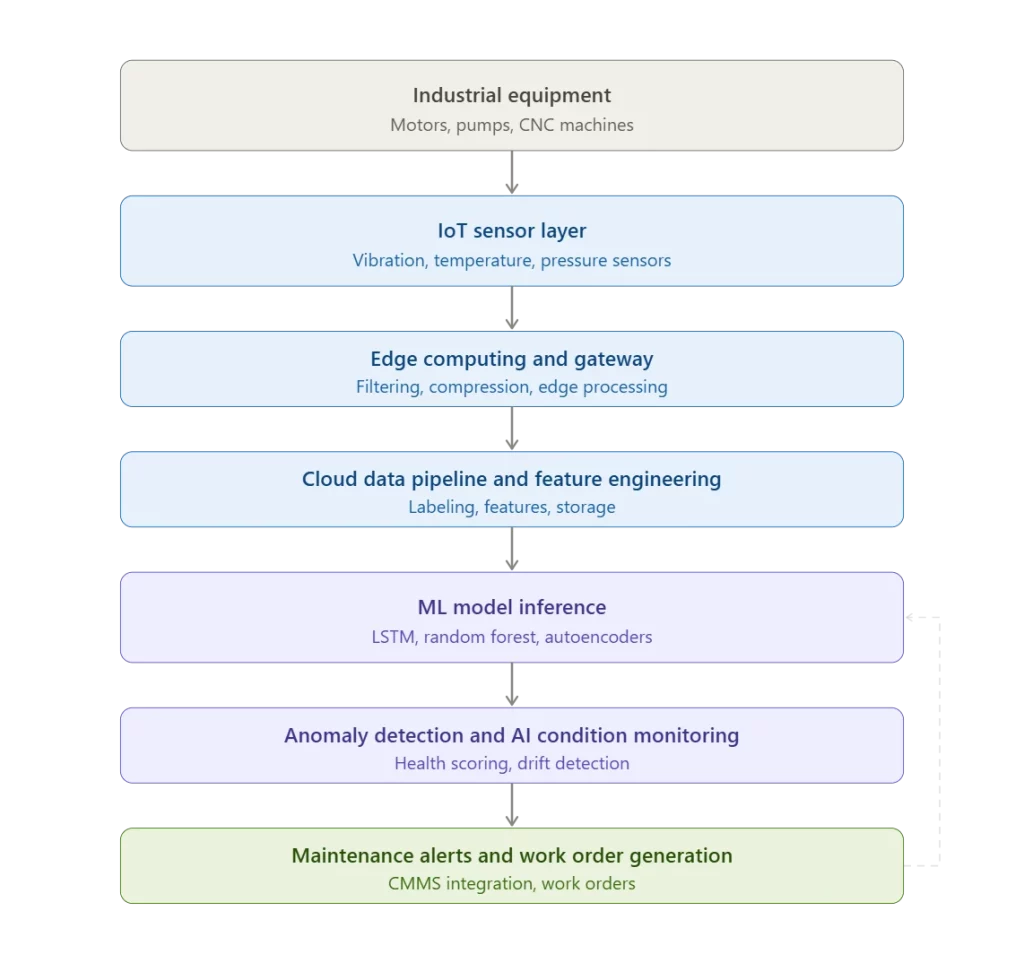
- Sensors collect machine data. Vibration, temperature, pressure, and current sensors sit on the equipment itself, continuously measuring the physical signals that change as a part wears down.
- IoT devices transmit data continuously. Edge gateways handle a first pass of filtering right at the machine, then send the cleaned stream to the cloud, so you’re not paying to move raw noise across the network.
- Data is cleaned and stored. Incoming readings get standardized, timestamped, and stored in a way that ties sensor data back to specific machines and components.
- Machine learning models analyze historical patterns. This is where labeled maintenance history matters most. The model learns what the sensor signature looked like in the days or weeks before every past failure on record.
- The model predicts failure probability. Instead of a simple pass/fail flag, most systems output a health score or an estimated failure window, something like “80-140 hours of remaining useful life.”
- Maintenance teams receive alerts. Risk-scored notifications go to technicians, ideally routed straight into whatever maintenance system they already use.
- Engineers inspect equipment. A technician checks the flagged component, confirms or rules out the issue, and logs what they actually found.
- Repairs occur before failure. The part gets serviced during a planned window instead of during an emergency stoppage, and the inspection finding feeds back into the model so it keeps improving.
That last step is where most deployments either compound in value over time or quietly stall. Models that get real feedback from inspections keep sharpening. Models that don’t tend to plateau at whatever accuracy they launched with.
Softude worked through exactly this pipeline for a commercial vehicle maufacturer. Our machine learning development team built a system with 98% prediction accuracy that saved 12000 hours of downtime and 43% of maintenance cost.
The system processes roughly 10^8 records per day, combining historical and real-time sensor data analytics.
The model flags both vehicles that need immediate attention and components trending toward failure, giving the maintenance team up to 3 weeks’ advance notice instead of a same-day scramble.
How Is Predictive Maintenance Different from Preventive Maintenance?
Predictive maintenance acts on actual equipment condition, while preventive maintenance acts on a fixed schedule regardless of condition, and that distinction is where most of the cost savings come from.
| Preventive maintenance | Predictive maintenance (AI-based) | |
| Trigger | Calendar or usage interval | Real-time condition and ML risk score |
| Risk of over-servicing | High (parts replaced with life left) | Low (parts serviced based on actual wear) |
| Risk of missed failures | Moderate (failures between service cycles) | Low (continuous monitoring) |
| Cost profile | Moderate, but wasteful | Lowest total cost over asset life |
| Data requirement | Minimal | Sensor data plus historical failure records |
Preventive maintenance isn’t wrong; it’s just blunt. Replacing a bearing every six months, whether it needs it or not, avoids some failures, but it also throws away good parts and still misses the failures that happen five months into the cycle.
AI predictive maintenance solutions replace the calendar with the machine’s actual condition, which is why organizations moving from preventive to predictive typically see both fewer failures and lower parts spend at the same time.
What Data Does an AI Predictive Maintenance System Use?

An AI predictive maintenance system uses machine learning algorithms, sensor data analytics, historical maintenance records, and operational context, combined so the model can connect a specific sensor pattern to a specific failure outcome.
- Vibration sensors catch bearing wear, misalignment, and imbalance earlier than almost anything else.
- Temperature sensors flag thermal anomalies in motors, bearings, and electrical panels.
- Current and voltage sensors pick up abnormal load patterns that often precede motor winding failures by hours or days.
- Pressure sensors track the health of hydraulic and pneumatic systems.
- Acoustic (ultrasonic) sensors catch leaks and electrical arcing that a walk-through inspection would miss.
- Oil quality sensors measure viscosity and particle count, a direct proxy for gear and bearing wear.
- Historical maintenance logs are what turn raw sensor readings into a labeled training set, mapping “this is what the data looked like right before that failure.”
Raw sensor data by itself isn’t usable. It has to be processed into features a model can actually learn from, things like RMS amplitude, frequency-domain values from FFT analysis, and rate-of-change metrics.
Organizations that skip this feature engineering step typically see accuracy drop 20-30% compared to teams that do it properly. It’s tedious work, and it’s also the single biggest lever on how good the model ends up being.
Which Machine Learning Models Are Used?
There’s no single best model for equipment failure prediction. The right choice depends on how much labeled failure data you have and what kind of failure you’re trying to catch.
| Algorithm | Best for | Data you need |
| Gradient boosting (XGBoost, LightGBM) | Structured sensor data with labeled failure history | Moderate — 50+ failure events per failure mode |
| LSTM networks | Time-series data with gradual degradation trends | High — 1,000+ sequences |
| Autoencoders | Anomaly detection when labeled failures are scarce | Low—to—normal operating data is enough |
| Survival analysis | Estimating remaining useful life | Moderate — time-to-event data |
Most teams don’t pick one model and stop there. A common, practical path is to start with gradient boosting on whatever structured data already exists, layer in autoencoders for early anomaly detection while labeled failure data builds up, and add LSTM models later, once there’s enough historical depth to justify it.
A high false positive rate, not low accuracy, is usually what kills adoption. If technicians get paged for problems that often turn out to be nothing, they stop trusting the alerts, and the system dies quietly from disuse rather than from being technically wrong.
Which Industries Benefit Most From AI Predictive Maintenance Solutions?
Any industry with expensive, hard-to-replace equipment and a high cost of downtime benefits, but a few sectors consistently see the fastest returns.
- Manufacturing. CNC machines, injection molders, and conveyor systems generate rich sensor data and fail in fairly learnable patterns. McKinsey reports that predictive maintenance can reduce machine downtime by 30–50% while extending machine life by 20–40%.
- Automotive. Stamping presses, welding robots, and paint booths run at high speed with almost no tolerance for surprises, and a single stoppage can cost past $1.3 million an hour. Connected vehicle and fleet programs extend the same logic beyond the factory floor.
- Energy and utilities. Wind turbine gearboxes, gas turbines, and pipeline compressors are remote, expensive, and painful to service reactively. A single offshore wind gearbox failure can cost $350,000 or more; models trained on vibration and oil analysis can flag these failures 30-45 days out.
- Aviation. Airlines running predictive maintenance programs report 15-30% fewer technical delays and cancellations.
- Healthcare equipment. MRI machines, ventilators, and infusion pumps are high-stakes assets where unpredictable failure timing directly affects patient care, not just budgets.
Also Read: Top 8 AI Use Cases in Manufacturing Driving Measurable Business Results
What Are the Benefits of Using Machine Learning for Machine Maintenance Prediction?
The core benefits of using AI for equipment failure prediction are fewer surprises, lower costs, and longer-lasting equipment. The numbers back that up fairly consistently across independent research.
| Metric | Typical improvement |
| Unplanned downtime reduction | 30-50% (McKinsey) |
| Maintenance cost reduction | 10-25% (McKinsey) |
| Asset lifespan extension | 20-40% (McKinsey) |
| Return on implementation investment | 8-12x (Deloitte) |
| Payback period | 12-18 months (Deloitte) |
Beyond the headline metrics, there are second-order benefits of using AI predictive maintenance solutions that don’t always make it into a business case but matter operationally:
- Fewer emergency parts orders at 3-4x standard pricing
- Fewer safety incidents from sudden failures
- Less accelerated wear on assets that keep getting forced through emergency restarts.
Run the math on your own numbers before trusting a benchmark table, though. A plant losing $3 million a year to unplanned downtime could reasonably save $900,000 to $1.5 million annually at a 30-50% reduction rate. A deployment covering 50-100 machines typically runs $400,000 to $800,000 in the first year, which puts payback inside 12 months for high-criticality environments.
How to Implement AI Predictive Maintenance?
Start with your worst assets, not your whole plant. Here’s a sequence that actually works in practice.
1. Map asset criticality. Pick 5-10 machines where downtime hurts the most. This is not the stage to think about fleet-wide rollout.
2. Audit your existing data. Check what your PLCs, SCADA systems, and DCS already capture. You may have more usable data than you think, and the gaps tell you exactly where to add sensors.
3. Fill sensor gaps. Deploy vibration, temperature, and current sensors where instrumentation is thin, with edge gateways handling local processing.
4. Label your historical failures. Go back through maintenance records and map them to sensor data. Slow work, but it’s what determines whether your model is actually accurate or just looks accurate on paper.
5. Pick your models. Match the algorithm to your data volume and failure type, as covered above.
6. Integrate with your CMMS. Alerts should generate work orders automatically. If technicians have to manually re-enter what the system already told them, adoption suffers fast.
7. Run in shadow mode first. Let the model generate predictions for 4-8 weeks without triggering real work orders, and compare predictions to what actually happened before going live.
8. Roll out and train. Technicians need to understand what an alert means and what to log when they inspect a flagged component. That log is what feeds the next training cycle.
9. Keep retraining. Quarterly retraining as failure data accumulates, with accuracy and false-positive rates tracked over time, not just at launch.
Most deployments fail in the same few places: skipping the data labeling work because it’s slow, launching alerts without CMMS integration, so they generate alert fatigue instead of action, or never closing the feedback loop, so the model never gets better than day one.
Softude’s ML Model Engineering team handles this end-to-end, from sensor data and feature engineering through model validation and CMMS integration, for teams that would rather not build the full pipeline from scratch internally.
Conclusion
AI predictive maintenance isn’t an emerging idea anymore. It’s a working operational tool, and the gap between businesses using it and those still running reactive or calendar-based maintenance keeps widening as equipment costs and labor shortages make every hour of downtime more expensive.
The organizations getting the most out of it aren’t necessarily running fancier algorithms than everyone else. They’re the ones treating data quality and feedback loops as an ongoing discipline instead of a one-time project, the same discipline that got a commercial vehicle manufacturer to 98% prediction accuracy and 12,000 hours of downtime saved.
Frequently Asked Questions
It varies by implementation, but well-built systems commonly reach 90%+ prediction accuracy. Softude’s commercial vehicle manufacturing deployment reached 98% failure prediction accuracy, driven mainly by high daily data volume and disciplined historical labeling rather than a particularly exotic model.
No. It predicts failures that resemble patterns already present in historical data. Sudden, novel failure modes with no prior precedent, or failures caused by one-off external events like an impact or a power surge, are harder for any model to anticipate.
It depends on the approach. Autoencoders for anomaly detection can work with just 3-6 months of normal operating data. Supervised models predicting specific failure types generally need at least 30-50 historical failure events per failure mode. Without much failure history yet, start with unsupervised anomaly detection and move to supervised models as data builds up.
Not always. Existing PLC logs, SCADA historians, and manual inspection records can be enough to get a first model working. Dedicated sensors give richer, higher-frequency data and usually better accuracy, especially for mechanical failures where the early signal is subtle, but they’re not a strict prerequisite for getting started.
Yes, as long as sensors can be retrofitted or relevant operational data (like current draw or run hours) is already being logged somewhere. Older equipment without any electronic instrumentation needs sensor retrofitting first, but that’s a common and well-understood step, not a blocker.
A focused rollout across 10-20 high-priority machines usually takes 3-5 months from sensor deployment to a live, working model. Enterprise-wide deployments across 100+ assets typically run 9-18 months, depending mostly on labeled data availability and CMMS integration complexity.
McKinsey reports that predictive maintenance can reduce machine downtime by 30–50% while extending machine life by 20–40%.