Softude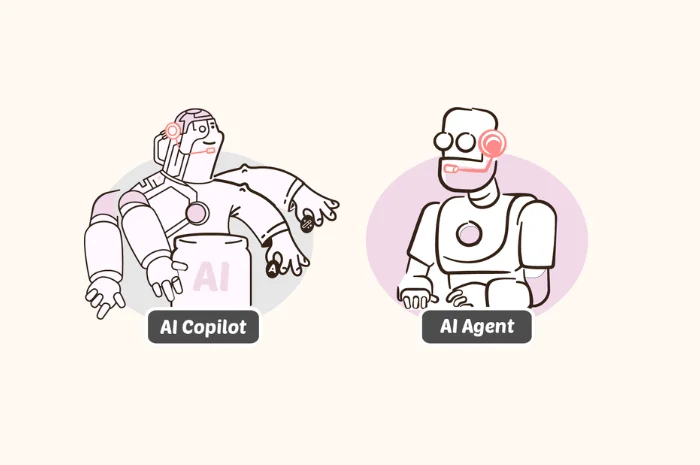
AI agents are good for clear workflows and span across multiple systems. Use copilots when tasks require human judgment, context, or ambiguity.
The real decision is not about where to put these intelligent tools. It is about how much autonomy your enterprise workflow can safely support, and whether your governance setup is ready for it.
- Copilots support users inside a single application, with humans approving each step
- Agents execute tasks across multiple systems with minimal human input
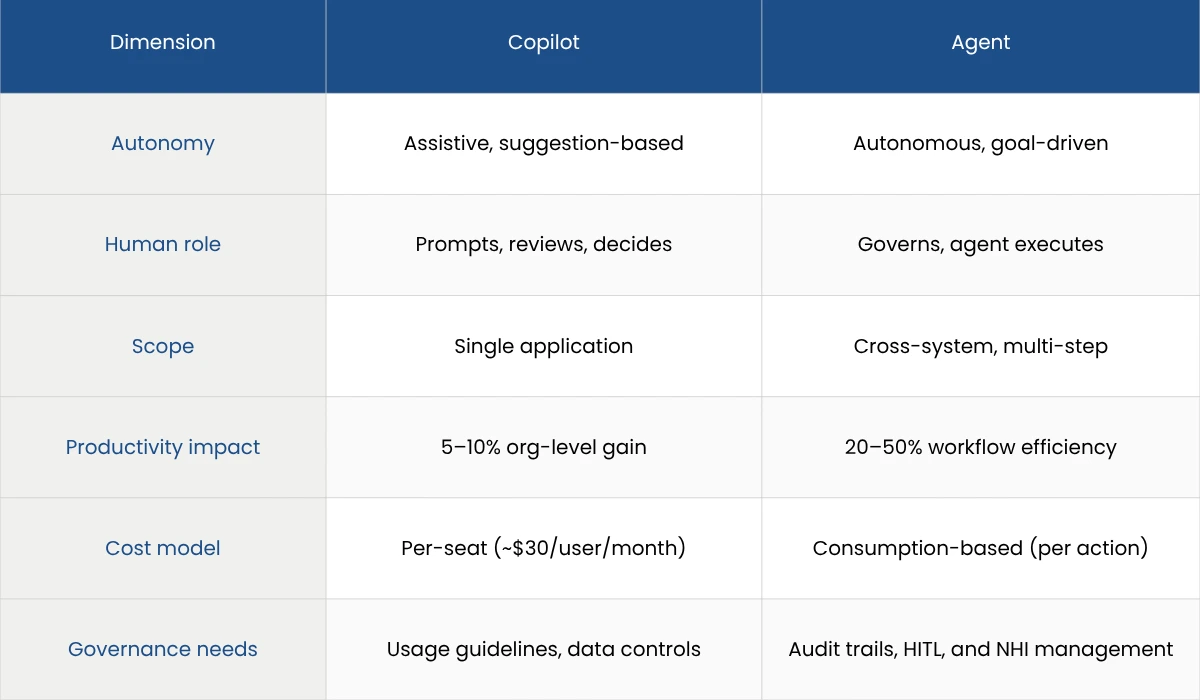
- Agents typically deliver 20–50% efficiency gains, compared to 5–10% for copilots, around a 4–5x difference (PwC, Gartner)
- Around 90% of Fortune 500 companies have tested Microsoft 365 Copilot, but only about 5% have scaled it fully (Gartner)
- More than 40% of agentic AI initiatives may fail or be stopped by 2027 due to governance gaps (Gartner)

Many leaders are investing in AI agents and Copilot without having a proper understanding of what those tools actually do.
This confusion comes with a cost. Proof? According to PwC, 56% of CEOs report no clear return from AI investments. So, the issue is not AI capability itself, but a mismatch between tools and workflows. To make sure you don’t pick the wrong AI tool for your workflows, here is a clear definition of an AI agent and a copilot.
What is an AI Agent and Copilot?
A copilot is like a smart assistant deployed within an application, for example, a copilot writing emails in Microsoft Outlook or suggesting code in GitHub Copilot. It waits for you to ask something, helps you draft or analyze, and then you decide what to do next. It never really takes control.
In simple terms, a copilot does not act on its own. It only assists.
An AI agent, on the other hand, is more like a real employee. You don’t guide every step. You just say what needs to be done, and it figures out how to complete it across systems. For example, instead of telling an AI agent step-by-step to “check invoices, validate them, update ERP, and send alerts,” you just say, ” Process all pending invoices and it does. An agent can plan, take actions, and complete workflows on its own.
Below is a simple comparison between AI agents and Copilots:
One important point: many tools are being labeled as “agents” when they are not. This is known as agent washing.
Research from Gartner suggests that only a small fraction of products marketed as agents meet the real definition. A true agent must be able to plan, act across systems, and recover from errors during execution. If a system cannot handle failure during a task, it is not an agent.
AI Agent Vs Copilot Productivity Gap Is Bigger Than Expectation
On paper, both copilots and agents improve productivity. In practice, the impact at enterprise scale is very different.
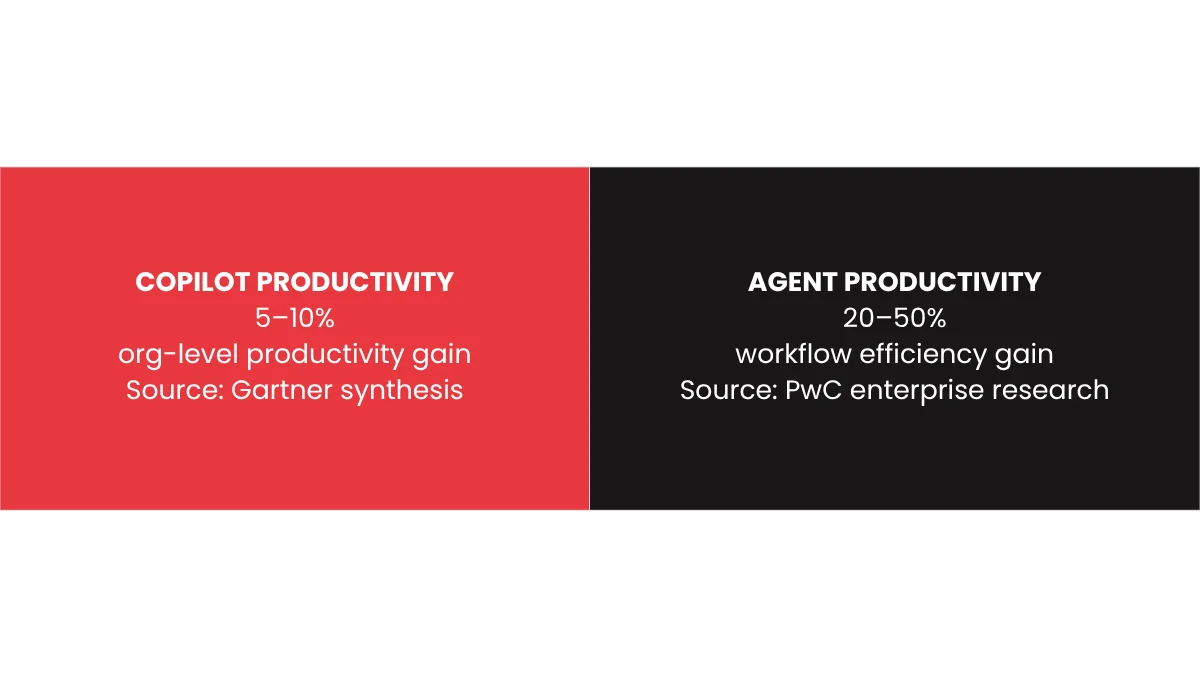
At enterprise scale, this difference becomes financially meaningful. For example, in a company with 1,000 employees, the difference between the two approaches can easily amount to millions in annual efficiency gains.
Copilot Approach: At an individual level, copilots can still show strong results. Studies such as NBER research on GitHub Copilot show developers completing tasks significantly faster. However, at the enterprise level, improvements are often limited because underlying workflow bottlenecks remain unchanged. Work still depends on reviews, approvals, and team coordination.
This explains a common pattern seen in large organizations. Many businesses experiment with copilots and see early gains, but struggle to scale them beyond pilot programs. The issue is not usage or adoption, but the fact that copilots improve individual productivity without redesigning the system itself.
AI Agent Approach: Agents take a different approach. Instead of improving individual tasks, they reduce or eliminate entire steps in a workflow. That is why their impact is higher, but they also require stronger governance and operational readiness.
AI Agents Vs Copilots for Different Enterprise Use Cases
The key question is not when to use AI agents Vs Copilots, but which is best for different enterprise use cases. We have figured it out for you in this comparison table.
Two important clarifications:
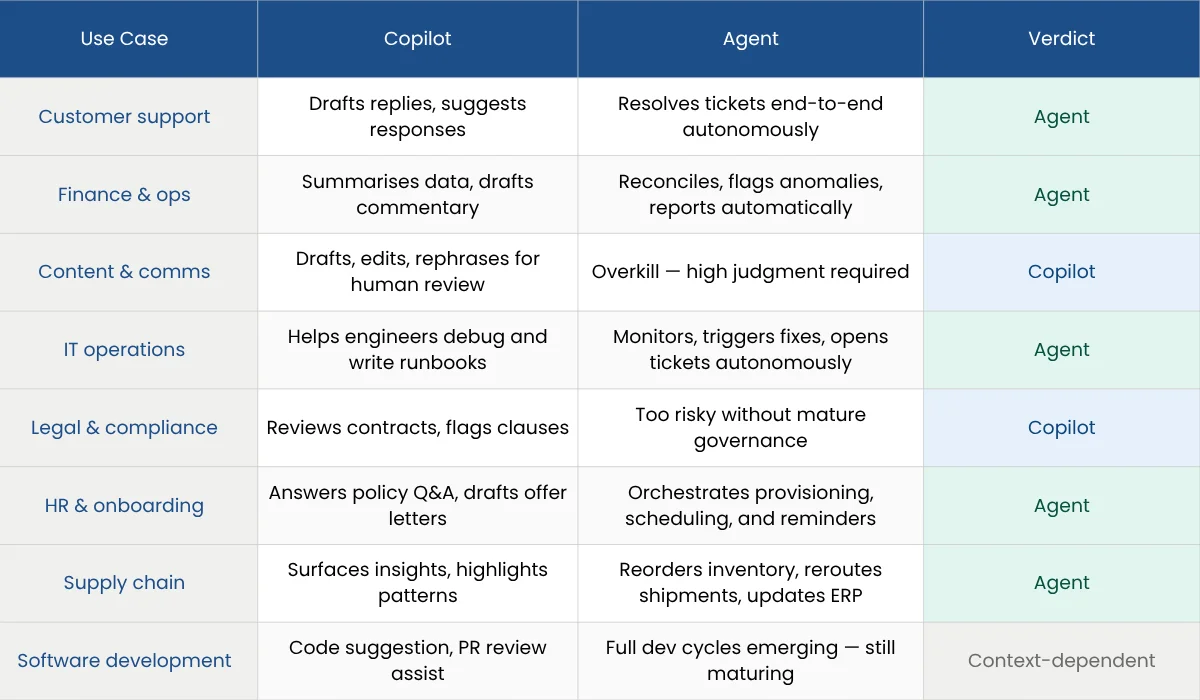
Legal and compliance workflows are better suited for copilots today. The risk level is high, and most enterprises do not yet have strong governance systems in place. Regulations like the EU AI Act, effective from August 2026, will also increase compliance requirements.
Software development is a mixed area. Copilots already improve developer productivity significantly. Fully autonomous coding agents are still emerging and are not yet stable enough for most enterprise environments.
Decision Framework: AI Agent or Copilot or Both?
Most organizations will eventually use both copilots and agents. The real decision is about matching the tool to each workflow.
Step 1: Assess with questions
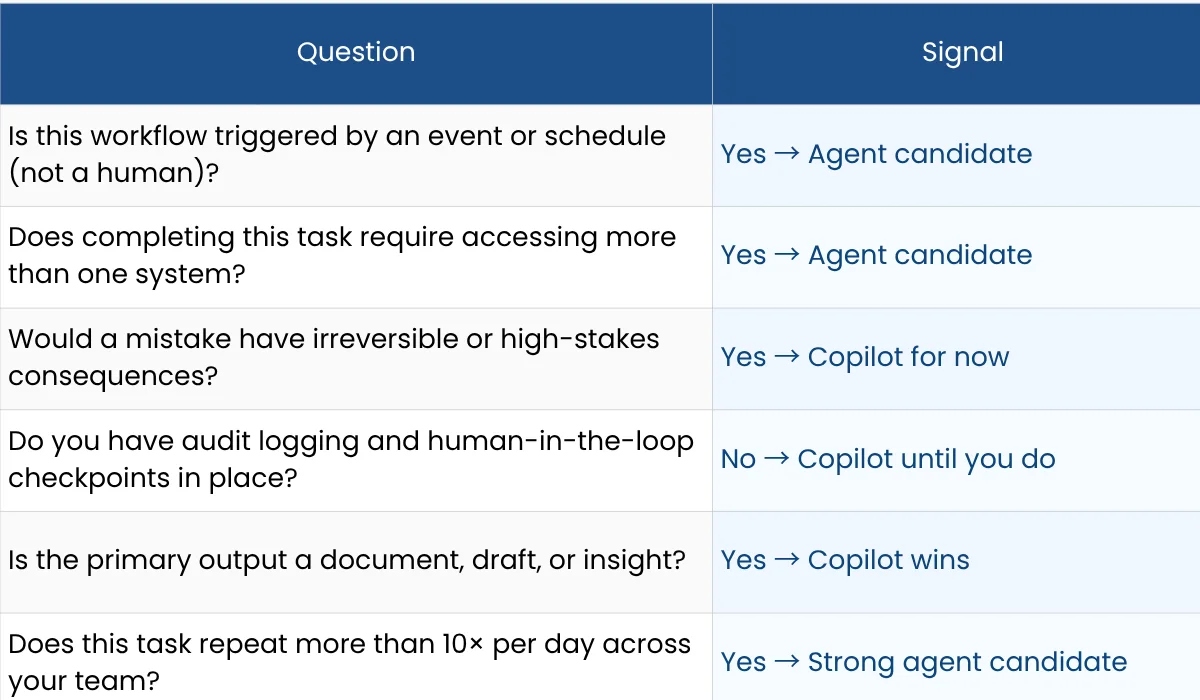
Step 2: Score each workflow
If you’re unsure whether to use a copilot or an agent, don’t overcomplicate it. Just evaluate the task using three simple factors.
1. How structured is the task?
Ask yourself: Does this task follow the same steps every time, or does it change based on context?
If the process is clear and repeatable, it’s a strong candidate for an agent. If it requires thinking, judgment, or changes often, a copilot is a better fit.
For example, processing invoices follows a fixed set of steps. Writing a strategy document does not.
2. What happens if something goes wrong?
Some tasks can tolerate small mistakes. Others cannot. If an error can be corrected easily, you can automate the task with an agent. But if the outcome is high-risk, like legal approvals or financial decisions, it’s better to keep a human in control and use a copilot.
3. How many systems are involved?
If the task is done within a single tool, a copilot is usually enough. But if it requires moving data across multiple systems, like CRM, ERP, or support platforms, an agent becomes more valuable because it can handle those steps automatically.
Putting it together
You don’t need a complex scoring model. A simple rule works well:
- If the task is repeatable, low-risk, and spans multiple systems, use an agent
- If the task is unclear, high-risk, or needs human judgment, use a copilot.
For example, invoice processing or IT ticket routing often scores high and is suitable for agents. Contract review or strategic planning typically remains copilot-driven.
Also Read: Cursor AI vs Copilot
What Enterprise Leaders Need to Think About Before Adopting AI Agents

Moving toward agent-based systems is less about choosing a tool and more about preparing the environment in which they will operate.
The first consideration is clarity of outcomes. Agents work best when goals are clearly defined. Instead of requesting partial outputs, enterprises should define end-to-end objectives, such as “resolve customer support tickets” or “process vendor invoices with validation.”
The second consideration is system integration. Agents are only effective when they can interact with core business systems such as CRMs, ERPs, data warehouses, and communication tools. Without this, they remain limited in scope and value.
The third consideration is governance and trust. Unlike copilots, agents take actions. This means organizations need clear guardrails around permissions, audit logs, escalation paths, and error handling.
Finally, there is the question of change management. Teams need to shift from task execution to outcome supervision. This is often the most difficult transition because it changes how people define their role in the workflow.
Where Enterprises Typically Get It Wrong
Assuming Copilots Are the Starting Ladder
One of the most common mistakes organizations make is assuming that copilots are a stepping stone to agents. While this is partially true, it often leads to a misleading assumption that upgrading tools alone will unlock autonomy. In reality, agents require a redesign of workflows, not just a tool upgrade.
Assuming Agents Will Work From Start
Another common issue is overestimating automation coverage. Leaders often expect agents to handle entire processes from day one. In practice, successful implementations start with narrow, well-defined workflows and expand gradually.
Overlooking AI Governance
A third issue is underestimating the complexity of governance. The more autonomous a system becomes, the more important visibility and control become. Without proper oversight structures, even well-performing agents can introduce operational risk.
These challenges are not blockers, but they do require planning. Organizations that treat agent adoption as a transformation initiative rather than a software rollout tend to see better outcomes.
The Bottom Line
The most successful enterprises are not choosing between copilots and agents. They are applying both based on workflow readiness. Copilots improve individual productivity. Agents transform end-to-end processes.
The key is to start with clear, well-defined workflows, build governance gradually, and avoid deploying autonomous systems faster than your organization can safely manage them.
The 40% failure risk is not about AI performance. It reflects how prepared organizations are to handle autonomy at scale.
FAQs
What is the main difference between AI agents and AI Copilots?
A copilot helps you complete tasks by giving suggestions, drafts, or insights, but you stay in control the entire time. An AI agent, on the other hand, can take a goal and complete the task on its own by performing multiple steps across systems. In simple terms, a copilot supports your work, while an agent executes the work.
What is the difference between an AI agent, a chatbot, and Copilot?
A chatbot answers questions, a copilot helps you complete tasks, and an AI agent completes tasks on its own. Chatbots are limited to conversations, copilots assist within a tool, and agents can take a goal and execute it across systems with minimal human input.
When should an enterprise use a copilot instead of an agent?
A copilot is the better choice when the task involves judgment, creativity, or high risk. For example, writing content, reviewing legal documents, or making strategic decisions usually requires human thinking at every step. In these cases, copilots help improve productivity without taking control away.
When should an enterprise use AI agents?
AI agents work best for tasks that are repetitive, well-defined, and involve multiple systems, for example, invoice processing, IT ticket routing, customer support automation, and supply chain updates. These tasks follow clear steps and can be executed without constant human input.
Can enterprises use both copilots and AI agents together?
Yes. Copilots and agents solve different problems. Copilots improve how individuals work, while agents improve how entire workflows operate. In practice, organizations use copilots for decision-making tasks and agents for execution-heavy processes.
Do AI agents require more governance than copilots?
Yes, significantly more. Since agents can take actions independently, organizations need stronger controls such as audit logs, access management, and human approval checkpoints for critical steps. Without these, autonomous systems can introduce operational risk.
Are AI agents more expensive than copilots?
They are different, not always more expensive. Copilots usually charge a fixed price per user, which makes costs predictable. Agents are often priced based on usage, which can vary depending on the number of tasks they perform.