Softude
In the rapidly evolving landscape of artificial intelligence, organisations are moving beyond simple chat interfaces toward sophisticated, autonomous agents. As you begin to integrate these tools into your business workflows, you will face a fundamental challenge: Should you build a single AI agent or a multi-agent AI system?
This choice is far more than a technical preference; it is a strategic decision that impacts your data security, operational costs, and the speed at which your teams can innovate. Much like deciding whether to hire a single specialist or build an entire departmental team, each approach offers distinct trade-offs in complexity and control.
This guide provides a clear, evidence-based framework to help you navigate the “Build” phase of your AI adoption. We will break down the structural differences, weigh the benefits of each model, and provide a decision tree to help you choose the most effective path for your organisation’s unique goals.
How the Architectures Differ: The Core Concept
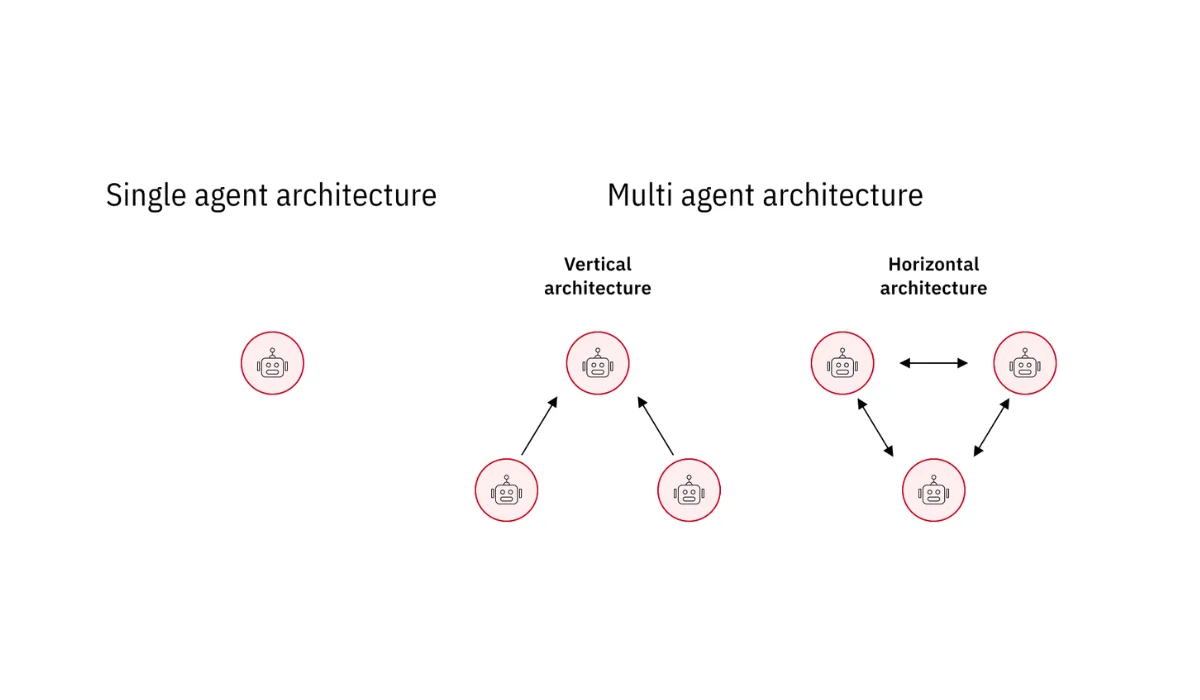
To understand the difference between a single AI agent and a multi-agent AI architecture, think about how information moves through the system. Because architecture isn’t just about the “code”, it’s about the flow of logic and the boundaries of memory.
Single-Agent Architecture: The Solo Specialist
In a single AI agent architecture, there is a single “brain” (the AI model) and a single unified memory (the context window). Every piece of information, every rule, and every tool is connected to this single point.
Imagine a solo project manager who stays in the room from start to finish. They hear every detail, see every document, and make every decision. Because they have “total context,” they never have to be caught up on what happened five minutes ago. However, if the project gets too big, that one person might get overwhelmed by the sheer volume of details.
Multi-Agent AI Architecture: The Coordinated Team
In a multi-agent system, the work is broken into pieces. Information is handed off from one agent to another. Each agent has its own “mini-memory” and its own specific job.
It is like a relay race where runners pass a baton. The first runner (the Researcher) finishes their lap and hands the results to the second runner (the Writer). The Writer doesn’t need to know every single website the Researcher visited; they only need the final notes. This keeps the work clean, but it requires a “coach” (an orchestrator) to ensure the handoff happens at the right time and the baton isn’t dropped.
Benefits of Single and Multi-Agent Systems
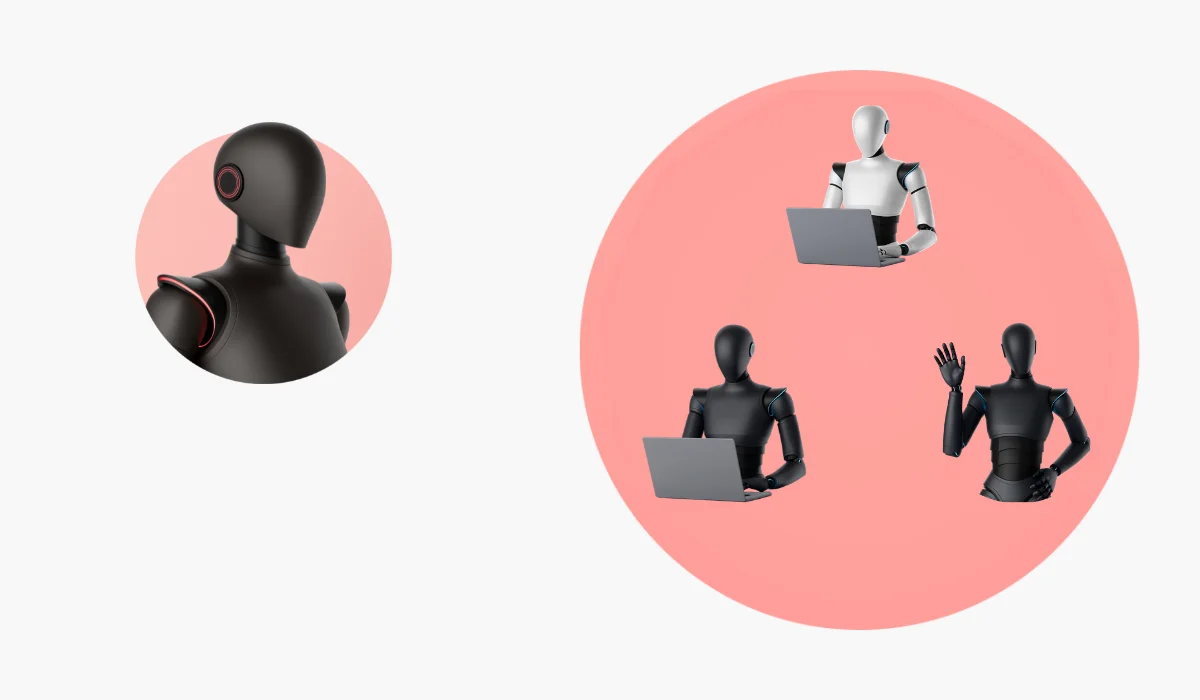
Each setup has specific strengths depending on what you are trying to achieve. Neither is “better” in isolation; they are simply different tools for different scales of work.
Benefits of a Single AI Agent System
- Easier to Manage and Debug: Since everything happens in one place, it is much easier to see what went wrong if the AI makes a mistake. You have one “log” or transcript to read. You don’t have to wonder if Agent A gave bad info to Agent B; you just look at the single thought process of the solo agent.
- Faster to Build and Iterate: You don’t have to write complex code to help agents “talk” to each other or agree on a format for sharing data. You just focus on the main task. This makes single agents perfect for “Proof of Concept” projects where you need to show value to stakeholders in days, not months.
- Lower Operational Costs: AI models charge by the amount of text (tokens) they process. In a multi-agent system, agents often have to summarize their work and “explain” it to the next agent. This repetition adds up quickly. A single agent keeps the information internal, which is almost always more efficient with your budget.
- Lower Latency (Speed): Every time an AI has to “think,” it takes a few seconds. In a team of agents, if three agents work in a row, the user has to wait for all three to finish. A single agent can often reach a conclusion in one or two “thoughts,” leading to a snappier experience for the user.
Benefits of a Multi-Agent AI System
- Strict Privacy and Security: This is perhaps the biggest professional benefit of multi-AI agents. You can keep sensitive data locked away with one agent (like an “Accounting Agent”), while letting another agent (a “Customer Bot”) talk to the public. Because they are separate, there is no risk of the public bot “accidentally” remembering a private salary figure from the accounting bot. You only share exactly what is needed for the specific task at hand.
- Easier to Scale and Maintain: If you want to add a new feature, say, the ability to generate images, you can just build a new “Image Specialist” agent. You don’t have to retrain or rewrite your existing “Text Agent.” This modularity means your system can grow piece by piece over several years without becoming a “tangled mess” of code.
- Higher Accuracy through Specialization: Just like a human, an AI can get “distracted” if its instructions are too long. By giving an agent one narrow job (e.g., “Just check this text for grammar errors”), it is much more likely to do that job perfectly. Multi-agent systems use this to create “Quality Control” loops in which one agent checks another’s work.
- Parallel Processing: If you need to analyze ten different financial reports, a single agent has to read them one by one. A multi-agent system can spin up 10 agents to read them all at once, potentially cutting your wait time by 90%.
Which is Better for Enterprise: Single Agent vs Multi-Agent AI Systems
For enterprises, choosing between single and multi-agent systems can be tough. The best rule of thumb is: Start with a single agent. It is the simplest and most cost-effective way to see if AI can solve your problem. You should only switch to a multi-agent team if you hit a “hard stop” that a single agent cannot overcome.
Use Multiple AI Agents in the Following Scenarios
You should skip the single-agent test and go straight to a team-based design if your project meets any of these three organizational conditions:
1. Security and Compliance Boundaries
In many industries, regulations such as GDPR and HIPAA mandate strict data isolation. If your AI process involves crossing these boundaries,for example, taking data from a secure internal database and sending a summary to an external partner,you should use separate agents. This ensures that the “external-facing” agent never has direct access to the “secure” database.
2. Multiple Team Ownership
If your company is large, different departments will want to own their own AI “logic.” If the Legal team wants to manage the rules for the “Contract Agent” and the Sales team wants to manage the “Lead Agent,” they should be separate. This allows the Legal team to update their agent on a Tuesday without accidentally breaking the Sales team’s agent. It mirrors the structure of your actual company.
3. Long-Term Complexity and Growth
If your roadmap shows that this tool will eventually handle dozens of different, unrelated tasks (like booking travel, filing taxes, and writing code), starting with a single agent is a trap. Eventually, that one agent will become too “heavy” and slow. Starting with a modular, multi-agent design saves you from a painful and expensive “rip and replace” project two years down the line.
When to Stick with a Single Agent
1. Role Emulation (Persona Switching)
You don’t need three separate agents just to have a “writer,” a “checker,” and a “manager.” Modern AI models are very good at “persona switching.” You can give a single agent a prompt that says: “First, write a draft. Then, look at it from the perspective of a critical editor and list three flaws. Finally, rewrite the draft to fix those flaws.” This often produces the same quality as three agents but at a fraction of the cost and complexity.
2. Rapid Time-to-Market
If your primary goal is to prove to your boss that AI can help the company, don’t spend a month building an agent “swarm.” Build a single agent with the best available model (like GPT-4o or Claude 3.5). Get it in front of users, gather their feedback, and use that data to decide if you actually need more complexity.
3. Large Document Analysis
If your task requires the AI to “connect the dots” across a very long document (like a 200-page legal case), keeping that context in one “brain” is usually better. When you split a document between multiple agents, they can miss the subtle connections between page 10 and page 190.
The Reality of “Orchestration”
Orchestration acts as the hidden layer that connects different parts of an AI system, transforming a standalone model into a coordinated workflow.
Single-Agent Workflows
Even a single agent needs a workflow to be reliable. This usually involves:
- Repeatability: Ensuring the agent follows the same steps every time it summarises a meeting.
- Human Review: A “checkpoint” where a person has to click “Approve” before the agent sends a summary to a client.
- Logging: Keeping a record of what the agent did for audit purposes.
Multi-Agent AI Workflows
Multi-agent systems require much more “plumbing.” You have to build logic for:
- Routing: How does the system know to send a question to the “Legal Agent” instead of the “Tech Agent”?
- State Management: How does Agent B know what Agent A already did?
- Error Handling: What happens if Agent A crashes? Does the whole process stop, or can Agent C take over?
Single Agent Vs Multi-Agent AI Systems
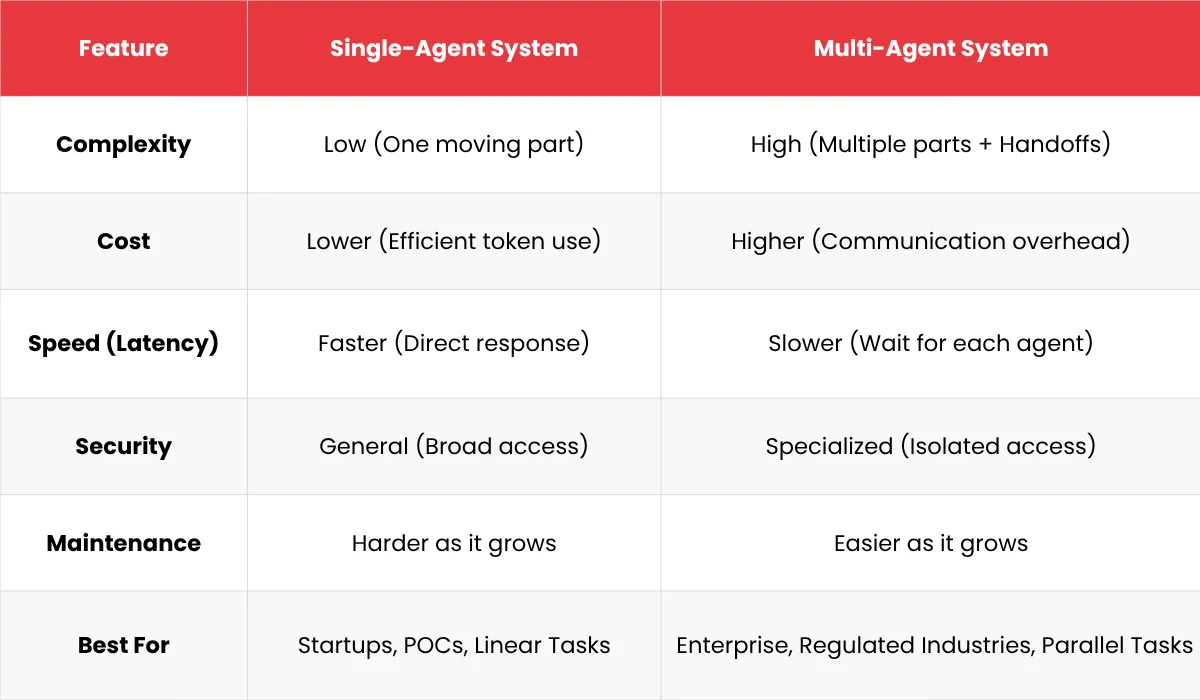
Decision Framework: A Step-by-Step Path
To help you decide today, follow these steps:
Step 1: Define the Boundary. Does any part of this task require data that must be kept away from other parts? If yes, go Multi-Agent.
Step 2: Check the Ownership. Are two different departments going to be responsible for the “knowledge” in this tool? If yes, go Multi-Agent.
Step 3: Evaluate the Scope. Is the task a single, clear process (like “read this email and draft a reply”)? If yes, go Single-Agent.
Step 4: Prototype. Build a single-agent version first. Test it under “heavy load” (give it 50 tasks at once).
Step 5: Identify the Break Point. Only move to Multi-Agent when the single agent starts to “forget” its instructions or when the prompt becomes so long that it’s impossible to edit without breaking something else.
Final Thoughts
In the real world, the best systems are often hybrids. You might have one “Manager Agent” that talks to the user (Single-Agent interface) but uses a team of “Worker Agents” behind the scenes to do the heavy lifting (Multi-Agent backend).
By focusing on simplicity first, you ensure that your AI project delivers value quickly without getting bogged down in “architecture for the sake of architecture.” Build what you need today, but keep your design modular so you can grow tomorrow.
If you need assistance in building AI architecture, Softude is the right partner. Our AI experts specialise in building AI agents for every industry and use case. Contact Us today to learn more.
FAQs: Common Questions About AI Setup
Does having more agents make the AI “smarter”?
No. In fact, it can make the AI seem “dumber” if the handoffs aren’t perfect. A single, high-quality model is usually smarter than a team of low-quality models. Multi-agent AI systems are about organization and reliability, not raw “IQ.”
Is it harder to fix a multi-agent AI system?
Yes. If the final answer is wrong, you have to investigate the whole chain. It is like a “game of telephone”; you have to find out who misheard the message. Single agents are much easier to troubleshoot.
Can one agent use different tools, like a database and a calculator?
Yes. This is a common misconception. A single agent can easily manage 5 to 10 different tools. You only need multiple agents if those tools require different security permissions or if the instructions for the tools are so complex that they “confuse” the agent.
What is the most expensive part of a multi-agent system?
It’s the “Inter-agent communication.” When Agent A explains a 500-word problem to Agent B, you pay for those 500 words twice. If they have a “conversation” to solve a problem, your bill grows with every message they exchange.
How do I know if I’ve outgrown a single agent?
The clearest sign is “Instruction Drift.” If you find that adding a new rule to your agent’s prompt makes it “forget” or ignore an old rule, your prompt has become too complex. This is the perfect time to split that one agent into two.
Do multi-agent AI systems require different AI models?
They don’t require them, but they allow them. This is a huge benefit. You can use an expensive, “genius” model to plan the work and a cheap, “fast” model to do the simple data entry. This saves a lot of money in the long run.