Softude
Over 70% of enterprise AI initiatives fail to deliver their promised value, not because the models are weak, but because the AI agent architecture is poorly designed. In large organizations, an AI agent’s ability to reason, act, and integrate with enterprise systems depends almost entirely on its underlying architecture. Even the most advanced models can stall or produce inconsistent results if orchestration, tool execution, or memory layers are misaligned.
A robust enterprise AI agent architecture ensures that intelligent systems can:
- Execute complex workflows across multiple enterprise platforms with low latency
- Maintain context and knowledge through structured memory and data layers
- Enforce security, compliance, and governance without compromising agility
- Scale efficiently across single or multi-agent deployments
On the other hand, flawed architecture can cripple an agent, causing failures in task execution, hallucinations in reasoning, integration errors, and increased operational risk. For technical leaders, AI architects, ML engineers, and platform teams, understanding how to design resilient, scalable architectures is critical to turning AI agents into reliable enterprise assets.
This article dives into the layered architecture of enterprise AI agents, identifies common pitfalls, and provides best practices for building systems that are both robust and enterprise-ready.
What Is Enterprise AI Agent Architecture?
For enterprise AI agents, the difference between success and failure is rarely the underlying AI model; it’s how the system is structured. Enterprise AI agent architecture defines the blueprint that enables agents to reason, act, and integrate reliably across complex enterprise environments. It is the AI framework that connects intelligence, tools, workflows, memory, and governance into a cohesive, scalable system.
At its core, enterprise AI agent architecture is a layered system design that ensures:
- Consistency in reasoning and decision-making across tasks
- Seamless integration with enterprise software such as ERP, CRM, and internal APIs
- Scalability to handle multiple concurrent agents and workflows
- Security and governance to maintain compliance and operational integrity
Unlike generic AI systems, enterprise AI agents must operate in environments with complex dependencies, heterogeneous data sources, and strict regulatory requirements. A well-defined architecture addresses these challenges by clearly separating responsibilities across layers, including:
- Interface Layer: How agents interact with users and systems
- Orchestration Layer: How tasks are decomposed, assigned, and executed
- Reasoning Layer: Where AI decision-making occurs
- Tool & Action Layer: How agents execute operations and interact with enterprise systems
- Memory & Data Layer: How context and knowledge are maintained
- Governance & Observability Layer: How compliance, monitoring, and auditing are enforced
Without this structure, even the most capable AI models may produce inconsistent results, fail to integrate with enterprise workflows, or introduce unacceptable operational risk.
Core Components of AI Agent Architecture
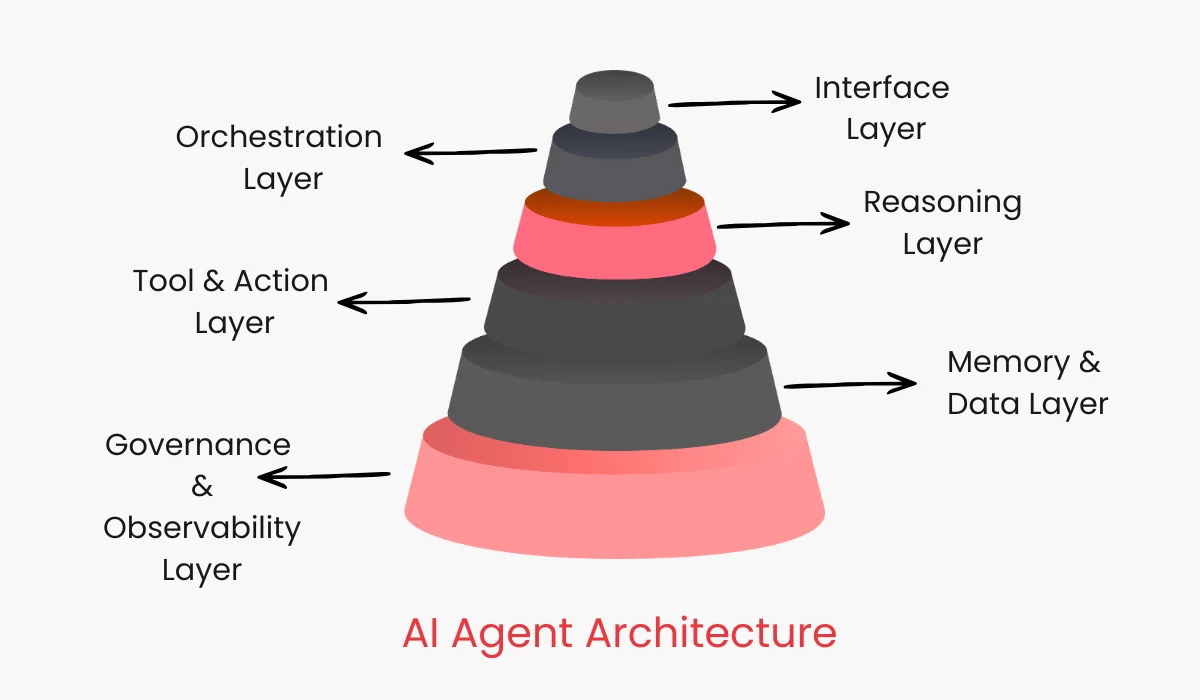
A robust autonomous agent architecture is built on a layered design, with each layer having a specific responsibility. Understanding these layers is essential for AI architects, ML engineers, and platform teams, because the success of an agent depends not only on its model but also on how these layers interact.
Below are the six critical layers and why each matters:
1. Interface Layer: How Users and Systems Interact
The interface layer is the point of contact between humans, external systems, and AI agents. It translates user inputs into structured requests that the agent can understand, and routes the agent’s outputs back to the user or the system.
Key responsibilities of the AI agent at this layer
- Convert raw input into structured requests
- Perform input validation to prevent errors in downstream processing
- Send structured tasks to the orchestration layer
- Ensure proper task prioritization and routing in multi-agent environments
- Return results to users or systems in a readable and actionable format
- Support multiple channels like dashboards, notifications, and APIs
Why it matters:
A poorly designed interface can result in misinterpreted tasks, delayed responses, or low adoption. For enterprise AI, the interface must support multiple channels, such as chatbots, dashboards, APIs, and voice commands, ensuring consistent, reliable interaction.
Best Practices
- Maintain modular and channel-agnostic design to easily extend new interfaces
- Implement input validation and preprocessing to reduce errors in reasoning and execution
- Ensure real-time feedback mechanisms, so users know when a task is in progress or completed
- Design for scalability, particularly in large enterprises where multiple users or systems may interact simultaneously
2. Orchestration Layer: Managing Tasks and Workflows
The orchestration layer acts as the control hub of the AI agent. It decomposes complex tasks into manageable subtasks, assigns responsibilities to appropriate agents or tools, and ensures execution follows a defined workflow.
What AI agent does at this layer:
- Analyze complex requests from the interface layer
- Break them into actionable steps for reasoning and tool layers
- Maintain execution order for dependent tasks
- Monitor task progress and completion
- Assign tasks to specialized agents or external tools
- Manage multi-agent collaboration and communication
- Detect failures in task execution or tool calls
- Implement retry mechanisms and escalation protocols
Why it matters:
Without effective orchestration, tasks may fail, tools can be misused, and multi-agent collaboration can break down. Orchestration ensures that workflows are executed reliably, in order, and at scale.
Best Practices
- Use modular orchestration frameworks that allow easy updates to workflows and task decomposition logic
- Implement robust logging and observability for each step to quickly diagnose failures
- Design for scalability, ensuring multiple tasks and agents can operate concurrently without conflict
- Include fallback mechanisms when tools or agents are unavailable
3. Reasoning Layer: The Intelligence Engine

This layer contains the agent’s cognitive core, where decision-making and planning occur. It includes large language models, reasoning modules, and planning algorithms that determine what the agent should do next.
What an AI agent does at the reasoning layer:
- Understand structured requests from the orchestration layer
- Incorporate context from memory and data layers to improve reasoning
- Determine the sequence of actions needed to complete a task
- Choose the right tools, agents, or services to achieve the goal
- Produce clear instructions for the tool and action layer
- Ensure outputs are consistent, auditable, and aligned with enterprise policies
Why this layer matters:
Even with powerful models, reasoning is ineffective without a structured system. The reasoning layer integrates context, chooses tools, and generates actionable outputs that orchestrate downstream tasks.
Best Practices
- Integrate retrieval-augmented reasoning to leverage enterprise knowledge bases for accurate decision-making
- Use modular reasoning components to allow updates and improvements without disrupting the entire system
- Include confidence scoring and validation to flag uncertain or risky decisions
- Ensure auditability, so each reasoning step can be traced for compliance or debugging
4. Tool & Action Layer: Executing Tasks in the Enterprise
The tool and action layer connects AI agents to external systems, APIs, and automation tools. It enables the agent to perform actual operations, such as retrieving customer data, updating records, or triggering workflows.
Key Responsibilities:
- Execute tasks by calling APIs, functions, and enterprise automation tools
- Interact with databases, ERP, CRM, and internal microservices
- Handle task execution errors and retries
- Ensure reliable integration between the reasoning layer and enterprise systems
Why it matters:
AI agents are only valuable if they can act effectively. A robust tool layer ensures reliable execution, error handling, and seamless integration with enterprise systems.
Best Practices:
- Implement robust API connectors with proper error handling
- Maintain modular and extensible integrations to add new tools easily
- Include logging and observability to track task execution
- Use transactional safety mechanisms when updating critical enterprise data
5. Memory & Data Layer: Maintaining Context and Knowledge
This layer stores both short-term context and long-term enterprise knowledge, allowing agents to maintain continuity across interactions. It typically uses vector databases, knowledge bases, and enterprise data lakes.
Key Responsibilities:
- Store short-term conversational or task context
- Maintain long-term enterprise knowledge for retrieval-augmented reasoning
- Provide structured and queryable access for reasoning and orchestration layers
- Ensure data consistency, accuracy, and security
Why it matters:
Without memory, agents cannot provide contextual responses or retain enterprise knowledge, which leads to repetitive or inconsistent decisions. Memory enables retrieval-augmented reasoning and personalization.
Best Practices:
- Use vector databases and knowledge graphs for scalable context storage
- Implement persistent memory for enterprise knowledge with version control
- Ensure data governance and access controls to protect sensitive information
- Optimize retrieval strategies to minimize latency in decision-making
6. Governance & Observability Layer: Ensuring Compliance and Reliability
This layer monitors agent behavior, enforces security and compliance policies, and provides observability tools, including logging, auditing, and performance monitoring.
Key Responsibilities:
- Enforce security, compliance, and policy rules across all layers
- Monitor system performance, errors, and task execution
- Maintain audit logs and provide observability dashboards
- Detect and escalate operational issues in real time
Why it matters:
Enterprise AI operates in regulated environments with strict compliance requirements. Governance ensures that agents act responsibly, that risks are managed, and that failures are detected and mitigated quickly.
Best Practices:
- Implement role-based access control and compliance policies
- Use centralized monitoring and logging frameworks for all layers
- Conduct regular audits and validation of agent behavior
- Include alerting and anomaly detection for early issue identification
What Happens If Agent Architecture is Bad

Even the most sophisticated AI models can fail to deliver value if the agentic AI architecture is poorly designed. Technical leaders must understand the real-world consequences of architectural weaknesses, as these failures directly affect scalability, reliability, and business outcomes.
- Poor orchestration can cause tasks to execute in the wrong order or fail entirely.
- Multi-step workflows may stall or produce inconsistent results.
- Weak tool and action layers lead to broken API calls or misaligned data updates.
- Agents may fail to interact correctly with ERP, CRM, or internal systems.
- Memory layer issues can cause agents to forget previous interactions or misinterpret inputs.
- Reasoning errors propagate if contextual knowledge is missing or inconsistent.
- Poorly architected orchestration or memory layers can increase response times.
- High-concurrency enterprise environments may experience task backlog or failures.
- Weak governance layers expose enterprises to unauthorized access, data breaches, or regulatory violations.
- Lack of auditability undermines accountability and operational trust.
Key Challenges in Enterprise AI Agent Architecture
Challenge 1: Integration Complexity
Enterprise AI agents often need to connect with multiple systems, such as ERP, CRM, databases, and internal microservices. Misaligned APIs or inconsistent data formats can lead to task failures and cascading errors.
How to Mitigate: Standardize API contracts and data formats across systems. Build robust connectors with error handling and retry logic, and continuously test integrations in multi-system workflows.
Challenge 2: Scalability and Performance
High-concurrency tasks and multi-agent deployments can overwhelm the system if the architecture is not designed for scale, causing bottlenecks and delayed responses.
How to Mitigate: Design orchestration and memory layers to support horizontal scaling. Use caching and optimized retrieval for low-latency responses, and monitor system metrics to tune performance in real time.
Challenge 3: Context Loss and Memory Limitations
AI agents may fail to retain context across tasks or sessions, resulting in inconsistent reasoning and lower accuracy in multi-step workflows.
How to Mitigate: Implement persistent memory layers for long-term knowledge and use retrieval-augmented reasoning (RAG) to maintain context. Regularly validate memory consistency to ensure accurate decision-making.
Challenge 4: Governance and Compliance Risks
In regulated environments, enterprise AI agents can expose organizations to security breaches or noncompliance if governance is weak.
How to Mitigate: Enforce role-based access control and auditing across all layers. Apply compliance policies consistently and monitor for anomalous or unauthorized actions with alerting mechanisms.
Challenge 5: Handling Uncertainty and Errors
AI agents often encounter ambiguous instructions, incomplete data, or unexpected system behavior, leading to incorrect actions or failed tasks.
How to Mitigate: Integrate confidence scoring and fallback mechanisms in reasoning modules. Include human-in-the-loop checkpoints for critical decisions and log errors for continuous improvement.
Conclusion
Designing enterprise AI agents is much more than implementing AI models; it requires a well-thought-out architecture that ensures reliability, scalability, and business impact. From layered design to governance and future-proofing, every decision affects performance and adoption.
Key Takeaways
- Layered Architecture is Critical: Clearly separate interface, orchestration, reasoning, tool, memory, and governance layers to ensure modularity and maintainability.
- Orchestration Drives Reliability: Proper task coordination and workflow management prevent cascading failures in complex enterprise environments.
- Reasoning and Memory Enable Intelligence: Context-aware reasoning and persistent memory ensure accurate, consistent, and actionable AI outputs.
- Integration and Tooling Must Be Robust: Well-designed connectors and error handling in the tool layer reduce operational risk.
- Governance and Observability Are Non-Negotiable: Security, compliance, auditing, and monitoring maintain enterprise trust and regulatory alignment.
- Future-Proofing Ensures Longevity: Modular design, scalable infrastructure, and adaptability to new AI models and trends make the architecture resilient for future growth.
- Design Patterns and Best Practices Matter: Retrieval-augmented agents, multi-agent systems, tool-using agents, and human-in-the-loop approaches optimize performance for enterprise use cases.
A strong enterprise AI agent architecture transforms AI from a novelty into a strategic enterprise asset. By focusing on layers, integration, governance, and adaptability, technical teams can deliver agents that are scalable, reliable, and aligned with enterprise objectives.