Softude
Artificial intelligence is moving into a new phase. We are no longer just building AI systems that respond to commands or generate content on demand. The next evolution is autonomous AI systems- systems that can understand objectives, make decisions, and take actions with minimal human involvement. This shift is commonly referred to as Agentic AI.
Microsoft Azure is becoming one of the most important platforms for this transformation. While Azure does not offer a single product called “Agentic AI Framework,” it provides the infrastructure, tools, and AI services that together form a practical foundation for building autonomous systems at scale.
In simple terms, Azure is enabling AI to move from being a helpful assistant to becoming an independent digital operator.
From Reactive AI to Autonomous Systems
Traditional AI systems are mostly reactive. They wait for a prompt, generate an answer, and stop. Even advanced chatbots and copilots still rely heavily on human input to determine their next actions.
Agentic AI changes this model completely. Instead of reacting, the system is given a goal, and it determines the best way to achieve it. It can plan steps, use tools, gather information, adjust its strategy, and continue until the objective is met.
This is what makes autonomous systems possible. The AI is no longer just producing text or predictions; it is performing real work across digital environments.
Also read: Agentic AI for Sales: From Lead Generation to Deal Closure
What “Agentic AI” Actually Means on Azure
On Azure, agentic AI is built by combining large language models with cloud-native services that give the AI memory, tools, and control over workflows.
At the center is Azure OpenAI Service, which provides the reasoning engine. Models like GPT-4 act as the “brain” of the system, capable of understanding complex goals and making logical decisions.
Around that brain, Azure adds three critical capabilities:
- Memory: so the system can store knowledge, context, and past actions.
- Tools: so the system can interact with real software, APIs, and databases.
- Orchestration: so the system can plan and manage multi-step tasks.
When these pieces come together, the AI becomes an autonomous agent rather than a simple chatbot.
Why This Matters for Autonomous Systems
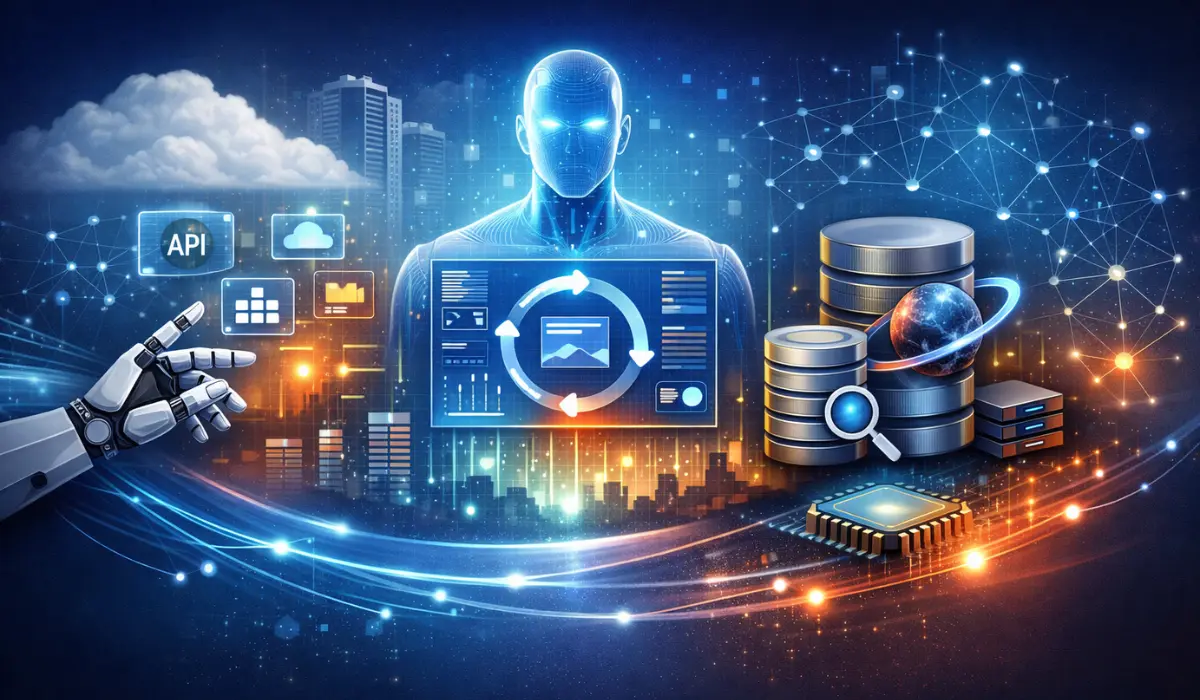
Autonomous systems are defined by three qualities: independence, adaptability, and persistence.
Azure’s agentic approach supports all three.
Independence comes from giving AI direct access to tools like APIs, cloud functions, and enterprise systems. The agent doesn’t need a human to execute every action.
Adaptability comes from continuous reasoning loops. The system can evaluate results, adjust its plan, and try again if something fails.
Persistence comes from memory stored in services like Cosmos DB or Azure Cognitive Search. The agent remembers what it has done and builds long-term understanding.
This is what allows Azure-based agents to operate more like employees than software.
How Azure Turns AI into a Digital Worker
An autonomous system on Azure typically follows a cycle that feels very human:
- Interpret the goal
- Decide what information is needed
- Choose the right tools
- Take action
- Evaluate the outcome
- Continue until complete
This loop can run for seconds or days, depending on the task.
For example, instead of telling an AI to “generate a report,” you could give it a goal like:
“Monitor sales performance and alert leadership to emerging risks.”
An Azure agent could then continuously pull data, analyze trends, generate insights, and notify stakeholders, without further instructions. That is the practical meaning of autonomous systems.
The Role of Multi-Agent Systems on Azure
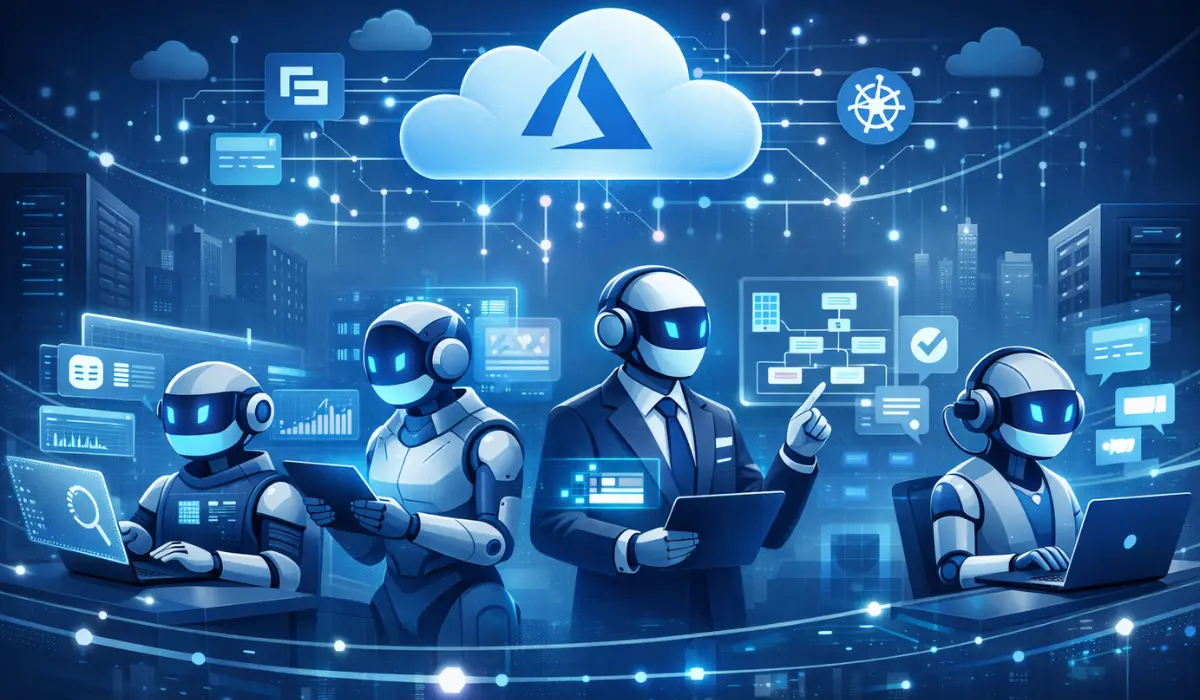
One of the most powerful ideas behind agentic AI is that not all intelligence needs to live in a single model. Azure supports architectures where multiple specialized agents collaborate.
You might have:
- One agent focused on data retrieval
- Another analysis
- Another on decision-making
- Another on communication
Each agent has a role, and together they form a digital team. Azure services like Service Bus, Event Grid, and Kubernetes make this coordination scalable and reliable.
This mirrors how real organizations work, which is why agentic systems feel more natural and effective in business environments.
Real Meaning for Enterprises
For organizations, Azure’s agentic AI framework means a fundamental shift in how software is built and used.
Instead of building rigid applications, companies can build goal-driven systems. These systems do not just follow workflows; they create them dynamically.
This opens the door to:
- Self-managing IT operations
- Autonomous customer support
- Continuous financial analysis
- Intelligent supply chain optimization
- AI-driven compliance monitoring
In each case, the system is not simply assisting humans; it is actively replacing manual decision processes.
Challenges That Come with Autonomy

Autonomous systems are powerful, but they also introduce real risks.
Control becomes critical. An agent that can take actions must be constrained by policies, permissions, and approval layers.
Transparency becomes essential. Businesses need to understand why an AI made a decision, not just what it did.
Cost management becomes important, too. Continuous reasoning and tool usage can become expensive without proper optimization.
Azure addresses these concerns through monitoring, logging, role-based access control, and enterprise governance frameworks. Autonomy without control is dangerous; Azure’s strength is making autonomy safe.
The Bigger Picture
Azure’s Agentic AI Framework represents a transition from software that executes instructions to software that pursues objectives.
This is not just a technical upgrade; it is a philosophical shift in computing. Systems are no longer passive tools. They are becoming active participants in business processes.
In the coming years, the most valuable AI systems will not be the ones that generate the best text or images, but the ones that can:
- Operate continuously
- Make independent decisions
- Coordinate with other systems
- Improve over time
Azure is building the foundation for exactly that future.
Final Thought
What Azure’s Agentic AI Framework really means for autonomous systems is simple but profound:
We are moving from AI that responds to AI that acts.
And once AI can act reliably, safely, and intelligently, it stops being a feature and starts becoming a workforce.
FAQs
What is the core idea behind the Azure agentic AI framework?
It is about building AI systems that can reason, act, and adapt on their own instead of merely responding to prompts.
How is agentic AI on Azure different from chatbots or assistants?
Chatbots answer questions. Agentic AI pursues goals, makes decisions, and completes multi-step tasks.
Is agentic AI on Azure suitable for production environments?
Yes. Azure’s security, governance, and scalability make it well-suited for real-world autonomous systems.
Can agentic AI work alongside humans rather than replace them?
Absolutely. These systems are meant to reduce cognitive load and handle routine complexity, not remove human judgment.
Is the Azure agentic AI framework still evolving?
Very much so. As models and orchestration tools improve, agentic systems on Azure will continue to become more capable.