Softude
For a long time, Robotic Process Automation (RPA) was the preferred solution for automating business processes. And for good reason. RPA was easy to implement, cost-effective, and highly efficient at handling repetitive, rule-based tasks such as data entry, invoice processing, and report generation. Organizations across industries adopted RPA to achieve quick operational wins without making major changes to their existing systems.
However, the automation landscape is changing. A newer, more advanced approach, Agentic AI, is steadily gaining traction. Unlike traditional RPA, Agentic AI doesn’t just follow rules. It can reason, adapt, and make decisions on its own. This makes it better suited for complex, dynamic workflows where conditions change and flexibility is essential.
This evolution naturally raises some important questions:
- Is RPA the same as Agentic AI?
- Can Agentic AI replace RPA entirely?
- Or will RPA and Agentic AI coexist?
The answer isn’t a simple yes or no. The debate around RPA vs Agentic AI isn’t about which technology is better overall; it’s about understanding where each one fits best.
In this article, we’ll break down what differentiates RPA and Agentic AI, explore the RPA bot vs AI agents comparison, and help you decide which approach, or combination, makes the most sense for your business.
What is Robotic Process Automation (RPA)?
Robotic Process Automation (RPA) is one of the most widely adopted automation technologies today. At its core, RPA uses software bots, often referred to as RPA bots, to replicate human actions across digital systems. These bots can log into applications, move data between platforms, complete forms, and trigger workflows exactly as a human would.
RPA is best suited for tasks that are repetitive, predictable, and governed by clear rules. If a process follows the same steps every time and relies on structured data, RPA delivers excellent results.
Why businesses continue to rely on RPA
These benefits of implementing RPA are what make it so valuable:
- Cost-Effective Automation: Ideal for quick wins without heavy investment.
- Fast Deployment: Works on top of existing systems, reducing implementation time.
- Accuracy and Consistency: Eliminates human errors in repetitive tasks.
- Scalability for Routine Work: Easily scales for high-volume, rule-based processes.
- Compliance Support: Ensures processes follow predefined rules for regulatory requirements.
That said, RPA has limitations. It struggles when processes require judgment, frequent changes, or interpretation of unstructured data such as emails, documents, or images. This is where Agentic AI can become useful.
Also Read: How to Implement RPA in Your Company: A Complete Guide
What is Agentic AI?

Agentic AI is an advanced form of artificial intelligence designed to act like an autonomous “agent.” Instead of just following fixed rules like traditional automation, it can make decisions, adapt to changes, and work toward specific goals. Think of it as automation that doesn’t just execute steps, it understands the objective and figures out the best way to achieve it.
For example, while RPA can copy data from one system to another, Agentic AI can decide which data matters, handle unexpected scenarios, and even learn from feedback to improve over time. It’s ideal for complex, dynamic processes where flexibility and intelligence are required.
Benefits of Agentic AI
- Intelligent Decision-Making: Handles complex workflows that require reasoning and adaptability.
- Works with Unstructured Data: Processes emails, documents, and dynamic inputs effectively.
- Goal-Oriented Automation: Focuses on achieving outcomes, not just following steps.
- Continuous Learning: Improves over time through feedback and data.
- Future-Ready: Enables hyperautomation and advanced digital transformation strategies.
This makes Agentic AI ideal for scenarios such as intelligent customer support, complex supply chain coordination, fraud detection, or compliance monitoring, use cases where rigid automation falls short. While powerful, Agentic AI is not without trade-offs:
- Building an AI agent starts with quality data. Without the right training data, even the smartest algorithms can’t perform well.
- Success depends on strong foundations. Reliable data, robust governance, and scalable infrastructure are essential for implementing AI effectively.
In short, Agentic AI is about intelligent, adaptive automation, not just task execution.
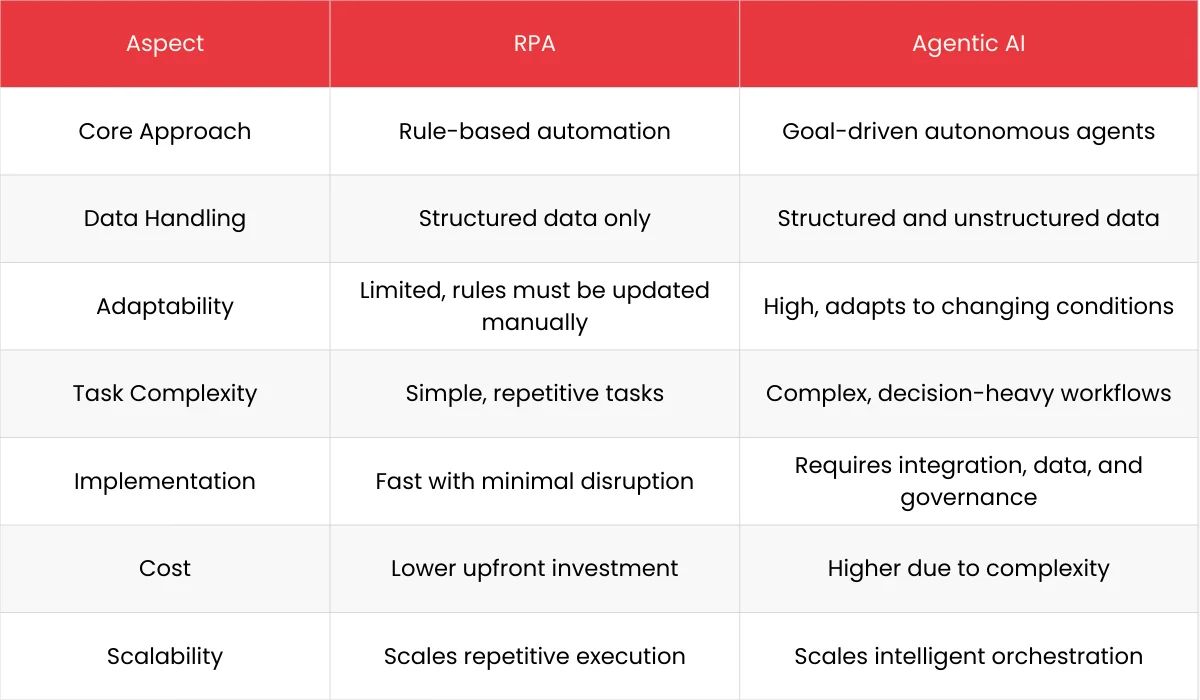
RPA Bot vs AI Agents: What’s the Real Difference?
One of the most common comparisons businesses make today is RPA bot vs AI agents. While both automate work, they operate very differently.
Which One Should You Choose?
When deciding between RPA and agentic AI, understanding the use case is important. If you want to automate invoice processing, system–to- system data entry, or routine report generation, choose RPA.
Other reasons to choose robotic process automation are:
- Your processes are repetitive and rule-based
- Your data is structured and predictable
- You need quick automation wins with minimal risk
- Budget and timelines are limited
Agentic AI is right if:
- Your workflows involve complex decisions
- You work with unstructured data like emails or documents
- You want automation that learns and improves over time
- You’re prepared to invest in long-term scalability
Can Agentic AI Replace RPA?
Not entirely. While Agentic AI can handle tasks that RPA cannot, RPA remains extremely effective for structured, repetitive work. Replacing RPA with Agentic AI for simple tasks would often be unnecessary and cost-inefficient. Instead of replacement, the future lies in RPA and Agentic AI working together.
How Softude Helps You Navigate Intelligent Automation
Adopting the right automation strategy requires more than technology; it requires experience and vision. At Softude, we help organizations design, implement, and scale automation solutions that deliver measurable value.
Why businesses choose Softude:
- Strategic Automation Assessment: We analyze your processes and identify where RPA, Agentic AI, or a hybrid model makes the most sense.
- End-to-End Implementation: From RPA bots to advanced AI agents, we deliver solutions with proven ROI.
- Hyperautomation Expertise: We build integrated ecosystems where RPA and Agentic AI work seamlessly together.
- Governance and Compliance: Our frameworks ensure security, transparency, and responsible AI adoption.
Whether you’re exploring RPA, Agentic AI, or both, Softude helps you make confident, future-ready decisions.
Conclusion
Automation is evolving, and businesses need strategies that keep pace. In this shift, RPA and Agentic AI play different but complementary roles, not rivals, but partners in driving efficiency.
If your goal is fast, cost-effective automation of repetitive tasks, RPA is still essential. If you need intelligent, adaptive systems capable of handling complexity, Agentic AI is the future.
For most enterprises, the optimal path is a hybrid approach, combining the strengths of both. This blend is the foundation of hyperautomation, and it’s shaping the next wave of digital transformation.
FAQs
- Is Agentic AI replacing RPA completely?
No. Agentic AI is more advanced and suited for complex, dynamic tasks, but RPA still plays a critical role in automating repetitive, rule-based processes. In fact, many businesses use both together for maximum efficiency. - Which is easier to implement, RPA or Agentic AI?
RPA is generally easier and faster to implement because it works on top of existing systems and doesn’t require major changes. Agentic AI needs strong data foundations, governance, and infrastructure, making it more complex. - Can RPA handle unstructured data like emails or images?
Not effectively. RPA works best with structured, predictable data. For unstructured data, you need AI-driven solutions like Agentic AI. - What industries benefit most from Agentic AI?
Industries with complex workflows and dynamic decision-making, such as healthcare, finance, supply chain, and customer service, see the biggest gains from Agentic AI. - Is a hybrid approach possible?
Yes. Many organizations combine RPA for repetitive tasks with Agentic AI for intelligent decision-making. This is the foundation of hyperautomation. - Is Agentic AI expensive compared to RPA?
Yes, generally. RPA has a lower upfront cost and faster implementation. Agentic AI requires investment in data, infrastructure, and expertise but delivers higher long-term value for complex automation.