Softude
Imagine running a sales and marketing engine where your team spends zero time on repetitive tasks, every campaign is optimized automatically, and your revenue forecasts are so accurate that they guide strategic decisions with confidence. According to McKinsey, AI can increase sales productivity by up to 40%, and marketers who use AI personalization see up to 30% higher ROI on their campaigns.
Yet most teams barely scratch the surface of AI’s potential. This guide breaks down how AI transforms sales and marketing and gives you free tools you can use immediately, regardless of your team size or budget.
By the end, you’ll understand not just what AI does in sales and marketing, but how to implement it intelligently, avoid common pitfalls, and stay ahead of the trends shaping the next generation of customer acquisition.
Why the Sales and Marketing Teams Must Use AI

Before we dive into the solutions, let’s identify the core problems that AI is designed to solve for sales professionals and marketers. There are three major yet common challenges they struggle with.
- The Velocity Trap: In today’s digital landscape, customers expect instant responses. Waiting an hour to qualify a lead or two weeks to generate an ad campaign is a missed opportunity. Human teams simply cannot process the volume of inbound queries, update CRM records, or analyze vast datasets fast enough to keep pace with the market. This operational lag directly impacts conversion rates.
- The Personalization Paradox: Buyers demand personalized experiences, yet most businesses still treat customer segments as monolithic groups. Sending the right message to the right person, at the perfect moment, across multiple channels, is manually impossible for large and global customer bases. This is where generic outreach fails to connect, leading to low engagement and wasted effort.
- Data Overload and Blind Spots: Every interaction with your customers or prospects generates data, regardless of where it happens. But data is not the issue; the problem is analyzing it correctly and quickly. However, traditional analysis often relies on outdated historical data or gut feeling, leading to inaccurate sales forecasts and suboptimal ad spend.
AI tools for sales and marketing tackle these challenges head-on. Our next section is all about those tools and applications of AI in sales and marketing.
How AI Helps in Sales

The primary goal of using AI for sales operations is to increase seller efficiency and pipeline accuracy. Here is how AI systems are achieving this across the sales cycle.
1. Lead Scoring & Qualification
Traditional lead scoring relies on static, rule-based systems (e.g., “Job Title X gets 5 points”). AI lead scoring chatbots change this entirely by using machine learning to analyze the real-time behavior of every prospect.
How it works: AI models for lead scoring track visitors’ actions, such as visiting the pricing page twice in 24 hours, watching a demo video, or spending time on a case study page. These are actions that actually correlate with a closed deal. This process, known as predictive lead scoring, automatically ranks leads based on their likelihood to convert.
Actionable Insight: Your sales team stops chasing “suspects” and focuses entirely on the “high-quality prospects” that the AI has scientifically qualified. This boost in focus is a direct path to higher win rates and is central to any effective sales automation strategy.
2. Sales Forecasting
Sales forecasting, which is the prediction of future revenue, is difficult and often prone to human bias. How does AI improve sales forecasting?
AI-powered forecasting tools analyze not just the sales rep’s subjective probability, but a massive range of real-time variables that a human cannot track:
- Historical Data: Past performance across teams and regions.
- External Market Signals: Economic indicators, competitor activity, and seasonal trends.
- Engagement Metrics: Email open rates, call sentiment analysis, and CRM activity.
- Deal Health: Identifying stalled opportunities or deals where key stakeholders haven’t been engaged recently.
By processing these complex inputs, AI provides a rolling, adaptable forecast with a significantly higher degree of accuracy than traditional methods. This allows leadership to allocate resources more effectively and mitigate risks early.
3. CRM Automation
One of the biggest tasks where sales professionals waste time is manually entering all the data into the CRM system. AI can automate this process. Here’s how
Instead of manually logging every email, call, and meeting, AI sales agents listen to (or read transcripts of) conversations, automatically summarize key discussion points, identify the next steps, and update the CRM record instantly. Furthermore, they can automatically schedule follow-up tasks and draft initial response emails, freeing up hours per week for high-value activities.
4. Personalized Outreach
Generic outreach messages are immediately recognizable and ignored. AI-driven personalization goes far beyond simply inserting a prospect’s name.
AI tools can analyze a prospect’s LinkedIn activity, recent company news, and past website engagement to generate hyper-personalized message copy. For example, an AI could automatically draft an email referencing a specific product feature the prospect viewed on your site last week and tie it directly to a recent pain point identified in their public profile.
Also Read: Why and How to Use AI in Market Research?
How is AI Used in Marketing

While sales focuses on closing deals, AI tools for marketing focus on understanding the customer, optimizing campaign performance, and creating personalized content.
1. Customer Segmentation
Traditional segmentation groups customers by basic demographics. AI uses machine learning to create dynamic, complex segments based on predictive behavior and intent.
How it works: AI identifies hidden patterns such as grouping customers who buy Product X, browse Blog Category Y, and live in a specific geographic area, even if those connections weren’t obvious to a human analyst. This enables “micro-segmentation” that is far more granular and effective. Marketing messages can then be tailored perfectly to these ultra-specific groups, dramatically improving the efficacy of targeted campaigns.
2. Content Generation & Optimization
Generative AI tools have become essential for content marketers. They streamline the most time-consuming parts of the content lifecycle.
- Drafting and Ideation: AI tools can generate initial blog post drafts, video scripts, social media captions, and email subject lines in seconds. This eliminates the “blank page syndrome” and significantly boosts content velocity.
- Repurposing: Instead of spending hours adapting a whitepaper into ten social media posts, AI writing tools can repurpose the content instantly, ensuring brand voice consistency across channels.
- SEO Optimization: AI tools analyze competitive content and search engine trends to suggest key phrases to incorporate, ensuring the content is optimized for high visibility.
3. Ad Spend Optimization
Managing vast advertising budgets across platforms like Google, Meta, and LinkedIn is complex. AI introduces a continuous, analytical approach to ad buying.
AI systems constantly monitor campaign performance across every channel and use predictive analytics in marketing to anticipate which ad sets are likely to underperform or overspend. The AI can then dynamically adjust bids, reallocate budget to the highest-performing audiences, or pause underperforming creative assets in real time, maximizing return on investment (ROI). This level of responsiveness is impossible with manual oversight alone.
4. Predictive Analytics
Predictive analytics is the marketing team’s crystal ball. Instead of just looking at what customers did, it focuses on what they are likely to do next.
This application helps marketers answer critical questions: Which customers are likely to churn next month? Which leads are most likely to respond to a discount code? What is the ideal time to launch our new product? By answering these questions proactively, predictive analytics ensures that marketing resources are always aligned with the highest potential revenue opportunities, preventing customer attrition and promoting high-value engagement.
What Are the Benefits of Using AI in Sales and Marketing
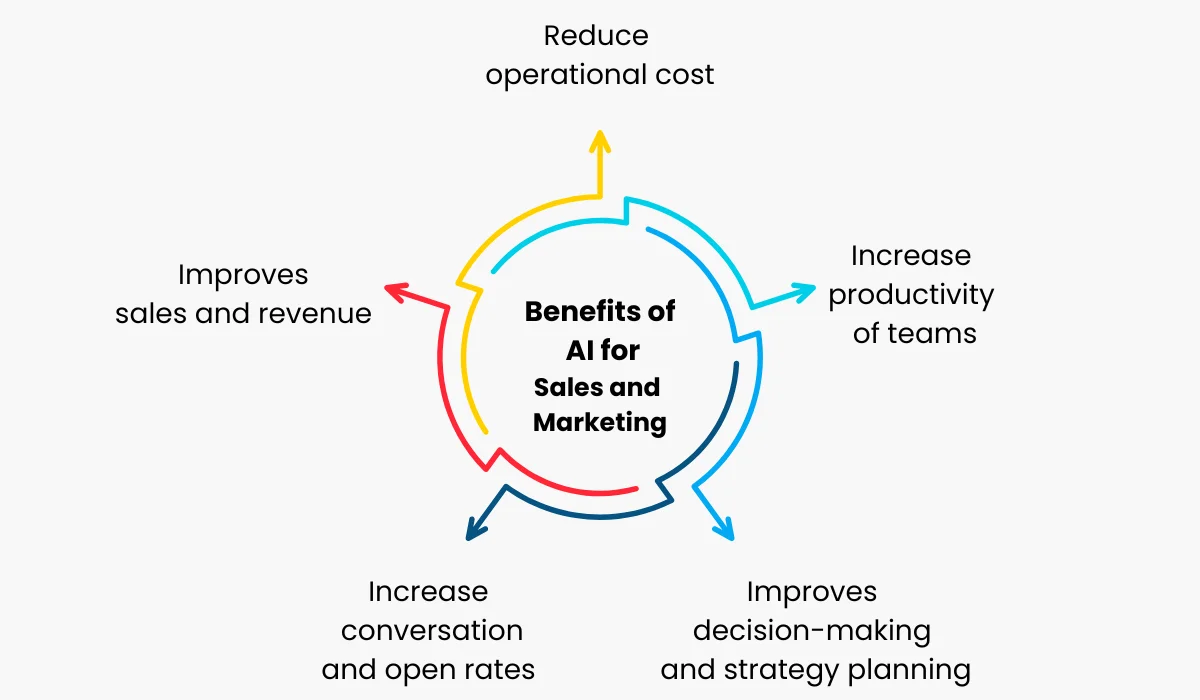
The benefits of adopting AI for sales and marketing are more than you can count.
- Massive Productivity Gains: By automating repetitive, administrative tasks (data entry, lead nurturing, scheduling), AI gives human employees countless hours back. Sales teams can spend up to 70% more time on high-impact customer interactions, while marketing teams can focus on strategic, creative problem-solving.
- Superior Decision-Making: AI processes millions of data points, identifying correlations and insights that human analysts would miss. This leads to data-driven, confident decisions regarding pricing, product focus, and campaign strategy.
- True Personalization at Scale: AI moves beyond generic segmentation to provide hyper-relevant, one-to-one communications, resulting in higher conversion rates (with personalized emails generating up to 26% higher open rates).
- Improved Revenue Predictability and Risk Mitigation: Highly accurate sales forecasts reduce business risk by preventing inventory issues or misallocation of resources. By flagging at-risk deals or customers likely to churn, AI enables proactive intervention.
- Reduced Operational Costs: While there is an initial investment, the increase in efficiency and the reduction in wasted ad spend typically lead to significant long-term cost savings and a strong ROI.
What Are the Free AI Tools for Sales and Marketing

You don’t need to spend dollars; there are many free AI tools for sales and marketing.
- ChatGPT/Copy.ai: These generative AI tools are excellent for quickly drafting initial content, brainstorming campaign ideas, writing social media posts, or composing personalized email opening lines that require creativity. Just give the right prompt and create content in seconds. ChatGPT also has a prompt template for different use cases, so if you don’t know how to write a prompt, choose the template that best fits your task.
- Canva (Magic Studio): Famous for design, Canva now includes powerful AI features (Magic Studio) that can quickly generate images, remove backgrounds, or resize creative assets for different social media platforms, making visual marketing much faster.
- Grammarly (Free Version): While simple, this AI-powered writing assistant is crucial for ensuring your marketing copy maintains a consistent tone, is error-free, and has clear, human-friendly language, a foundational element of effective outreach.
- HubSpot CRM (Free Tools): HubSpot’s free CRM tier often includes AI-driven features like automated chatflows, basic lead scoring, and automated task reminders, providing a great starting point for sales automation.
- Google Analytics (AI Insights): The platform uses machine learning to flag significant anomalies in your website traffic and suggest important trends (e.g., “traffic from Germany increased by 30% this week”), giving marketers instant, actionable intelligence.
- Salesforce Einstein: If you use Salesforce, the Einstein layer often provides free, foundational predictive insights and lead prioritization within your existing CRM setup.
Common Pitfalls & How to Avoid Them
1. Poor Data Quality (The GIGO Rule)
If your CRM data is incomplete, outdated, or inconsistent (the classic “Garbage In, Garbage Out” problem), the AI sales tools will generate misleading insights and flawed forecasts.
How to Avoid: Before you deploy a new AI tool, do a thorough data audit and cleansing process. Implement strict data governance rules to ensure new information is entered accurately and consistently across all platforms.
2. Over-Reliance on Automation
Over-relying on AI for every interaction leads to robotic, generic messaging that erodes customer trust. This is often called the “black box” problem, where AI makes a recommendation without explaining the why.
How to Avoid: Use AI to handle the first 80% of the task (drafting, scoring, prioritizing) and let your human team handle the last 20% (personal connection, negotiation, strategic empathy). Ensure your team reviews all AI-generated content to inject a human voice, specific context, and emotional intelligence.
3. Ignoring Strategy and Alignment
Rushing to adopt every latest AI tool for sales or marketing will bring nothing but frustration and an empty wallet.
How to Avoid: Define specific, measurable objectives before selecting a tool. Ask: “Are we implementing AI to reduce lead qualification time by 30%, or to increase cross-sell revenue by 15%?” Ensure the AI solution integrates seamlessly with your existing CRM and sales technology stack.
4. Employee Resistance and Lack of Training
Sales reps often view AI as a threat to their job security rather than a powerful assistant.
How to Avoid: Position AI as an “efficiency multiplier” that removes drudgery, not as a replacement. Invest in comprehensive training that shows team members how to use the AI tools to their advantage, boosting their productivity and closing power. Show them exactly how AI sales automation frees them up to focus on the rewarding parts of their job.
Conclusion
The convergence of AI for sales and marketing is creating a new blueprint for business growth. It offers an escape from the operational grind, providing teams with unprecedented levels of insight, speed, and accuracy. From improving sales forecasting to deploying hyper-personalized campaigns through advanced predictive analytics in marketing, AI is the engine powering the revenue revolution.
The best part? Getting started doesn’t require a massive overhaul. You can begin small by experimenting with free AI tools for sales and marketing, like ChatGPT for content drafting or the AI insights provided by your existing CRM or analytics platform.
FAQs
What is AI for Sales?
AI for sales refers to the use of artificial intelligence technologies such as machine learning, natural language processing, and predictive analytics to automate, optimize, and enhance the end-to-end sales process. Instead of relying purely on manual work, instincts, or static reports, AI helps sales teams make smarter decisions, work faster, and personalize interactions for every prospect.
How to use AI for sales leads?
AI can help you find, qualify, and prioritize sales leads by analyzing data patterns, scoring prospects based on buying intent, and automating personalized outreach. So your team focuses on high-potential opportunities.
How can AI help B2B sales?
AI enhances B2B sales by identifying high-value accounts, predicting deal outcomes, optimizing the pipeline, and personalizing engagement, enabling faster, smarter, and more efficient selling.
Can ChatGPT help with marketing?
Yes. ChatGPT can assist with content creation, email drafts, social media posts, ad copy, and brainstorming marketing ideas, saving time and improving creativity.
How to use AI for market research?
AI can analyze trends, customer behavior, competitors, and large datasets to provide actionable insights, helping businesses make informed marketing and product decisions faster.